
 (PHOTO BY BRIANNA BALOGH / THE VILLAGE REPORTER)
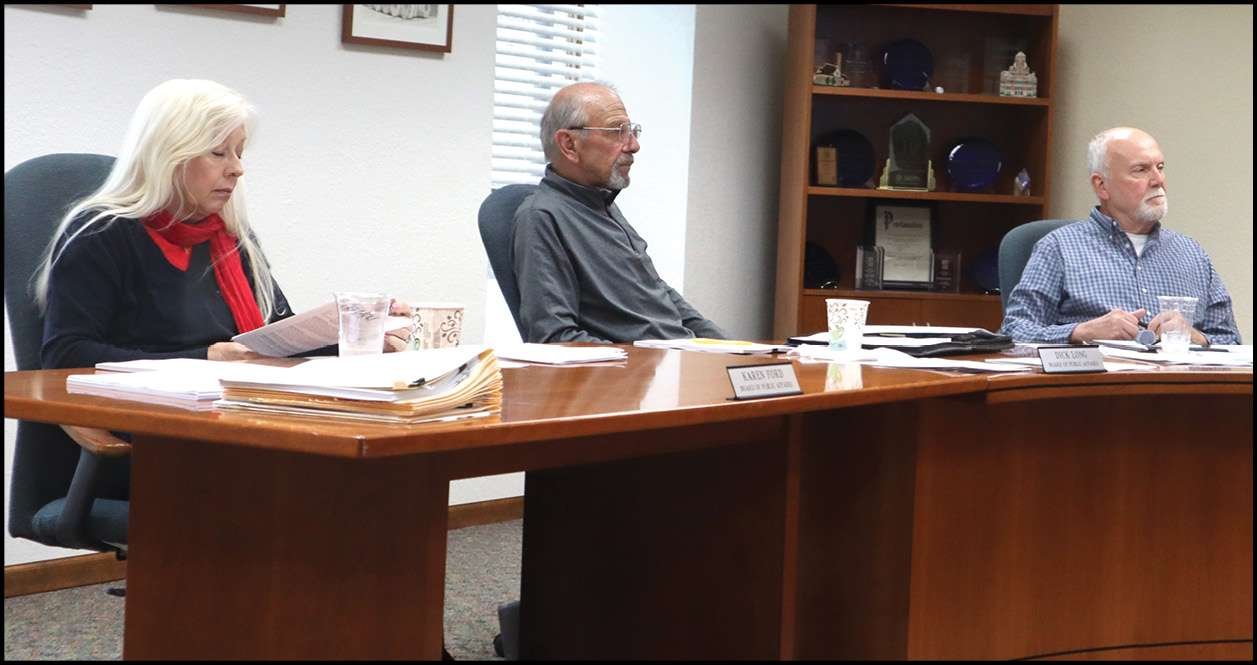
WATER WORRIES … Members (from left) Karen Ford, Dick Long, and Jim Salsbury listen intently as Utility Director Derek Schultz presents the Water System Improvement Plan Options to the BPA.
By: Brianna Balogh
THE VILLAGE REPORTER
publisher@thevillagereporter.com
Water was at the top of the board’s concerns during the regular meeting, held May 20 at 5:00 p.m. Chair Annette Schreiner called the meeting to order followed by the Pledge of Allegiance.
Clerk-Treasurer John Lehner took roll call with all members present including Vice Chair Bob Eyre, Jim Salsbury, Dick Long, and Karen Ford. Director of Utilities Derek Schultz, Mayor Carrie Schlade, and Attorney Marc Fishel were also present.

Schreiner started the agenda with approval of the minutes from the April meeting. Long made the motion to approve, seconded by Salsbury and approved by all.
The agenda then moved to public concerns of which there were none, so Schreiner moved on the Clerk-Treasurer report. With the financial reports through April 30 provided to the board, Lehner did not have any additional comments.
Lehner offered to take any questions now or at any time. With no question from the board, the motion was made by Eyre and approved by all.
Resolution 18-2025 followed. Read by Lehner, the resolution revises the Bryan Communication Department’s rules and regulations and corresponding exhibits. Schultz explained that this resolution was mainly due to the recent discontinuation of the cable modem internet service.
Lehner elaborated that most revisions were more language clean-up. Long clarified that this was basic housekeeping. Eyre made the motion to approve the resolution which was seconded by Long and approved by all members.
Director Schultz then approached the podium to deliver the Water System Improvement Plan. He included several slides, printed out in a packet to allow attendees to follow along.
First in the presentation was a timeline comparing two separate options for rehabbing the current system, including all steps that would be needed and the time frame for each.
The first option was rehab to the current water treatment plant and a new wellfield while the second option detailed the construction of a new treatment plant and wellfield.
It was broken into 3 stages: preliminary, design, and construction. Schultz explained the two options that were being presented for the study, the basic model and the premium model.
Both starting in 2026, the basic would take around six and a half years to complete and the premium option would take eight years.
Both models would include a required hydrogeological study and a distribution system model. The basic model cost was $39,500 and would include a water distribution model and engineering report.
The premium model cost was $108,400 and included extras such as a unidirectional flushing plan, water quality analysis, and energy study.
The model would be developed in WaterCAD, with an option to buy the software or have Jones & Henry update the model. Reports including maps and recommendations would be provided digitally and in print.
Required for both models is the hydrogeological study which is broken down into several tasks. Task one includes data collection, pump test analysis, geological data, infrastructure data, and water quality considerations. A detailed report will be provided to the board. The cost of task one would be $59,500.
Task two includes initial exploration to confirm the presence of sand and gravel resources. Exploration could include drilling of test wells or test borings. Each location will include two to three test borings and the collection of formation samples for analysis.
Following completion, each will be sealed or used as a monitoring well. Again, these results would be provided to the board with recommendations and the cost will be determined based on the information obtained in task one.
Task three is performing an aquifer test in the proposed wellfield. Once a potential site or sites are chosen, a well will be installed with an appropriate diameter for a pumping test. Ohio EPA paperwork will be completed and approved.
A 72-hour pump test will take place, and samples will be collected for water quality analysis. These results will also be provided to the board with cost being dependent on the previous tasks.
Task four is developing the new wellfield and source water plan. Once long-term yield is established, the proposed configuration of the new wellfield and amount of wells will be finalized.
Following will be the installation of wells. The source water protection plan will be revised to the new flow model and the management plan.
Schultz then provided his recommendations. In his opinion, the basic distribution system model is the preferred option.
The premium option had several add-ons that were valuable but non-essential and some are already being managed internally.
There is an option to add items a la carte in the future. The basic model contains essential data to continue progress for the Water System Improvement Plan and provides functionality to support current planning and operations.
Schultz recommended continuing the partnership with Jones & Henry Engineers, who they have worked with for many years.
He also recommended Bennett & Williams Environmental Consultants to perform the hydrogeological study, which has done evaluations in the past. The total cost is projected at $99,000 of capital expenses.
The final item in the Water System Improvement Plan was an outline of capital projects and considerations. Two capital projects had already been delayed, one well rehabilitation and a high-service pump rehabilitation, due to repairs needed on the water treatment plant filter.
Other capital projects to be aware of are the East Mulberry Street waterline, with advertising for bids to come soon, and the water treatment plant header and control valves, currently waiting on contractor proposals.
Considerations to take into account are the numerous unknown budget variables at this time and the potential of requesting additional appropriations after more projects are completed later in the year.
There is flexibility with Bennett & Williams, with the possibility to begin part of the study in 2025 and the remaining work could be budgeted in 2026. The start date has already been pushed back to August due to Bennett & Williams’ availability.
Schultz stated with all the variables and uncertainty, waiting until some current projects are complete will help to better understand what funds would be available.
Once open to discussion, Eyre asked for clarification on the timeline of task one to task four of the initial study. Schultz clarified that Jones & Henry provided a 12-18 month timeline but he guessed it may be a little longer, potentially 18-24 months.
Long spoke up and made it very clear that his opinion was to get started as soon as possible with the age of the current plant. Ford echoed this opinion as well.
Long asked if the rehab to the current well could be postponed, to which Schultz answered he would have to investigate when it was last rehabbed. Long emphasized the importance noting, “We can live without electricity but not without water.”
Following Schultz was attorney Marc Fishel, law director, bringing a topic of committee structure to the board. The suggested structure, known as a committee of the whole, places each board member as the chair of the five committees.
Currently, each committee, water, finance, electric, communication, and HR, has two members. All board members would be members of all committees.
A committee chair could then contact one other board member, less than a majority, to discuss a specific topic relating to their designated committee.
The chair could only discuss with one other board member. This proposed structure was also presented to the city council the previous night.
There were several questions and discussions surrounding this topic. Fishel helped clarify that this proposed structure provides several benefits including adherence to sunshine laws and a distinct point of contact for each committee.
Mayor Schlade elaborated that for her office that would be very helpful and would help eliminate the same board member being contacted all the time, essentially playing favorites.
Several questions were asked about specific scenarios, for example emailing a summary to all board members which would be allowable.
Conversations through email would not. Schreiner clarified that each time this would occur, a different board member could and probably should be contacted for each topic of discussion.
However, no more than one person can be involved in each topic discussion. All others involved, such as Mayor Schlade, Director Schultz, or Clerk-Treasure Lehner could be involved in any and all discussions as they are not subject to sunshine laws.
Throughout the discussion, several other ideas were brought up, including eliminating committees or having each department head present to the board.
The key takeaway is that discussions are held in an open public forum and meetings are not taking place behind the scenes, but the process allows for flexibility when needed.
With several ideas presented, the board decided to discuss further at the next meeting and hoped to be able to have a detailed plan and vote on committee chairpersons.
The board then proceeded to effect semi-monthly disbursements or pay the bills. Long motion to approve, Salsbury seconded and all members approved.
The final item on the agenda was comments from BPA and staff. First up was Schultz, who started with the upcoming Wheels on Display event on May 23 at the Fountain City Amphitheater.
This event allows children to touch and explore vehicles such as fire trucks and ambulances. Adults are welcome to touch a truck too, Eyre confirmed stating he would enjoy this event.
Schultz finished with a thank you to the utility workers who recently traveled to Michigan along with other AMP communities to provide mutual aid after the recent storms.
Schlade was next starting with Memorial Day parade information. Line-up will begin at 9:00 a.m. The Memorial Day ceremony will take place at Fountain Grove Cemetery with the high school band performing. She finished with a congratulations to all the graduating seniors.
All board members reiterated in their comments the importance of getting started on the Water System Improvement Plan, especially Eyre.
He made a point to address the audience in an effort to increase public knowledge of what goes into trying to replace the aging water treatment plant. The current plant has been operating since 1972 and can take eight to ten years to update.
Ford thanked Schultz for the detailed water improvement report and commented he is very knowledgeable on the subject. Long and Salsbury made brief statements on the water project. Both wished everyone a happy and safe holiday.
Schreiner was last to address the board, where she also congratulated the graduates and wished everyone a happy Memorial Day.
The board then adjourned at 6:53 p.m. for a brief recess before going into executive session to discuss pending litigation with the city attorney.