
Staff Report
The Village Reporter
An open burning ban is in place throughout the area for the next three months, but this year’s ban carries far greater urgency than in years past as northwest Ohio grapples with what meteorologists are calling an unprecedented drought.
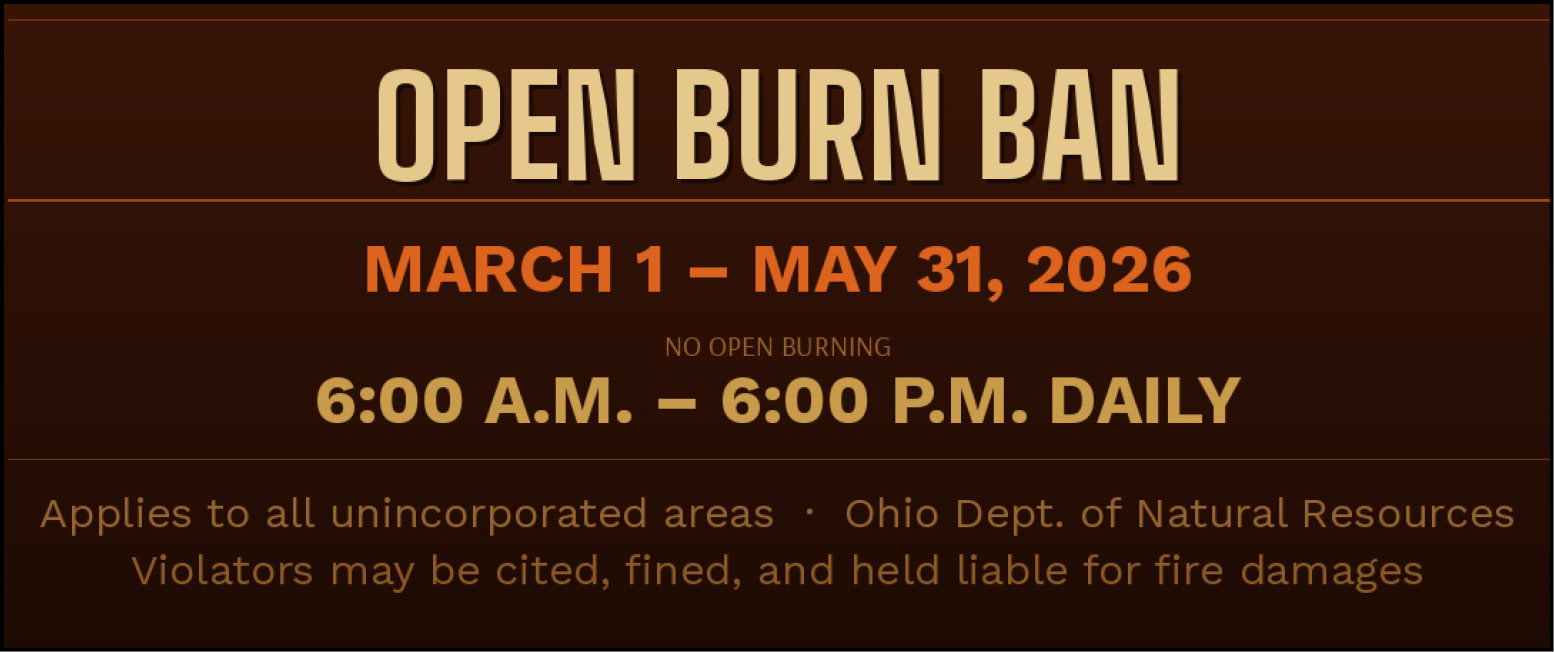
The statewide ban, which took effect March 1 and runs through May 31, prohibits open burning between 6 a.m. and 6 p.m. daily in all unincorporated areas under Ohio Department of Natural Resources regulations.
Prohibited burning includes yard waste, brush piles, leaves, and debris. Violators may be cited, fined, and held liable for damages, and depending on severity could face criminal charges.
Bryan Fire Department Chief Doug Pool said area fire departments have issued warnings via social media this year in an effort to better get the word out.
Pool noted the restricted hours align with when wind typically picks up during the spring months. He added that while open burning is technically permitted during evening hours, caution is still urged and residents should check weather conditions and avoid doing so if winds are high.
Dry vegetation, combined with high seasonal winds, adds significantly to the danger of grass and field fires, and this year those risks are compounded by drought conditions that have been building since last summer.
Despite the heavy snowfall a few weeks ago, the area remains under strong drought conditions. For the first time since the U.S. Drought Monitor began tracking conditions in 2000, extreme drought has gripped much of the region at the start of meteorological spring.
For northwest Ohio to end the drought in the next 90 days would require 16 inches of rainfall — a figure that is not in any current forecast.
According to a map added to his post, the southernmost part of Williams County is in severe drought, while the northern part is in moderate drought.
Portions of Williams, Defiance, and Fulton counties have shifted into the D3 “Extreme Drought” category on the U.S. Drought Monitor scale, which ranges from D0 (abnormally dry) through D4 (exceptional drought).
The drought traces back to 2025’s wild weather swings. Ohio experienced its fifth-wettest April-to-July period on record, followed by its driest August since recordkeeping began in 1895. That dramatic shift devastated crops during the critical pollination and grain-fill stages.
By fall, corn across northwest Ohio was prematurely senescing with tip dieback and missing kernels at the ends of ears, and soybeans were aging early, reducing pod fill and lowering yields.
Soil moisture heading into the 2026 growing season has been described by Ohio State University agricultural experts as “abysmal.”
Although snowfall this winter was above average in many areas, it did not deliver enough moisture to offset the six to twelve inches of precipitation deficit that accumulated over the past year. Much of northwest Ohio remains six to twelve inches below normal rainfall over the past six months.
The situation prompted the USDA to act. On Feb. 3, 2026, the agency designated 23 Ohio counties as natural disaster areas due to drought. Defiance, Fulton, Henry, Lucas, and Williams counties were all designated as primary counties, making area farmers eligible for USDA emergency loans.
Farmers have eight months from the date of declaration to apply through their local Farm Service Agency office. The loans can cover production losses, repair or replacement of essential property, and restoration of agricultural operations.
This is not the first round of disaster designations for the region. In September 2024, the USDA had already designated 22 Ohio counties as primary natural disaster areas due to that year’s drought, and additional counties in northwest Ohio received designations in October and November of 2024.
Ohio State University researchers have noted that regenerative agriculture methods, including cover cropping and reduced tillage, helped some area farmers better withstand the drought conditions.
Ohio farmers who experienced drought-related losses and want to determine what programs they may be eligible for can use the USDA’s Disaster Assistance Discovery Tool at farmers.gov. To file a Notice of Loss or ask questions about available programs, farmers should contact their local USDA Service Center.
In the meantime, fire officials urge residents to take the burn ban seriously and exercise extreme caution with any outdoor activity that could produce a spark.
The ODNR warns that even a small flame can quickly become a dangerous wildfire threatening homes, property, and emergency responders — a risk that is exponentially greater under the current extreme drought conditions.