

PHOTO BY JESSE DAVIS / THE VILLAGE REPORTER
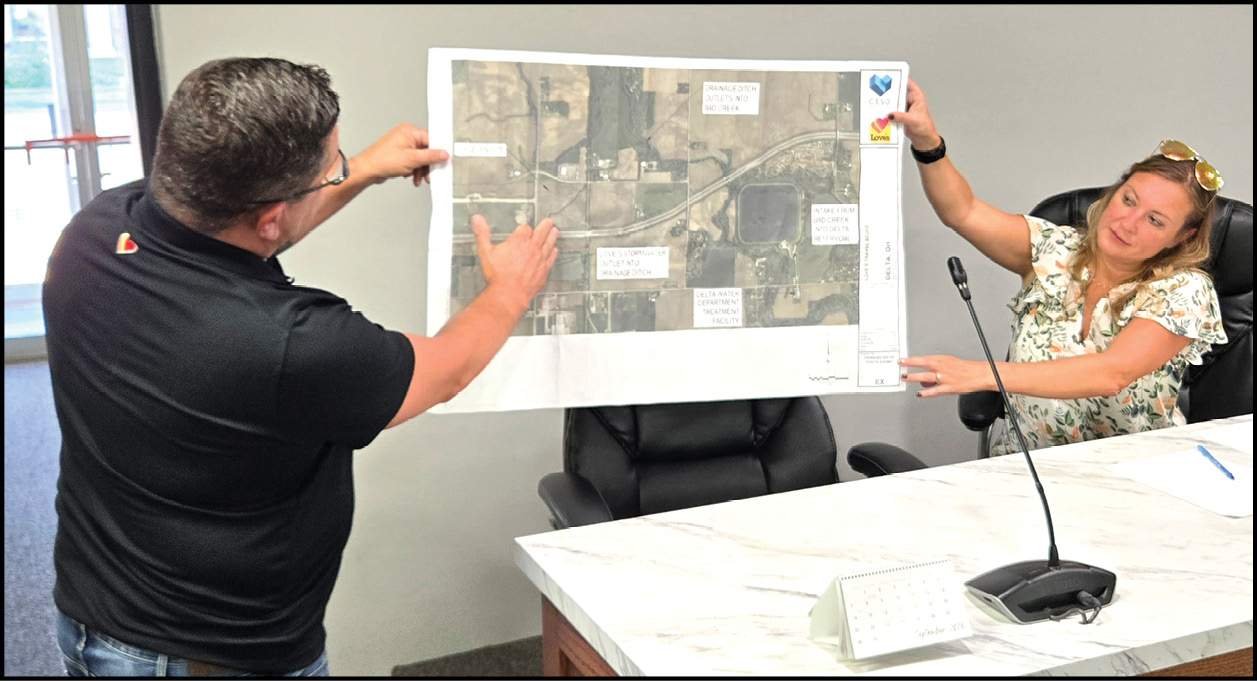
BREAKING IT DOWN … Love’s Travel Stop Real Estate Project Manager Steve Walters (left) explains the proposed layout of the stormwater system for the new Love’s Travel Stop, to be located on the northwest corner of the intersection at County Road H and State Route 109. Also pictured is Councilwoman Daphne Demaline (right).
By: Jesse Davis
THE VILLAGE REPORTER
jesse@thevillagereporter.com
Miscommunications regarding the soon-to-be-constructed Love’s Travel Stop, the installation of new pickleball courts at Delta Park, and the pursuit of grant funding for sidewalk improvements led to several discussions at Tuesday evening’s meeting of the Delta Village Council.
Love’s Travel Stop and Country Stores Inc. Real Estate Project Manager Steve Walters appeared at the meeting to better explain the stormwater plan for their new facility, which will be located on the northwest corner of the intersection at County Road H and State Route 109.
At a council meeting in August, the potential for contamination of the village’s drinking water by Love’s and other businesses, which could tap into their stormwater system, raised concerns, which Walters said were misguided and based on an inaccurate representation of the facts.
Chief among the concerns was one brought by Councilman Robert Shirer, who said if there was a fuel spill into the Love’s discharge at Bad Creek north of the village’s drinking water intake, the best-case scenario to close the intake pumps manually was 30 minutes, enough time for contaminants to enter the village water supply.
According to Waters, part of their development agreement includes the business fully funding the installation of a roughly $476,400 remote intake valve at the village’s water facility to allow it to be closed remotely with no delay.

Once installed, ownership of the intake valve, along with its control and maintenance, would be turned over to the village.
According to Walters, the confusion came with the portion of the agreement that allowed future developments to take advantage of the infrastructure put in place by Love’s.
The previous idea that such developments would pay Love’s in order to dump into their system, he said, was incorrect.
“We have a development agreement in place that if any other development in the future ever comes along and there’s something like that – the remote system and everything – would be required for their use that we’ve already paid for, they’d help pay for that cost,” Walters said.
He further explained a variety of system features to be located at their facility to prevent contamination of Bad Creek, including filters to remove sediment and oils, a manual on-site storm valve that could be closed if a spill were to occur, and the over development of retention ponds to ensure runoff stays on site longer to allow more time for a response before it would flow through the rest of the system and into the creek.
In response to traffic concerns from one resident, Walters said Love’s would also put up a large sign directing truck traffic to the truck route on 109 to ensure they don’t go down County Road H instead, and agreed to look into the possibility of adding additional curbing, though he made no promises on implementation of the option.
Despite the clarifications and reassurances from Walters, Water Superintendent Jammie Flores said she still had concerns about the agreement.
According to Flores, the requirement that new developers in the immediate area negotiate with Love’s and pay them upwards of $238,000 in order to benefit from the remote system might deter them from coming to Delta at all.
Walters responded by saying that, in order to assuage concerns that Love’s would profit off such fees and in order not to deter long-term growth, Love’s would be willing to put a time limit of something like 2 to 3 years on the requirement that is satisfactory to the village.
In addition to Walters’ comments at the meeting, Love’s also issued a press release clarifying the business’s position.
“Love’s is committed to being a good neighbor in the Village of Delta and is working closely with local officials to address concerns about water safety in relation to its proposed travel stop in the area,” the release states.
It went on to delineate the filter system, a weir gate to be installed, and monthly monitoring for “substances such as oil, grease, and pH levels to ensure continued safety and compliance.”
The release also pointed to the investment Love’s is making in Delta’s infrastructure with the remote gate.
“Love’s has agreed to cover the cost of these upgrades as part of its ongoing commitment to being a responsible and responsive partner in Delta,” the release states.
SIDEWALK IMPROVEMENTS
Village Administrator Chris Frazer provided the council with a copy of a letter from the Planning Commission, which was read aloud by Mayor Allen Naiber.
The letter stated that the commission does not believe any new sidewalk laws are necessary, but implored the village to do something to improve the state of the sidewalks in town.
Multiple council members shared their opinion that the village use the full $10,000 set aside for the sidewalk improvement program, whether or not verified applicants for the cost-sharing program qualify for the full amount.
Under the program rules, applicants can receive funding for 50 percent of the cost to repair or install sidewalks, not to exceed $1,000 per person.
Council members stated they believed that if enough people don’t apply, qualify, or can afford their portion of the work, the full amount should be spent wherever possible to make Delta’s sidewalk system better.
He also said he thinks the village should maintain all the sidewalks, but he’s been told since his first day on council that the village can’t afford it.
Under the current law, residents are required to maintain their own sidewalks, with the village authorized to have the work done and bill the resident if they do not.
“I know the village of Pioneer has been replacing sidewalks and approaches and streets and sewer mains for the last two years with great success, all provided by grants from what I understand,” Councilman Chad Johnson said. “So I would seek their opinion on how to … get that done.”
Frazer said he has not yet been pursuing grant funding for the improvements.
“There’s no reason we are not filling out grants. If we can help the residents by getting free money from the state, and help pay for this stuff, we need to get it done,” Naiber said to scattered applause from meeting attendees.
Naiber further said that if Frazer couldn’t accomplish it, he knew individuals who could help write the grants. He also chastised
Frazer, saying he provided the former finance director, as well as Frazer, with at least 10 grant options to look into at the beginning of the year, which Frazer said he didn’t recall and would have to dig out to look at. Frazer excused the lack of grant applications based on how busy his office has been.
DELTA PARK
Delta Recreation Council head Angela Riley appeared at the meeting to give council members a copy of the plans for the new pickleball courts at Delta Park.
During the previous council meeting, Frazer reported that the work on the courts was beginning that week, when Johnson said they hadn’t yet seen the plans, which they were supposed to approve prior to work commencing.
Riley complained that she could have brought the plans to the council in plenty of time before the work began, but that no one from Frazer’s office, the Park Board, or the council reached out to her to tell her she needed to do so.
The old asphalt at the location had already been torn out and resurfaced for the pickleball courts before Monday’s meeting.
Review of the plan discovered an issue, where the courts will be draining toward the basketball courts, which already have flooding issues.
Johnson said the recreation council could purchase drainage equipment, such as tiles to be installed between the courts by the village. “Your court will fall apart if we don’t put drainage in,” Johnson said.
After more discussion with Riley, council members voted to fund the $5,500 for the installation of fencing around and between the courts.
Riley reported the recreation council was not interested, however, in helping to fund the installation of a new transformer in the park, the main cause for which was the overloading of existing electrical infrastructure by food trucks and other users during the recreation council’s annual Chicken Festival.
In other park developments, a resident reported that the skate park was in a dangerous condition, creating a liability for injury to anyone who uses it.
Johnson instructed Frazer to close the skate park immediately and have its condition assessed. Fencing will be installed around the skate park to prevent its use until any necessary repairs have been completed.
POLICE DEPARTMENT
Police Chief Samuel Chappell reported that, as he is preparing information for the proposed 2026 department budget, he believes the village should pursue some kind of service for social media archiving.
According to Chappell, there is currently no system in place for long-term saving of village social media posts or comments on them.
As an example, he pointed out that CivicPlus (on whose system the new village website runs) offers that service at a cost of $2,722 per year.
He said the service would cover all social media accounts run by the village. He also said Swanton and Wauseon currently use that system.
Chappell reported that the department will be receiving free training and taking part in free tabletop exercises regarding cybersecurity through a program with the Ohio Cyber Range Institute.
Chappell said an additional crosswalk is needed on Main Street west of the crosswalk in front of the Delta Public Library. He said a grant is available for the installation of a crosswalk under the same program through which the village received a grant for new signage for the expanded school zone.
OTHER BUSINESS
Council members approved on final reading the sale of a 2017 Ford Explorer as surplus property no longer needed by the village.
Council members approved on final reading an agreement with Mannik and Smith to provide general engineering services as needed after Frazer reported he found the funds to use for it in unused county auditor fees received by the village. Those fees will need to be transferred via ordinance at a future meeting.
Council members approved on first reading the final application for annexation of the 1.53-acre property belonging to Ryan Woodring from York Township into the village.
It was intended to be passed on an emergency basis requiring only a single reading, but with the empty council seat vacated by Lynn Frank and the absence of Councilman Robert Shirer, there were not the required five members present in order to pass such a measure.
Council members approved on first reading the designation of surplus property for sale or other disposal, including old police department radios, which will be donated to the Fulton County Amateur Radio Club.
Council members approved a $75 sewer adjustment for a resident who left a hose running outside. They tabled another adjustment request – put forward by village staff – regarding a possible leak at a now-vacant home.
Frazer reported that the village’s audit for 2023 and 2024 is scheduled to begin on September 29. Frazer reported that the new grills ordered for Delta Park have been received.
The council ended the regular portion of the meeting by going into an executive session to discuss the hiring of a new finance director.
Frazer reported that six applications were received and four applicants were interviewed for the position. Council members took no action on the potential hiring after the session.
The next regular meeting of the Delta Village Council will be held at 5:30 p.m. on Monday, Oct. 6, 2025, at 401 Main Street in Delta.