
PHOTO BY BRIANNA BALOGH / THE VILLAGE REPORTER
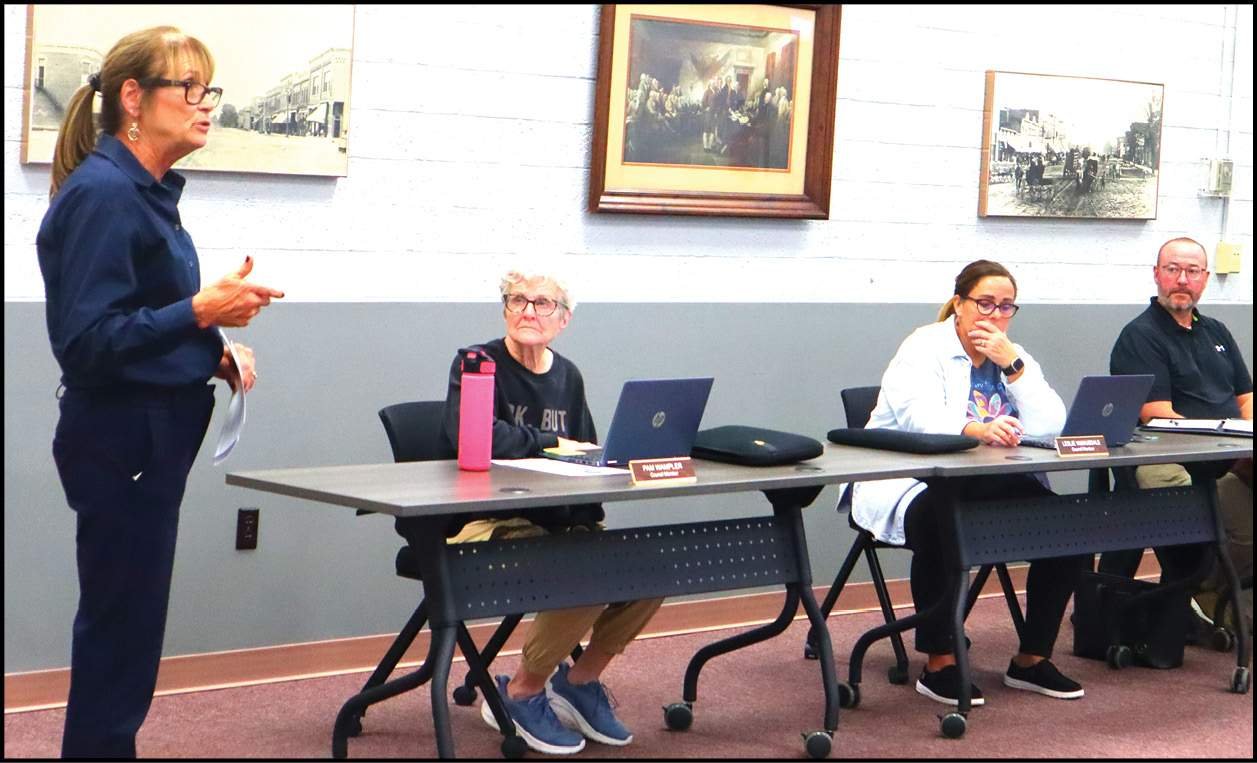
EFFICIENCY SMART … Joey Boston presents the current and future contract for the Efficiency Smart program.
By: Brianna Balogh
THE VILLAGE REPORTER
publisher@thevillagereporter.com
With a lengthy agenda to get through, Edgerton Village Council promptly called the October 15 meeting to order at 5:30 p.m. First, the Pledge of Allegiance was recited, followed by a brief prayer led by Mayor Bob Day.

Fiscal Officer Denise Knecht took roll call with members Lance Bowsher, Sharon Blinzler, Pam Wampler, Leslie VanAusdale, and Jason Gruver present. Council Member Chuck Wallace was absent.
Also in attendance were Village Administrator Dawn Fitzcharles, Administrative Assistant Amanda Knecht, village council candidates Brian Bowsher and Stephanie Gary, as well as representatives from Efficiency Smart and Courtney and Associates.
The first order of business was approval of the meeting minutes from October 1, which were passed quickly with a motion from VanAusdale and seconded by Gruver. Mayor Day was reminded that the minutes from the public hearing held prior to the last council meeting also needed approval. Bowsher motioned to approve, Blinzler seconded. Council approved the motion unanimously.
EFFICIENCY SMART PROGRAM
Moving into communication, both Efficiency Smart and Courtney and Associates had presentations for the council. This is not customary, but due to scheduling, both entities visited on the same night.
Administrator Fitzcharles introduced Erin Miller from AMP, American Municipal Power, and Joey Boston from Efficiency Smart. Miller was first to speak, starting out with some background info on AMP and their partnership with the village.
Edgerton has been a member of AMP since 1981. Beginning as AMP Ohio, after expanding in 2009 to nine other states, Ohio was dropped. AMP now provides power and energy services to 130 systems in several states.
AMP provides several programs, such as the smart thermostat program, the voluntary Eco Smart Choice, which provides the opportunity to utilize green power without the installation of solar, and line worker training.
Efficiency Smart is one of the hallmark programs, in effect since 2011. It’s been a very successful program, according to Miller. Edgerton has participated since 2017, with the three-year renewal contract expiring on December 31 of this year.
With a detailed presentation, Boston spoke to the council about the current state and what the next contract period may look like. Boston is the account manager for the Village of Edgerton.
The presentation was titled Power Supply Plus, the idea being that energy efficiency is a form of power supply. The “plus” is the additional benefits that come along with that.
One of the benefits is affordability. Energy efficiency is the most affordable way to meet power supply needs. This increases customer satisfaction and, through that, customer engagement as well.
Boston showed comparisons of rates through Efficiency Smart and market prices from 2023 to 2027. The Efficiency Smart prices have stayed flat or declined slightly, while market prices have gone up.
The projected cost for Efficiency Smart for Edgerton compared to the market prices in 2026 is at a discounted rate of about 66%.
Benefits above and beyond power supply are customer satisfaction. The program helps to build consumer loyalty by helping customers make better decisions and find ways to save money.
Boston shared a Word slide showing how customers have used the level of service they received. The larger the word, the more frequently it appeared, with some of the largest words shown being “thankful,” “helpful,” “easy,” “recommend,” and “professional.”
Customer engagement is another benefit. Boston explained, “We act as an extension of your utility.” Engagement through social media and surveys helps reach customers.
Economic benefits can also be seen through the program. With costs being lowered through the program, there are more funds to spend on development, reinvestment into the company, and staff. Lowering costs helps companies remain competitive and can attract business to the area.
To date, five commercial and industrial projects have been completed, working with four different companies. Before closing in December, they expect to have four additional projects completed with four additional companies. Boston included her favorite testimonial, from an Edgerton resident, praising the program and the assistance when removing an old appliance.
On the horizon for the program, currently, there is a promotion with triple rebates for Energy Star window air conditioners of $150. The promotion has been extended through December. A new website was launched over the summer. October will have a scavenger hunt, and starting in November, Trivia Tuesdays. Black Friday online savings promotions will have several discounts.
With the current forecast goals, the village will see a payment of $3,000. The basic level performance is the recommended package, with the same set of services but a lower price point and energy savings goals. The lifetime savings achieved for the Village of Edgerton are $349,017.
Recommendation for the basic service level cost would be $1,700 a month, with a goal of 170 megawatt hours of savings. That would result in $177,000 of avoided cost for the village, representing a 189% return on investment.
At the end of her presentation, Boston opened the floor to questions from the board. While there were no questions, Fitzcharles did comment that she felt the contract should be renewed, and it has been heavily used.
She also reminded the council that this is the program that placed the light bulbs in the grocery store, which residents seem to be a fan of.
Initially, when this was implemented, the village applied for street lights and was able to update all to LED lights.
One open project for 2025 is the community center, where the village will receive a rebate. Fitzcharles concluded that the service helps customers save money, as well as the village, especially during peak times.
Day spoke as a business owner reaping the benefits of the program. He updated the lighting in his building and was able to recoup the cost in a year with the rebate and savings.
Boston had one last comment, stating that after COVID, they doubled the rebate for the smallest businesses if they purchased products locally to help boost the local economic growth. Boston stated that the goal of the LED light bulbs program in the grocery store was not only to save money but to drive business into the store as well.
Boston and Miller thanked the council for their invitation and time as they exited.
UTILITY SERVICE REVENUE ANNUAL REVIEW
Courtney and Associates were next to present the annual review on revenue rates, with John Courtney presenting the report. Fitzcharles stated that with the proposed electric substation, it was determined to have the presentation, but also review the RFP, request for proposal.
The review ensures revenues are sufficient to meet term requirements, future plans are on target with sales, and any changes are captured as they occur.
The annual review includes an analysis of water, wastewater, storm sewer, and electricity through 2029. Each section was broken down into four specific topics with recommendations at the end of each section. The scope of services includes data acquisition, acquiring financial statements and billing records, and verifying that the data is consistent.
The next step is the revenue requirement analysis. Once completed, the existing rate structures are studied, and then recommendations are made.
The revenue requirement falls into four steps: project sales, project revenues at the current rates, revenue requirements or costs to operate and maintain, and determination of any required revenue adjustment.
WATER REPORT
Courtney jumped straight into the water report. For the analysis, they have assumed 0% growth in sales. Unless there is a specific reason, such as a new business coming into town with large water consumption, the growth is forecasted very conservatively. The water is broken into three classes: residential, commercial, and industrial bulk water.
Approximately 50 million gallons are sold yearly, with 37 million to residential, 13 million to commercial, and less than 1 million in bulk water sales.
The average regular rate for residential is a little over $8 per 1000 gallons, $7.50 for commercial, and bulk water at $6.89. Those averages are multiplied by the usage, resulting in the revenue projection.
Residential is a little over $300,000 per year, commercial is $97,000, and bulk water is about $4,000. Totaling over $400,000 per year for projected water revenue at the current rate. The water rate ordinance is a 3.5% increase per year to try to stay ahead of inflation.
The 2025 budget was considered, accounting for any changes in operations. Regarding inflation, going forward, it is still assumed at 3% despite the last few years.
Allowances for capital improvement and debt services are all added to other expenses to compile the gross revenue requirement. Subtracted from that are income credits to the net revenue requirements.
The next slide had a five-year breakdown with operations in 2025 of $360,00 with capital outlay at about $55,000. The number changes slightly across the capital outlay, with the focus being a 2029 number of $48,500, which looks reasonable for rate purposes.
There is some existing debt and some anticipated debt in the water system, but what is not reflected is a large debt for the potential water treatment project. Courtney recommends addressing the project in the future once funds are secured and the cost is more defined.
The project revenue requirements in 2029 have about a 2% shortfall, even with the 3.5% rate increase. The projected revenue is nearly sufficient to meet the revenue requirements.
Revenue would only need to be increased by 2% to meet the 2029 revenue requirements. Although it is noted that the review will need updates once the funding is done for the proposed water treatment project.
Courtney provided slides showing the current residential, commercial, and bulk water rates. The commercial and industrial rate fluctuates in water usage and capacity, based on service line sizes. The bulk water is $6.88 per 1,000 gallons.
The average residential water usage is 3,500 gallons. Courtney shared a story of when he first began performing these reviews, water usage was at almost 5,000 gallons; with more efficient appliances, water usage has decreased significantly.
The current rate is $31.15, which Courtney stated is a very good rate. He explained comparisons with other communities are difficult due to water source, treatment requirements, and stages of capital improvements.
Fitzcharles added that during the last visit from the EPA, they often commented on rates being too low. Fitzcharles stated she had to explain in detail and justify not raising rates just to raise them, based on an assumption.
She used the water tower project, which was anticipated to cost a lot more than it did. Prematurely raising rates would have been a mistake.
The recommendation is to raise rates by 3% across the board in the future, which is stated in the ordinance. Courtney did point out that the fire line charges were excluded from the ordinance; whether intentional or not, they recommend increasing those at the 3% annual rate.
Before moving to wastewater, Fitzcharles informed the council that the water treatment project would be brought before the council, as well as water supply revolving loan information, at the next meeting.
WASTEWATER REPORT
Projected sales on the wastewater side are 44 million gallons a year. Average revenues are pretty close to the water revenue. Projected revenues are about $364,000.
Projected revenue requirements for sewer followed, including the village-provided capital outlay information. Similar to water, it fluctuates slightly in 2026 but levels out near 2029. There is some new debt service, but it is negligible.
The shortfall in 2029 is about 1.9%, nearly identical to water revenue. The projected revenue is nearly sufficient, with an increase of 2% required to meet the revenue requirements in 2029.
The rate review slide was next, with only one rate for all customers. Usage rate is $3.70 per thousand gallons. Projected revenues are near sufficient to meet the revenue requirements.
Revenue would only need to be increased by 2% to meet the 2029 requirements. Recommendations are to continue the 3% yearly increase with a reevaluation once funds have been secured for the wastewater treatment plant.
STORM SEWER REPORT
Storm sewer was next, which is offered as a separate utility. In the past, the rates were $2.00 plus a percentage of the water bill. Currently, the rates are $5.00 for residential, $7.50 for commercial, and $10.00 for industrial.
Typically, storm sewer rates are based on impervious areas on the property, meaning the amount of solid surface area causing runoff to the storm system. It was recommended in the past and will be recommended again in this review.
Currently, the revenue is about $66,770 per year. The 3.5% a year was not adopted for storm sewer, which stays at the same rate every year.
The capital outlay is about $26,000 per year, again provided by the village. Projected revenue requirements are higher than the projected revenue, with about a 5% shortfall.
The projected revenue is not sufficient to meet revenue requirements, and a 5% increase would be needed to meet the 2029 requirements. However, it is not recommended by Courtney to increase rates, but to develop rates based on impervious surface area.
Courtney explained it is tedious work. On the prior recommendation, the county engineer was contacted to provide support, but was not able to. It takes intricate measurements from aerial photos to determine.
However, residential is defaulted to a standard size of 4,500 square feet per lot unless it is a special circumstance. The measurements would need to be completed for industrial and commercial use.
The residential rate would not change, but the commercial and industrial rates would. Fitzcharles asked Courtney for a proposal, as he owns a civil engineering firm and has a partner willing to do it.
Fitzcharles added that they are anticipating spending down some of the cash in the storm sewer fund for capital projects. At the end of September, the fund had $351,973, five times the annual revenue Courtney pointed out.
The sewer fund has $668,200. Fitzcharles stated they are sitting in a good cash position to spend down some of those balances. This is part of the reason no additional increases are being recommended.
Also, there may be some storm sewer projects needed, for example, a future project that would require boring under the railroad and would take several years to complete.
Gruver asked for clarification on the impervious surface area rate transition and if it would increase revenue. Courtney stated it would likely increase revenue, but it would mainly increase what industrial and commercial customers are paying.
The commercial and industrial rate being charged by area is a fairer way to determine rates with usage, where currently there is only $2.50 difference to residential.
Courtney even stated that some rates have been challenged in court for not being reasonable and fair. Fitzcharles reminded that this was the recommendation to go from the percentage of water usage rate. The roadblock has been getting the work done to determine the impervious surface area.
ELECTRIC REPORT
Electric was the final review presentation. The rate classes for electricity are residential, general service, and large power. Again, there is an assumption of 0% growth in revenue.
Twenty-three million kilowatt hours a year are sold, with almost half being large power to two main customers. Residential is about 36% and general service is 17%. That has been pretty consistent through prior studies.
Power supply requirements and costs lean heavily on AMP to get a power supply cost projection. With a portfolio of rates coming from a number of different power suppliers, Courtney does not have the resources to do those projections.
The projected average cost per kilowatt hour is applied to the projected energy requirements. This includes 7% loss, with 93% of the power coming into the village being sold.
In 2025, it was just over 2.2 million, with a slight increase to 2.4 million expected in 2029. This includes the JV5 debt service, which will be seen in more detail later in the presentation.
Included in the rates is a power supply cost adjustment, PSCA, which adjusts every month for changes in the power supply costs. The PSCA is about $0.02234 per kilowatt-hour.
The average residential revenue is about $0.144, general service $0.145, and large power $0.107. Projected total revenue is about $2.9 million.
Fitzcharles asked Courtney to better explain the losses mentioned previously. Courtney stated they usually expect to see those losses around 8%.
Part of the reason they are lower is that half of the sales go to two large industrial customers who are metered at primary voltage. Loss is basically in the system itself, during the transmission from one voltage to another.
Power losses include loss through the wires as they heat up and expend energy. Another factor is unbilled services, which could include things like street lights.
Courtney stated it’s a very good number. Fitzcharles added maintenance helps lower that percentage, such as tree trimming to keep objects from coming in contact with the lines.
Moving along, Courtney presented the 2025 expenses, with the bulk being large power supply, almost two-thirds of the total, followed by personnel services, then contractual services, capital outlay, and debt services.
The credit includes the JV5 refund from AMP. Fitzcharles interjected to verify JV5 would be completed in 2029. Fitzcharles explained that JV5 (Joint Venture 5) refers to a hydro plant built on the Ohio River in the 90s.
Overall revenue adjustment shows a shortfall where revenue requirements exceed current revenue rates. Revenue current rates are not sufficient and need to be increased by 10% to meet the revenue requirements. Fitzcharles asked to clarify if that was 10% by 2029, to which Courtney answered yes.
Rates took effect in 2023, with residential having a $15 service charge and rates at $0.103 per kilowatt hour for the first 500 kilowatt hours. $0.098 cents for the next 500, and everything over that at $0.093. The PSCA charge fluctuates monthly, and the kilowatt-hour tax imposed by the state is less than half a cent per kilowatt-hour.
General service has an added capacity charge of $7 per kilowatt hour over a certain amount. Large Power has a $75 service charge and a $10.50 per kilowatt for the first 500. $7.50 per kilowatt over 500.
The next slide provided the formula for the PSCA, with a note to look at adjusting the losses, which had gone down from 10% to 7%.
Toledo Edison comparisons were contained in the following slide. For comparison, Toledo Edison is at almost $0.17 per kilowatt hour, with the village at $0.14.
Average Edgerton residential usage is around 750 kilowatt hours, between the average of 500 to 1000 kilowatt hours. Rates are competitive throughout all rate classes.
Recommendations are to roll a portion of the PSCA into the base rate. The number will only increase, and once it starts pushing toward $0.03 per kilowatt hour, customers seem to notice it. That would mean adapting all new base rates.
In conclusion, the revenue needs to be increased by approximately 10% to meet the 2029 revenue requirements. A fourth of the increase every year would be approximately $2 a month. All at once would be closer to $10 a month.
Fitzcharles summarized that after the finance committee meeting, more information can be brought back. Council needs to decide how to implement the electric rate increase and consider rolling a portion of the PSCA into the base rate. The goal is to have these in place by January.
Day stated he has loaded questions for Courtney and asked his expert opinion on power availability, especially with AI facilities versus supply. Courtney said prices will not go down.
Capacity prices have taken a large jump, almost 12 times what they were a few years ago. With load forecasts far exceeding capacity forecasts, prices will be driven up by simple supply and demand.
The bigger picture with AI data centers is a tough problem to solve in meeting the demand. In his mind, Courtney believes those who are bringing in the new load will have to bring in the generation of power as well. They have already seen issues relating to transmission and capacity.
Courtney stated that with the wise decisions of the past, like JV5, and the current portfolio, the village will be able to stay competitive. Fitzcharles pointed out that the Efficiency Smart program also contributes to savings benefits to the village.
Limiting peak usage, smart thermostats, and other energy-saving measures all contribute to lower rates. Courtney emphasized the importance of peak usage alerts and conservation.
Explained by Fitzcharles, there are three pieces to energy efficiency: capacity, transmission, and energy. Capacity is when you flip a switch; there will be a generator on the other side providing power. Transmission is the line that delivers the power. And energy is the power itself.
With the mention of transmission, it was the perfect segue for Courtney to outline a proposal. AMP transmission, a subsidiary of AMP, enables it to acquire transmission facilities from its members.
The cost of those facilities can be rolled into the cost of transmission rates, in this case, First Energy, which owns Toledo Edison. The village gets paid for the facilities and improvements that are made at the facility with no cost to the village.
The proposal is to sell assets at the substation east of town. There was one response from AMPT. Much to his surprise, the pricing was significantly higher than expected at $303,000. Courtney expected a third of that.
One condition put into the RFB was that if the facilities were sold to another entity, that entity had to improve the village’s reliability. That entity is required to provide two separate sources that can automatically switch from one to the other.
AMPT agreed to that in the proposal. The date was set at 2027, but after a better understanding of the process, the 2031 deadline was agreed to be more reasonable.
At this time, if the agreed-upon improvement has not been completed, the village can buy the substation back at the same price it was sold. Courtney stated several other communities have done the same, with a local example in Pioneer.
With the experience in other communities, the legal language has already been worked out. The suggested counsel is already on retainer by the village. Courtney stated the contract process should not take too long and recommends moving forward with the proposal.
These conversations were brought about due to the catastrophic train accident that occurred in 2022. With a secondary power source, the effects would not have been as bad for residents.
Assistance was requested from AMP, and this was the most economical path to go down, as other options cost into the millions.
The proposal essentially takes the Bryan line and the Edon line and switches them into two. The ownership would transfer to AMPT, but an operator agreement would allow the village to bill back maintenance and operational costs to AMPT.
If the same situation were to occur, in theory, one breaker would trip, and the power supply would come from the other line. Other substation plans can be incorporated into the improvements as well.
Gruver asked about the drawbacks to selling the asset. Courtney stated there are none that he can see. The village can still provide maintenance when needed and charge it back to AMPT. It is a win-win as the added breaker will improve First Energy’s transmission, too.
AMP has a qualification within their guidelines that if a community is at five megawatts, they strongly encourage a second source. Courtney added that First Energy is 30 megawatts, which Edgerton would not qualify under First Energy but would under AMPT.
Fitzcharles pointed out that John Courtney was inducted into the AMP Hall of Fame at the recent conference. She thanked Courtney for his dedication and years of working with Edgerton.
Bowsher motioned to move forward with preparing the documents for council approval. The motion passed with Wampler seconding the motion.
MAYOR’S REPORT
The report agenda began with Mayor Day. He started off with several thank yous going out the Mainstreet Edgerton and all others involved for the success of the recent Big Little Fall Fest and the Rocktober Concert at Fleo’s Flicks.
He thanked local residents for the decorations at the bandstand. The day closed with a note for next year to be sensitive to the neighbors, as he received a small complaint about the lateness of the concert, ending at midnight.
ADMINISTRATOR’S REPORT
Administrator’s report followed with Fitzcharles presenting a certificate from the Health Department for the village’s support of breastfeeding employees. There is additional funding if local businesses are interested in putting in a facility for their employees.
U.S. Route 6 will be closed on Monday, October 20, for 45 days. It has been a little difficult with ODOT and INDOT, Ohio and Indiana’s Department of Transportation, trying to navigate and accommodate road closures. Council assured that State Route 249 was open because the websites are not always correct.
Fitzcharles continued with a quick reminder of the upcoming fall health fair being held at the town hall on October 24 and 25.
The annual Santa parade will be held on November 29, with line-up at the town hall at 5:00 p.m. The parade will go from the town hall to the bandstand, starting at 6:00 p.m. Participants can sign up online through Mainstreet Edgerton.
Continuing through the report, Fitzcharles updated the council on the transformer field service scheduled next week. The work is being completed based on a regular annual test. It is estimated at $15,000 but comes with additional training for employees once complete.
The salt contract through ODOT was released at $61.69 per ton, up $5.53 from last year. Since 2019, the contract price has fluctuated from approximately $80 to its current price.
Council authorized participation in April, and a bid was placed for 110 tons, with the holding facility capacity at around 200 tons.
A request was made to Fitzcharles for some funding assistance. The Williams County Training Officer contacted her to ask about a student from Edgerton who wants to attend the emergency medical responder class.
The books, supplies, and testing cost $750, which is being requested of the council to provide. After completion, the EMR would then be riding with the Edgerton EMS crew.
VanAusdale asked if there was some protection for the village’s investment, similar to the fire and electrical department, when funds are provided for training or education.
With the responder being an employee of Williams County, it is a different situation, as the village does not have a direct employee contract.
The council decided that the small risk of losing the funds was worth having a more robust emergency response, with Bowsher making the motion and Blinzler seconding.
The last item for discussion in the Administrator’s report was the purchase of a new truck for the electric department. With a newly added employee, the bucket trucks are not always the best option.
Fitzcharles also pointed out that driving the $80,000 bucket truck on a minor call is not the most economically responsible. A 2024 F-150 had been located by the electric department for $45,000. Bowsher commented that he felt the price was high.
Fitzcharles stated that the price was comparable to or lower than the state purchasing contract. With some disagreement, Day suggested tabling until the next meeting.
VanAusdale made the motion to table. The council clarified that they would like to see three comparables at the next meeting before making a decision on the purchase. Gruver seconded the motion to table, and all members approved.
Fitzcharles closed with the date of the next meeting, November 5 at 5:30 p.m. The meeting is scheduled until 6:10 p.m. with a five-minute break before the finance committee meeting at 6:15 p.m. This meeting will discuss capital items and projects with department heads for 2026.
Fiscal Officer Knecht followed with a brief report, beginning with the September financial which the council was provided for review. The second and final item was a motion to pay the bills, made by Gruver and seconded by Wampler, with all members approving.
LEGISLATIVE MATTERS
The agenda then moved into resolutions and ordinances. First was Resolution 295-014 to approve the execution of an Efficiency Smart schedule, presented earlier in the meeting, and the recommended basic package. VanAusdale put the approval motion on the floor, and Wampler seconded.
Ordinance 1159 followed, providing for a supplement to the 2025 annual appropriations. Personal services within the park fund, appropriations for capital expenses in the ODOT safe routes to school fund, and budget transfer from the capital line to the personal and fire department fund.
Knecht explained that there has been an increase in fire runs. The only budget increase would be to the park fund, which was discussed earlier in the year with the council. With an employee off but continuing pay, intern positions were added. VanAusdale again made the motion with Blinzler second.
The third and final item in this agenda was the first reading of Ordinance 1160, a zoning reclassification. This reclassification was the subject of the public hearing before the last council meeting, reclassifying from R2 residential to C2 general business. Gruver motioned with Wampler seconding.
All resolutions and ordinances were passed.
With no council discussion topics addressed, VanAusdale was swift to motion for adjournment, followed by a second from Wampler. The meeting was adjourned at 7:38 p.m.