
 PHOTO BY BRENNA WHITE / THE VILLAGE REPORTER
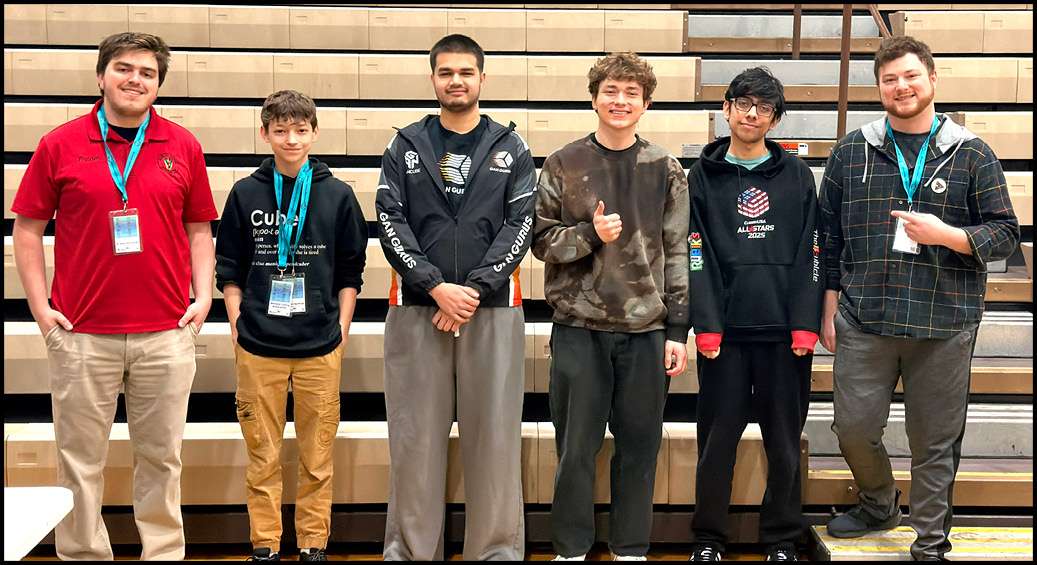
SPEEDCUBING … (Left to Right) Delegate Braden Richards, Organizer Gideon Banfield, Sujan Feist, Luke Garrett, Hassan Khanani, and Delegate Tyler Rose eagerly await the competition results.
By: Brenna White
THE VILLAGE REPORTER
publisher@thevillagereporter.com
What started as a personal passion for problem-solving turned into a full-scale competitive event, all thanks to one local student.
The Archbold High School gymnasium hosted “Algorithms in Archbold” on April 11, 2026.

This speedcubing competition was organized by 15-year-old freshman Gideon Banfield. His event drew 46 competitors, bringing a typically big-city competition scene into a small-town setting.
Banfield, who has been solving Rubik’s Cube puzzles since 2020, said his interest began with a desire to challenge himself mentally.
While other teenagers his age may be drawn to screens, his mother explained that he intentionally sought out ways to “stretch his mind,” eventually finding that outlet through cubing.
That curiosity quickly turned into skill. Although Banfield did not begin officially competing until 2024, he has since traveled to events in Dayton, Bowling Green, Mansfield, and Toledo. Still, those competitions required travel, something he hoped to change.
So, he did. Banfield took on the role of lead organizer, securing the Archbold High School gymnasium and recording the event through the Midwest Cubing Association – a notable accomplishment for someone his age.
The result was a well-attended, smoothly run competition with many well-known faces in the cubing world.

Speedcubing competitions, governed by the World Cube Association (WCA), challenge competitors to solve various Rubik’s Cube puzzles as quickly and accurately as possible.
Events are structured in rounds, with multiple solves recorded and averaged.
While the concept may seem simple at first glance, competitive cubing relies heavily on memorized algorithms. Participants use specific sequences of moves to recognize patterns and solve the puzzle in seconds.
Several high-level competitors were in attendance, including Sujan Feist, Luke Garrett, and Hassan Khanani – all well-established names within the cubing community. Feist holds the current world record average for the 2×2 cube at 0.86 seconds.
Garrett has also made a significant mark in the sport, holding a world record in the one-handed 3×3 category with an average of 7.72 seconds. Meanwhile, Khanani has achieved world-record status in the Square-1 event, recording a single solve time of 3.40 seconds.
In the competition’s main 3×3 event, Luke Garrett secured first place with an average time of 6.33 seconds.

Feist took the top spot in the 2×2 event with a 1.35-second average, narrowly edging out Garrett, who placed second with a 1.38 average.

Garrett continued to dominate across multiple categories, earning first-place finishes in Pyraminx (2.59 average), Skewb (2.78 average), Clock (4.73 average), and the one-handed 3×3 event (10.91 average).
Beyond the results, the event maintained a welcoming and energetic atmosphere.
For many, especially those new to the world of speedcubing, the event offered an introduction to a niche but rapidly growing competitive scene.

And at the center of it all was Banfield, who was not just competing, but creating an opportunity for others.
By bringing “Algorithms in Archbold” to life, he proved that even a globally recognized competitive hobby can find a home in a small-town gymnasium – one algorithm at a time.