
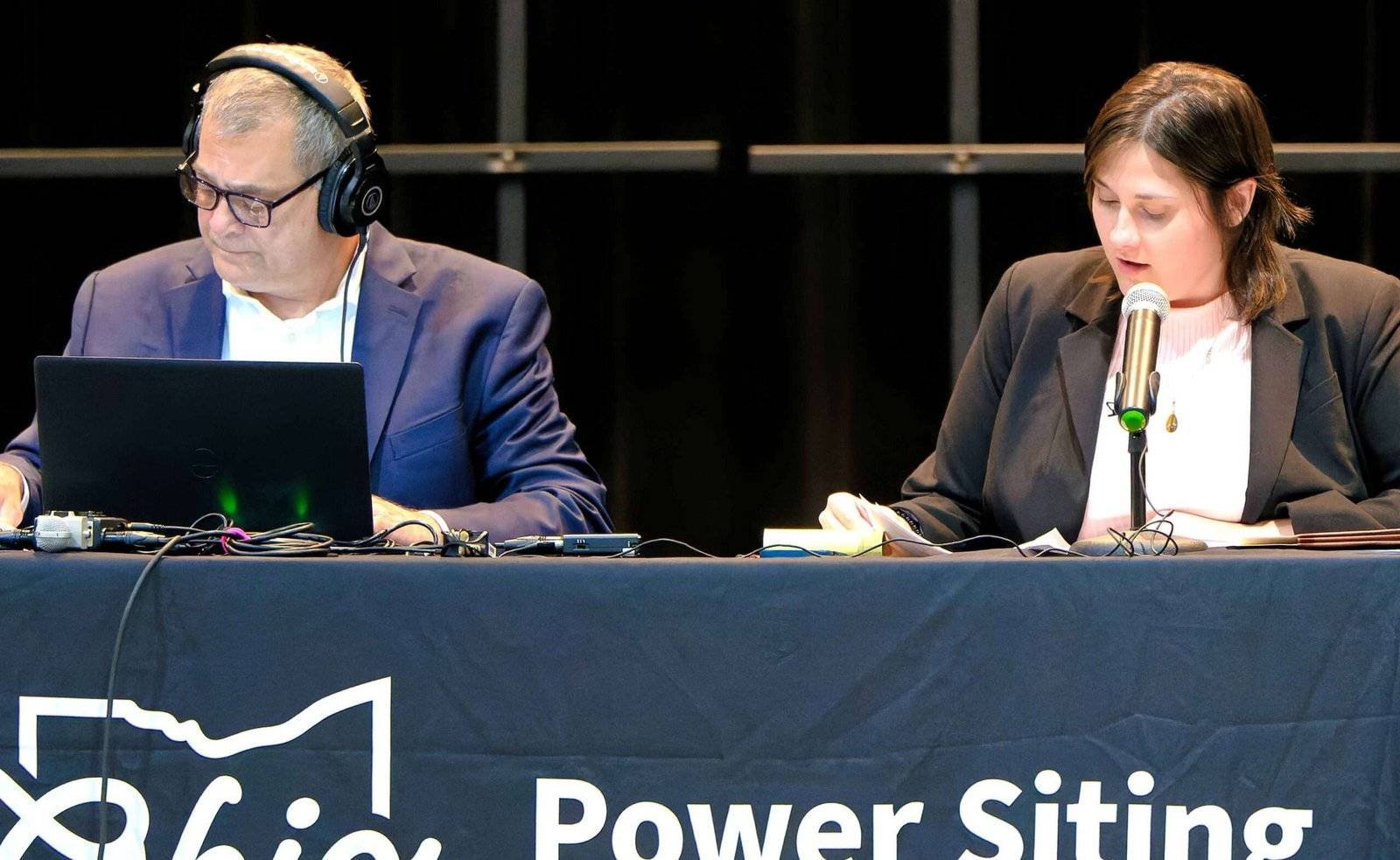
BOARD … Administrative Law Judge Manette Asta (right) and Court Reporter Michael Rennillo (left) preside over the meeting, hosted by the Ohio Power Siting Board, to collect public opinion regarding the proposed Ritter Station Solar Field.
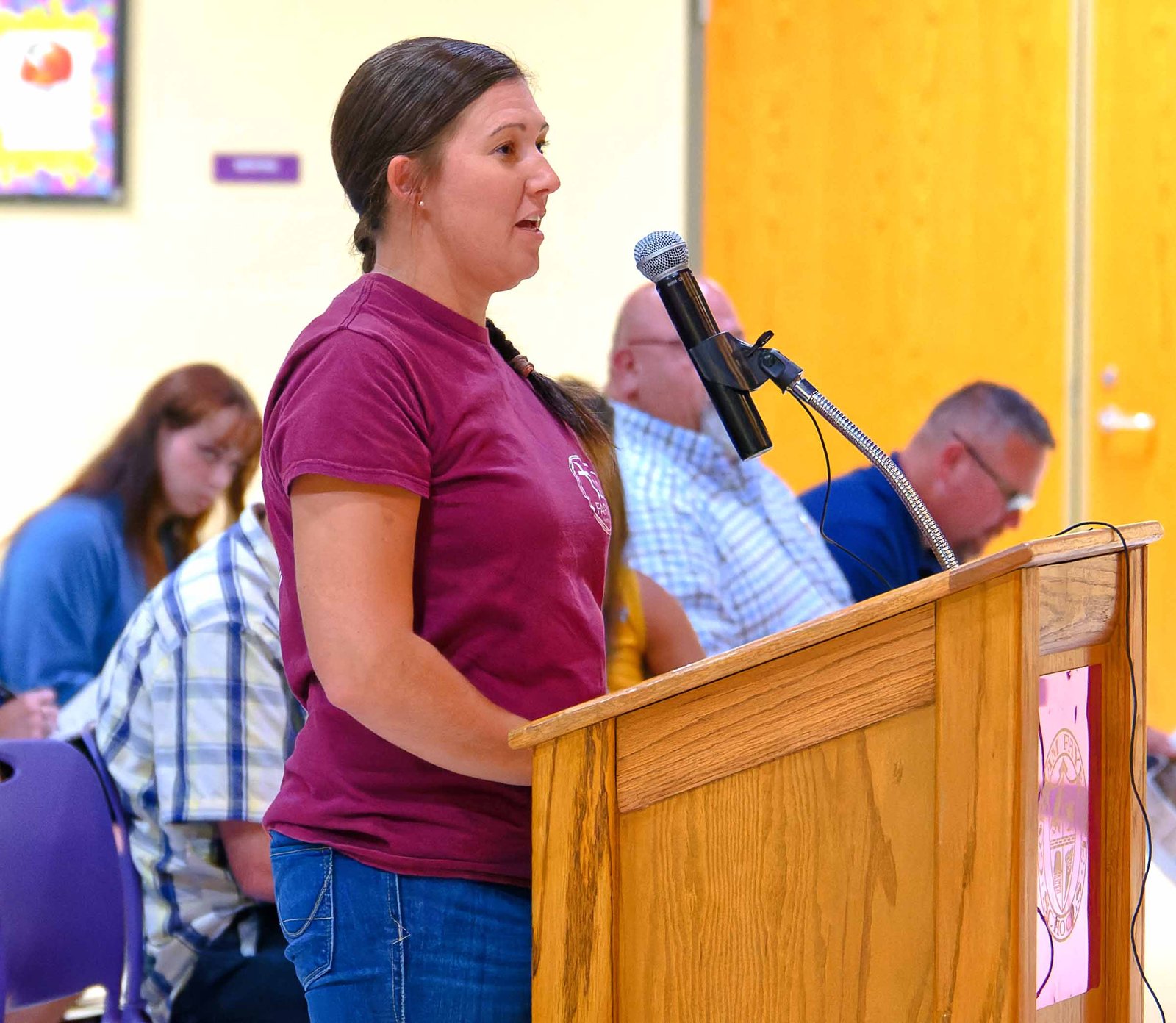
T22 … Katey Schaffner of T22 Farms offers testimony during the public hearing to collect opinions regarding the proposed Ritter Station Solar Field.
PHOTOS BY JACOB KESSLER / THE VILLAGE REPORTER
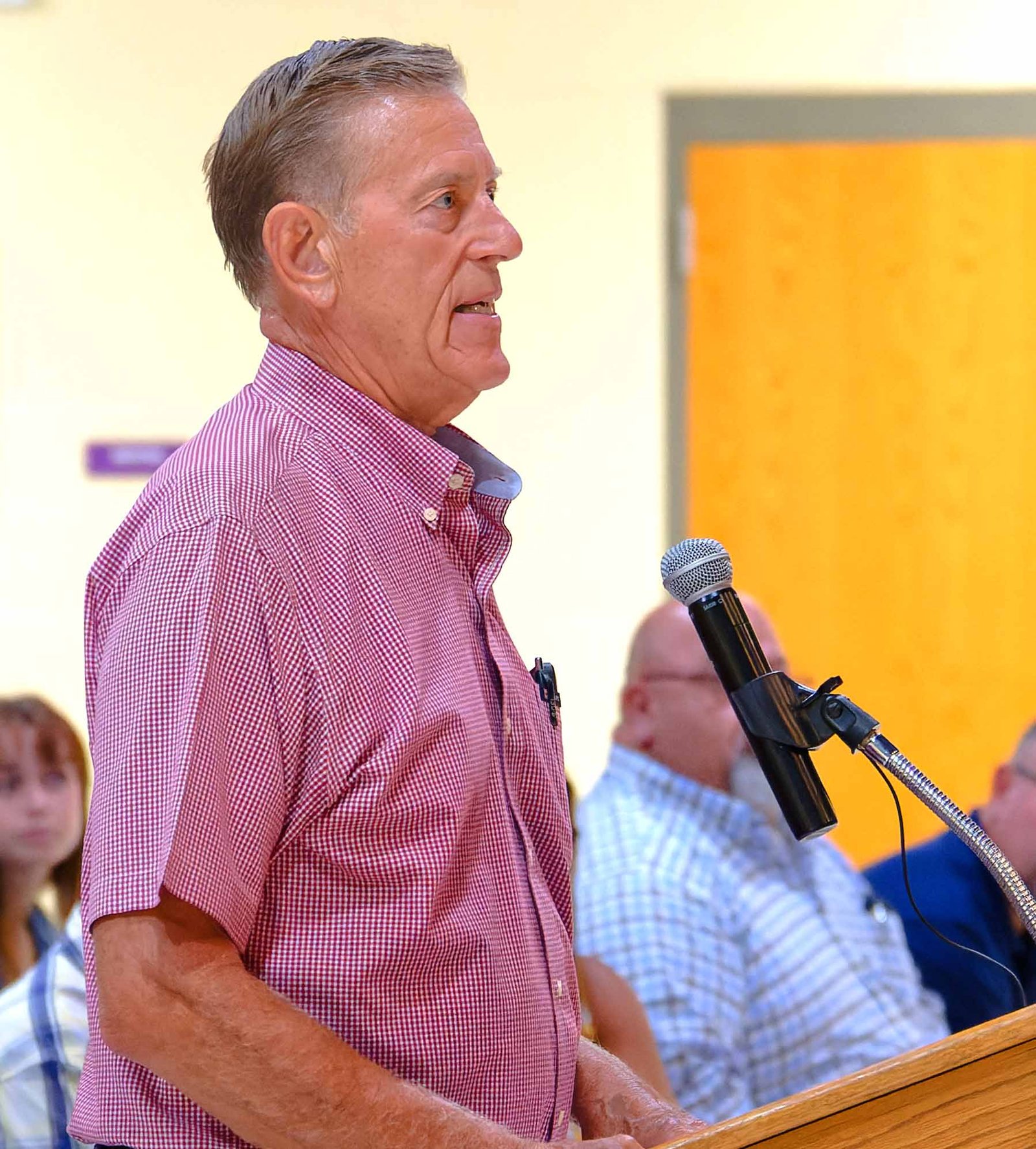
BEGINNING … Jeff Canfield offers testimony during the public hearing to collect opinions regarding the proposed Ritter Station Solar Field.
By: Jacob Kessler
THE VILLAGE REPORTER
jacob@thevillagereporter.com
A standing-room-only crowd filled the Fayette Local Schools cafeteria for a public hearing hosted by the Ohio Power Siting Board regarding the proposed Ritter Station Solar project in Gorham Township. The meeting took place on August 13 at 6:00 p.m., with more than twenty individuals signing up to speak.
Administrative Law Judge Manette Asta presided over the meeting, with Court Reporter Michael Rennillo documenting each statement made for the official record. The purpose of the hearing was to collect public opinion on the project, which seeks to construct a 199-megawatt solar-powered electric generation facility on approximately 1,700 acres of farmland, along with a 138-kilovolt electric transmission line running about 2.2 miles to connect the facility to the East Fayette Substation.
Plans call for the site to feature rows of solar panels mounted on racking, inverters, access roads, an operations and maintenance building, and laydown areas for construction staging.
The meeting was not intended for questions and answers, but rather to allow any resident, landowner, or interested party to offer their views directly to the board for consideration.
Those opposed to the project spoke at length about what they believe would be the loss of productive farmland, possible harm to local businesses, property values, drainage systems, and the overall rural character of the area.
Jeff Canfield opened the testimony by stating firmly that he opposed the project. He argued that Gorham Township does not want or need an additional 1,700 acres of prime farmland removed from production, especially when combined with the roughly 800-acre solar field already in place east of Fayette.
Canfield said this change would eliminate nearly ten percent of the township’s farmland, directly impacting agricultural output and the businesses tied to it.
He noted that the affected land produces corn yields of more than 175 bushels per acre, and soybean yields of over 60 bushels per acre, generating revenues exceeding $1.2 million annually.
Without this acreage, he warned that local grain elevators would handle over 300,000 fewer bushels each year, seed and fertilizer dealers would see sharp declines in sales, and at least one farmer could lose 40 percent of his rented acreage.
Canfield also expressed concern about property values for neighboring homes, saying few people want to live next to an industrial solar field.
He added that health concerns have been raised elsewhere about constant humming noises and glare from panels, and he questioned whether such risks were worth what he described as the “only real benefit,” money to a few landowners and the school district, while the broader community shoulders the downsides.
Katey Schaffner of T22 Farms said the proposed solar array would directly border their property, creating a visual and physical barrier that could alter the customer experience central to their agritourism business.
She explained that T22 Farms depends on its open, scenic farmland to attract visitors for seasonal events, farm tours, and other public activities, and that the industrial appearance of rows of solar panels could discourage customers from returning.
Sally Stuckey stated her children do not want to inherit land surrounded by solar panels, while Brittany Seiler said her family might leave the district if more solar fields were built, and that farmland should be preserved.
James D’Lamater shared his belief that plans for high wind damage and fire hazards were inadequate and that the developer had been unresponsive to local concerns.
The final speaker in opposition, Austin McLennan, who stated he was a former utility-scale solar construction supervisor who worked on the earlier Fayette project, said he stopped building such facilities when prime farmland began being used.
McLennan questioned whether the company had planned adequately for costly decommissioning, stating panels must be recycled at about $29 each plus labor, piles and underground wiring would add millions more, and private buried lines are often not marked in systems, creating future hazards.
Supporters of the proposal focused on economic benefits, property rights, and the need for renewable energy. Tom Barnes said he supports solar energy as a necessary alternative energy source and believes it can coexist with other land uses such as beekeeping.
He also said he was pleased with the company’s approach to drainage and viewed the project as beneficial in retirement.
Kelly Bentley, Treasurer of Fayette Local Schools, said the project could provide much-needed revenue for the district without raising taxes, especially with uncertain state funding.
Angela Belcher, Superintendent of Fayette Local Schools, echoed those sentiments, saying the additional revenue could help the district meet rising costs without shifting the burden to taxpayers, while also showing that rural communities can play a role in shaping Ohio’s renewable energy future.
Thomas Dew argued that property owners should have the right to choose solar if it does not harm others and warned of the growing need for electricity.
Ryan Santa Maria, representing the Ohio Land and Liberty Coalition, supported the project as a matter of protecting property rights from government overreach.
John Townes, speaking on behalf of the Operating Engineers Local Union, supported the jobs the project could bring to skilled trades workers. Kip Humbert called solar “farming sunshine” and said it was a necessary income stream for small farms.
The evidentiary hearing for the Ritter Station Solar project will take place on September 15 at 10:00 a.m. at the Public Utilities Commission of Ohio offices, 180 East Broad Street in Columbus.
During this proceeding, the applicant, the OPSB staff, and any intervening parties will present sworn expert testimony and evidence related to the generation facility and transmission line.
Once the hearing concludes, the board will review the complete evidentiary record alongside all public comments from the Fayette hearing before deciding whether the project meets Ohio’s requirements for public interest, convenience, and necessity.