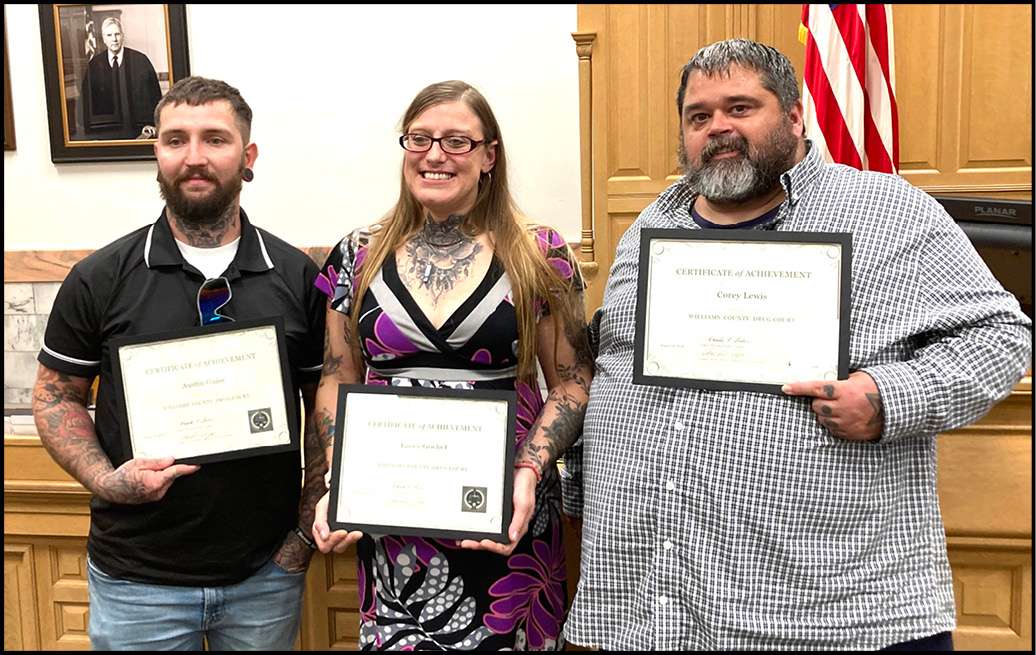
 PHOTO BY JOHN FRYMAN / THE VILLAGE REPORTER
DRUG COURT GRADUATION – Williams County Common Pleas Court drug court held its graduation on Wednesday, Aug. 19. From left are Austin Guise, Lacey Goebel and Corey Lewis, who were the court’s 72nd, 73rd and 74th graduates of the program.
By: John Fryman
THE VILLAGE REPORTER
john@thevillagereporter.com
The Williams County Common Pleas Court drug court celebrated three graduates on Wednesday, Aug. 19. They were the program’s 72nd, 73rd and 74th graduates.
“This is a testament to those who are graduating today and what a wonderful support system they have,” said Common Pleas Court Judge Rhonda Fisher.

“For all those who are still in drug court, I think it’s a good opportunity for you to see that good things can happen and you can do it.”
She then added, “This is a testament to these people who have done the work and put in the work and here they are at graduation day.”
The graduates were Austin Guise, Corey Lewis and Lacey Goebel.
Amber Ruger, who is the drug court coordinator, had supervised a couple of the graduates as their probation officer and has seen them in both capacities.
“It’s great to see them graduate today, watch them go through the process and to be able to be a part of it,” said Ruger.
There were many family members, friends and support groups who packed the courtroom for the graduation program showing their own support for the new graduates.
A Promise To Himself
Guise spoke about how he wanted to be motivational and a testimony to prove that for anyone new to drug court or partway through it, if you wanted to change it is worth it.
“I grew up with parents that brought me up right, and now I have a better understanding of who I am,” Guise said.
“I know that 15 years on being on a crash course and regardless after all the time in being in and out of incarceration and making nothing significant after my career of partying.”
“I eventually found myself looking at an indictment for possession, and I knew this was going to be the moment that would make or break me.
“So, I made a promise to myself that it was time for a change. No more causing grief or stress to my family or being a troublemaker. I began to make goals and start to build and believe in better morals. Day by day I began to chop away at them.”
Upon his graduation from drug court, Guise said this is only a beginning for him.

“I want to give the biggest thank you to my family and friends who have stood by me,” Guise said.
“Thank you dearly to the drug court and treatment team. I will never forget the advice, tools, and patience you gave me. Words will never express how grateful I am to all you and to all you attending drug court to keep going.
“These people are here for you and want to help you to get an outlook for life.”
From 12 Years Old To Fentanyl
Lewis spoke about his own story, where he came from, where addiction took him and why he finally decided he wasn’t going to die.

When he was 12 years old, Lewis became addicted to marijuana and alcohol despite being just a kid.
“I didn’t understand addiction and the consequences, the choices that I was going to follow me for decades, and I just thought that I was just having fun,” Lewis commented. “I thought I could stop whenever I want and I was dead wrong.”
Four years later at the age of 16, cocaine had entered his life, and by then getting high was just something that would become a part of his life.
At the age of 20, he started to do methamphetamine, and it became his drug of choice for many years. It also took him to places that he would never have thought he would go.

“It took my time, my relationships, opportunities, and it also took pieces of me,” Lewis commented.
“From the time when I looked into the mirror and didn’t recognize the person looking back at me. I spent years chasing something I thought would made me feel better when everything didn’t really matter to me was really slipping away.”
Toward the end of his addiction, Lewis began using fentanyl, and he knew things were getting serious.
“I was going from a 12-year-old kid experimenting with marijuana and alcohol to a grown man with an addiction taking a toll on his whole life,” Lewis said.

“Even then addiction tried to convince me that I couldn’t change and told me I was too far along. It told me this is just who I am, and I was always going to be an addict.”
He admitted there was one thing that couldn’t take him from addiction, his family, loved ones, and most importantly his children.
“Mentally, I had to stop and ask myself the question that changed everything, what kind of legacy am I going to lead to my kids,” Lewis emotionally said. “I pictured them growing up and telling people about their dad and I couldn’t accept it.”
Lewis’ own recovery hasn’t been easy, but getting sober didn’t magically fix everything for him.

“I had to face things, and I had spent years running from,” he said. “I had to learn how to run without drugs of alcohol, deal with problems instead of getting high and learn how to be accountable, rebuild trust and forgive myself.”

He pointed out that drug courts have been a major part of his own journey.
“There have been days when I didn’t want to be held accountable,” he admitted. “There were days when I was frustrated and also wondered if I could really do this.
“Looking back, I realized the accountability is exactly what I needed. For so long, addiction gave me excuses, recovery gives me responsibility. Addiction taught me how to roll from my problems, but recovery taught me how to face them.”

“Today I’m proud of something that I would never have thought to be proud of,” he continued. “I’m proud that I didn’t give up on myself. I can’t change what I did when I was 12 and can’t change what happened when I was 16.
“I can’t erase the years I spent doing meth and can’t undo things happen when fentanyl became a part of my addiction either and can’t get those lost years back.”
“I can decide what the years I have left and that’s what recovery means to me. It doesn’t mean my past disappears; it means my past doesn’t go get to decide my future,” added Lewis.
Lewis then concluded, “Today I don’t want my family, my loved ones or my children to remember me for the years I was lost. I want them to remember them who came back.”

Almost Two Years In Recovery
Goebel had been in addiction for eight long years and now has been in recovery for almost two years.
“One of the things that felt different about me was the support system for all the guidance received,” Goebel said. “I would never have thought about making it to see this day.
“Life in recovery is amazing. I have now been at the same job for a year at my own pace and fighting to get my ten-year-old back, and I’m expecting another one in December.
“Now I know I’m worth being the best mom, sister, and friend this amazing journey of recovery has brought me. Judge (Rhonda) Fisher asked me if I was excited to graduate, but I didn’t know because I questioned my sobriety and because I didn’t know that I could make it this far.

“Sober life is amazing and thank you to all of my support system and everyone guided me through my journey.”
Ruger stressed the importance of those who provided support for the drug court graduates.
“There are so many people here to support not just our drug court participants, but also past participants and family members,” she said.