
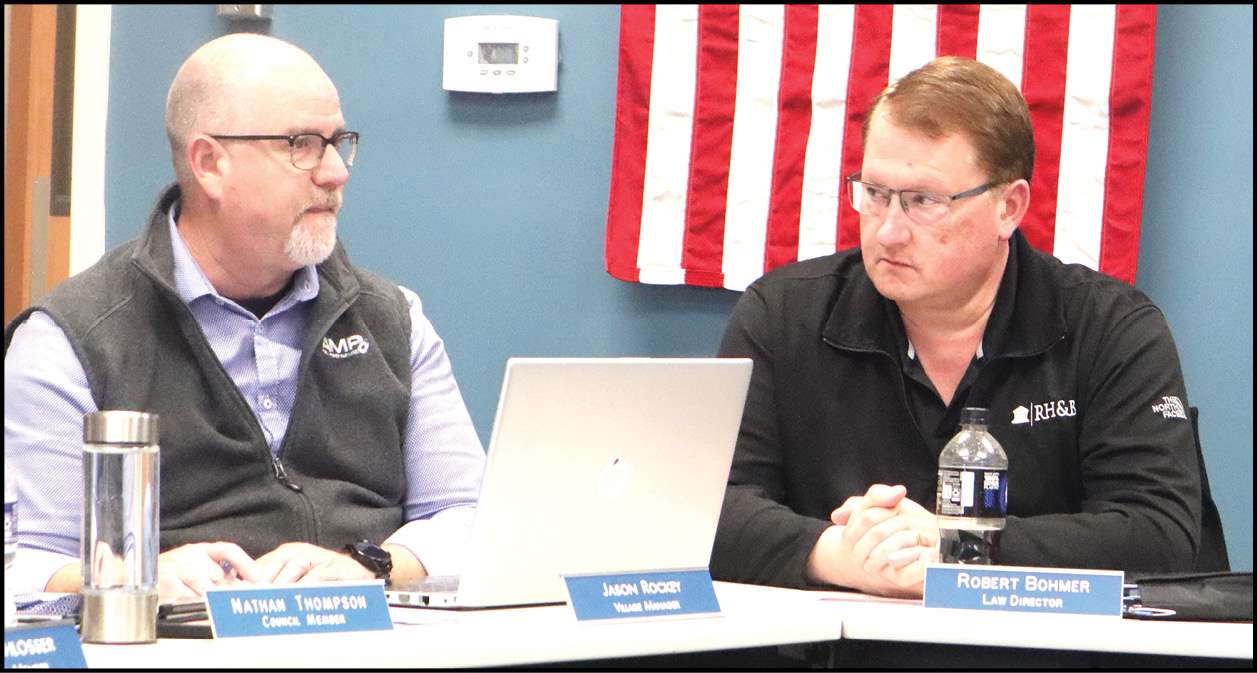
 (PHOTO BY BRIANNA BALOGH / THE VILLAGE REPORTER)
RESOLUTIONS PASSED … Law Director Robert Bohmer (pictured on the right) directs his attention to Village Administrator Jason Rockey (left) as he reads several resolutions.
By: Brianna Balogh
THE VILLAGE REPORTER
publisher@thevillagereporter.com
Held on Monday March 24th, the Montpelier Village Council started at 6:00 p.m. with roll coll. Members in attendance were as follows: Heather Freese, Melissa Ewers, Kevin Motter, Chris Kannel, Nathan Thompson, and Don Schlosser. Also attending were Mayor Steve Yagelski, Clerk of Council Molly Collert, Financial Director Nikki Uribes, Law Director Robert Bohmer and Village Administrator Jason Rockey. Following roll call was a prayer, led by Reverend Marc Lapointe and the Pledge of Allegiance.
Prior to starting any business, Mayor Yagelski made an adjustment to the agenda. An executive session was added to discuss confidential business information of an applicant for economic development assistance.

With no further additions or corrections, the agenda approval was motioned by Motter and seconded by Kannel.
The next two items were approval of meeting minutes, one from the regular council meeting on March 10th and public meeting minutes from March 13th.
The approval of the council meeting minutes was motioned by Thompson and seconded by Schlosser, the public meeting minutes approval was motioned by Kannel and seconded by Ewers.
Moving along, the council welcomed comments from the audience. Reverend Lapointe spoke up to share some information with the council members regarding the local ministries.
Starting with the monthly Christian ministry meeting held in Montpelier, where local ministers discuss and organize upcoming events such as Bean Days among other things.
Th last meeting welcomed guest speaker Charity Meuleman from Cornerstone Treatment Foster Home Collaboration. She shared the grave and growing need for foster and special needs homes in Williams County.
Lapointe handed out business cards to all members with information, encouraging anyone who is interested to reach out.
Lapointe also suggested a mayor’s breakfast, where the mayor along with local ministry leaders could meet. Mayor Yagelski was very open to the idea and encouraged Lapointe to set something up.
Next was council and committee reports. Thompson began by thanking the council members who advocated for the Williams County Health Department to stay in Montpelier.
Ewers followed with a question regarding seminars, conferences, training and other similar events that council members may be interested in attending.
The question was mainly focused on where the financial responsibility fell. Yagelski answered regarding the conferences he attends annually, and the financial responsibility is different because of the board positions and responsibilities he holds.
Uribes clarified that any AMP related conference would be covered under the electric fund, but all others would be under the general fund. Uribes advised that to cover these expenses it would have to be known when the budget is discussed.

Certain forms must also be filed and approved. Freese commented on a conference she has attended for AMP in Washington D.C, stating that she emailed prior to the budget being approved.
Yagelski added that the event should be evaluated for what kind of value it would bring back to the council.
The only repercussion would be if for some reason the plans were cancelled, the council member should be responsible for reimbursing the village for monies already paid for said conference, in his opinion. Ewers verified her question had been answered.
Yagelski followed with a warning about the increase in electric bikes and scooters. Since last fall, there has been increased numbers and Yagelski just wanted to remind all riders that they should follow all laws, the same as motor vehicles.

For example, stopping at intersections. Also, a reminder if the scooter is designed for one person, only one person should be riding. This is something that could cause serious injury.

Final comments were made by Kannel, starting by stating his appreciation to all council members and administration as well as members of the public for their involvement in the recent publicly held town hall meeting.
Members agreed that they felt it was a success and very informative. The meeting is posted on the village Facebook page.
Business moved along with Village Administrator Rockey presenting the first item, a motion to approve the comprehensive plan. Rockey introduced Kannel to provide further details from the Economic Development and Strategy Committee.

Kannel started by informing the council that this would be the first update since 2001. As explained in the town hall meeting. The purpose of the plan is to Guide, Inform and Measure. Guide the community in evaluating proposed public, private or joint projects. Inform current and prospective property owners, business owners, and developers on desirable growth patterns. Measure progress and effectiveness of projects in the village to ensure they strengthen the community as a whole.
There are four main sections of the plan: future land use and housing, downtown revitalization and local economy, parks recreation and community connections, community image and brand.
Having a plan set in place is critical as a guiding document but also for grant application as they often look to the plan for justification for projects and funding. The motion was made by Freese and seconded by Motter, approved by all.
The next item on the agenda was a motion to approve the water/sewer memorandum of understanding with Holiday City.

The MOU was drafted by Bohmer and based on the initial request from Holiday City for water supply to a new subdivision. In coordination with OHM a water study was performed to determine if Montpelier had the capacity to provide water to the subdivision.
The study was financed by Holiday City and did find that the capacity was there, but some improvements could be made. No estimate was given by the engineer for the recommended improvements.
The general scope of improvements are included in the MOU. Kannel asked outside of the obvious monetary gain, what other benefits could be involved.
Rockey responded that in his opinion any residential development within the county benefits the entire county. Even if not in Montpelier, those residents could work in Montpelier and pay income tax.

Kannel also inquired about the improvements and who would be financially responsible. Rockey responded it is stated in the MOU that Holiday City would cover those, if approved.
None of the improvements would need to be made immediately but it would be required to be in place within two years of groundbreaking on the subdivision.
Bohmer commented that it is not a legally binding document but will lead to one and is structured in that way. The motion to approve and send to Holiday City for signatures was made by Motter and seconded by Ewers, approved by all.
The agenda then moved on to four resolutions. Starting off with the second reading of Resolution 1442 for public safety income tax levy.

With no comments from the economic development committee, the second reading was motioned by Kannel and seconded by Schlosser. Rockey then read resolution 1442.
Resolution 1442 – declaring the necessity of an election on the question of approving the passage of an ordinance amending the codified ordinances of the Village of Montpelier in order to provide for an increase of two tenths of one percent in the existing income tax levied by the Village of Montpelier, effective January 1, 2026 and continuing until December 31, 2035, with said increase levied to provide funds for acquisition, equipping, repair and maintenance of fire apparatus and equipment and to fund police personnel, equipment and vehicles, and declaring an emergency.
Resolution 1423 followed, also a second reading. This resolution is to update the rules for council. Yagelski informed council that he made a few minor updates from the last meeting, to clarify some language.

The motion was made to suspend the second reading by Freese and seconded by Motter. The motion to pass was made by Thompson, seconded by Schlosser. Approved by all members.

Third resolution on the agenda, Resolution 1425 to advertise for the 2025 asphalt program is a suspend and pass resolution. Kannel asked for clarification on the fire station parking, where Rockey answered that it would only be to the north side of the station where the firemen park.
A miscommunication happened the previous year where the funds were available. So, this year to ensure there are no delays, it was entered in this resolution, but the funds would not be coming from the street paving funds for the fire parking lot. Kannel and Schlosser both asked for clarification on the exact areas.
The areas included would be resurfacing of Iuka Road 200-400 blocks; North Platt Street 100-300 blocks; Snyder Avenue 100 blocks; North Pleasant Street 400-600 blocks; Glen Drive 100-200 blocks and Fire Station Parking.
Work includes milling, base repair drainage, and asphalt overlay. This would also include chip and seal for the alleys and crack sealing potentially with Pioneer Industrial. The motion to suspend was made by Thompson and seconded by Motter. Schlosser made the motion to pass, Ewers seconded by. Both the motion to suspend and to pass were approved by all.

The last resolution was Resolution 1426, to purchase a 2025 John Deere 325G compact track loader for the water and sewer department was also a suspend and pass resolution.
Rockey informed the council that bids were collected from two other manufacturers, one coming in lower and one higher.
The department already has experience with the John Deere machinery so that is the one that was selected. Kannel asked what would happen to the old one.
Uribes clarified it would go to the electric department who would purchase it from the water and sewer department. The suspension motion was made by Kannel and seconded by Thompson. Passing motion made by Freese and seconded by Schlosser. Approved by all members.

The final item before adjournment was the village administrator’s report, given by Rockey. He informed the council that he had been contacted by an Ohio State University research team who wanted access to the wetlands on County Road 10.
The research would span three years and be focused on assessing the benefits of the H2Ohio program, which funded the wetland project, and what effect it has on marsh birds.
Kannel asked if the researchers would be willing to come and speak to the council about the study.
Thompson added that a potential tour of the wetlands may be beneficial too. Rockey will follow up via email. He informed council that the researchers would have a signed access agreement to be on the property.

Rockey finished with an update to the open assistant superintendent for the water and sewer department. Interviews have been completed, and a decision should be made by the end of the week.
The position has been open for approximately three months, but the open full-time position was filled first. All three of the current full-time employees expressed interest, with two completing the interview process.
The motion to move into executive session was made by Motter and seconded by Kannel. The meeting went to executive session at 6:36 pm, with no action to follow.
