
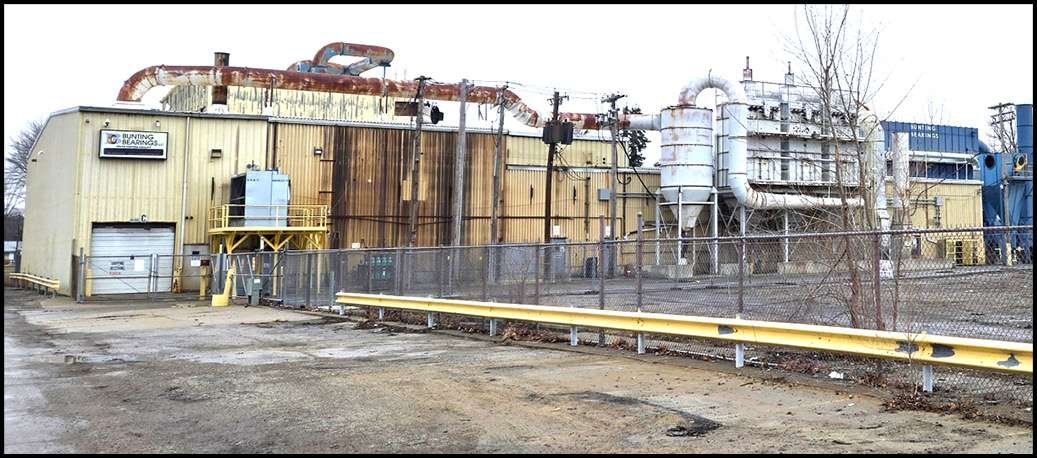
 LEAD SCARE … Demolition at the former Bunting Bearings site in Delta, seen here, has led to testing in Delta and Swanton after lead in the air was measured at five times higher than the U.S. EPA standards.
By: Jesse Davis
THE VILLAGE REPORTER
jesse@thevillagereporter.com
Following the discovery of lead levels in demolition dust at a site in Delta, roughly five times the allowable amount, a flurry of activity is already underway throughout the area.
According to the original January 6 OEPA release, regular testing results for November received on December 31, showed lead in the air near the site at 0.451 micrograms per cubic meter, three times the U.S. EPA’s National Ambient Air Quality Standard of 0.15.

Expedited results for December, received on January 2, showed an average of 0.747, or nearly five times the standard.
That the number is an average means there were times when that level was an unspecified amount higher. The monthly average for October, in comparison, was 0.006.
Delta Village Administrator Chris Frazer provided a brief comment on the situation. “The Village of Delta is working closely and cooperatively with the EPA and Health Department to address the issues raised at the Bunting Bearings demolition site,” Frazer wrote.
He directed all further questions to the OEPA and the Fulton County Health Department.
The situation is further complicated by the demolition site being located in the middle of residential development and a quarter mile from the Delta Middle School property.
The Pike-Delta-York School District has taken several actions in response to the potential hazard, following guidance received from the FCHD.

According to a January 6 release from Director of Curriculum, Instruction, Assessment, and Communication Barbie Shepherd, the schools are “limiting outdoor exposure for students to include moving to indoor recess,” “minimizing the amount of time students spend outside during arrival and dismissal,” cleaning the surfaces of outdoor play equipment, and “limiting the amount of outside air coming into the building through our ventilation by adjusting settings, while continuing the use of air filters.”
“Families should know that health officials emphasize that the risk has decreased now that demolition has ceased, but that caution is appropriate while data continues to be reviewed,” Shepherd wrote.
She specified that their actions are a “precautionary response,” and that there has not yet been any confirmed exposure at any school buildings.
Shepherd issued a follow-up release on January 7, stating environmental samples had been collected by the OEPA that day at all the school buildings and grounds, to be expedited to a laboratory for testing, with results expected by January 9.
She wrote that the district is continuing to work with the FCHD, the OEPA, the Ohio Department of Health, and the Fulton County Emergency Management Agency.
The same day they visited the schools, the OEPA also made a stop at the Swanton Water Treatment Plant, according to Swanton Village Administrator Shannon Shulters.

“As part of their visit, OEPA collected a water sample from the creek that, when flowing/full supplies our reservoir, which flows from Delta to Swanton, to ensure there has been no impact to our source water,” Shulters wrote in an email to The Village Reporter.

In the OEPA’s original release, it stated that both Delta and Swanton’s drinking water would be tested “out of an abundance of caution” despite the agency not having any concerns.
Staying on the lookout for potential lead issues is nothing new for the village of Swanton.
According to Shulters, the village completed a lead service line inventory in 2024 as required by the OEPA, with no lead lines identified.

She wrote that they have continued to monitor for lead as per OEPA regulations, “conducting 40 water samples twice per year.”
“At this time, there are no indications of lead issues within the village’s drinking water system, and we will continue to work closely with OEPA and communicate transparently should any concerns arise,” Shulters wrote.