

PHOTOS BY JACOB KESSLER / THE VILLAGE REPORTER
REMOVAL … Harold Stickley stands to leave council chambers after the 5–0 vote to remove him from office.
By: Jacob Kessler
THE VILLAGE REPORTER
jacob@thevillagereporter.com
The Wauseon City Council voted Monday night to remove newly elected council member Harold Stickley from office following a charter required public hearing that featured sworn testimony from current and former city officials, denials by Stickley to several allegations, and exchanges that at times interrupted the usual flow of proceedings.

The action came at the start of the February 2 regular meeting after Mayor Kathy Huner opened a special hearing conducted under Section 11.01 of the Wauseon City Charter, the provision that allows council to consider removal of an elected official for cause.
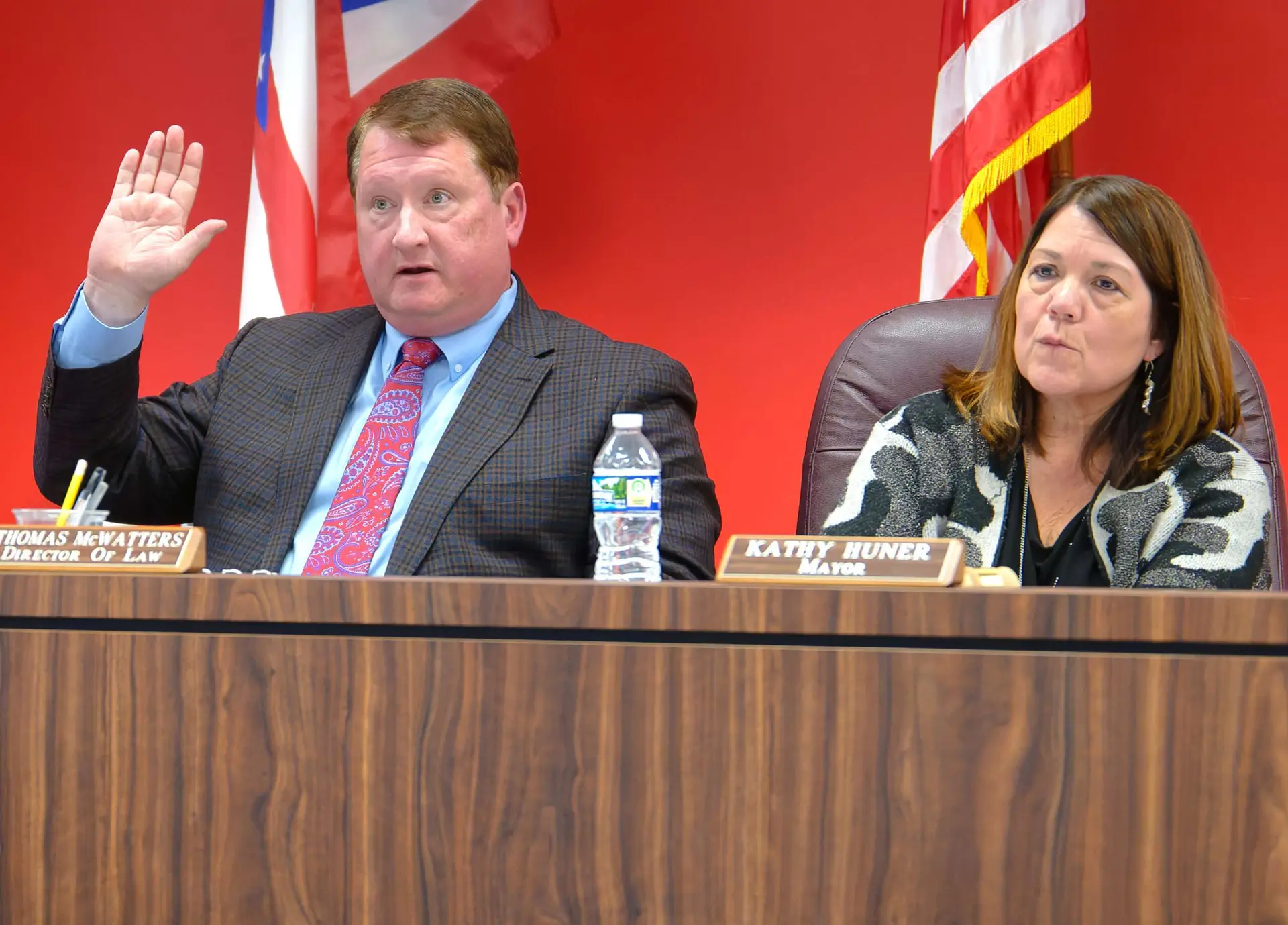
Acting law director Robert Bohmer presided over the hearing because City Law Director Tom McWatters recused himself due to his firm previously representing Mr. Stickley in the past, which was explained during the meeting.
The February 2 hearing stemmed from a Notice of Probable Cause for Removal issued January 6, 2026, that outlined a series of allegations from 2023 through 2025.
According to the notice and prior reporting by The Village Reporter, the notice alleged conduct described as sexual harassment, interference with city employees, and the creation of a hostile work environment.
The document cited multiple incidents involving comments to female employees and a former council member, as well as statements attributed to Stickley during a recorded Council of the Whole meeting.
The notice also referenced a March 2025 executive session in which city officials stated Stickley said he would resign and not seek reelection, with the city agreeing to describe his departure as for personal reasons.
Following his resignation, Stickley previously told The Village Reporter that his decision at that time was related to health issues and side effects from prescribed medication.
At the outset of Monday’s hearing, Huner explained that the city was required to follow the procedure outlined in the charter and that only the allegations contained in the notice served to Stickley could be discussed. Stickley immediately objected, telling the mayor he wanted council to bypass the hearing and proceed directly to a vote.
“Mayor, can I have a moment please. Can we just get on with this. Is that ok with you,” said Stickley. Huner responded that the charter did not allow that option and that the public and the accused were entitled to a formal process. Mr. Stickley continued and stated, “The dirty laundry has been aired long enough. So let’s just vote.”
Following more back and forth regarding the rules laid out in the charter and how the hearing will be held, Bohmer proceeded to outline the rules, stating that witnesses would be sworn-in, that testimony must relate only to the allegations in the notice, and that Stickley would have the opportunity to question witnesses and present his own.
The first witness called was former council member Sarah Heising, who served alongside Stickley for about four years, as according to her testimony.
Under oath, Heising described an incident she said occurred in the winter of 2023 shortly before a council meeting began.

She testified that she was seated between Stickley and now Council President Shane Chamberlin when she found herself in what she described as an inappropriate conversation.
Heising said she plugged her ears and said she did not want to hear it because Stickley was giving Chamberlin what she called bedroom advice.
She testified that Stickley asked Chamberlin his wife’s name and then said that if Chamberlin wanted better action in the bedroom he should call out Heising’s name.
Heising told the hearing she felt disgusted and degraded and later asked Chamberlin if she had heard correctly, saying he confirmed that she had.

She testified that she contacted the city’s human resources representative, saying it was the only formal complaint she made but that it was a turning point for her. When given the opportunity to question her, Stickley denied the account and told the room none of that ever happened.
“Wasn’t it that Shane Chamberlin asked me if I had heard any good jokes lately,” Stickley stated. Heising replied with, “I have no idea what other things were said. I stated what I heard at that time.”
“I don’t know what other advice you gave him, but you told him to call my name out when he’s having sex with his wife.” Stickley replied with, “Never did that. Never did that.”
City Finance Director Jamie Giguere was the next witness. She testified that in 2024 Stickley commented on her appearance while she was speaking with another employee.

Giguere said he remarked that she appeared to be losing weight because her clothes were fitting differently and that the comment made her feel he was judging the lower part of her body.
She told the hearing it made her uncomfortable. Stickley responded that he had been speaking to another employee, former Public Service Director Keith Torbet, about dieting and denied making inappropriate remarks to Giguere.
“Keith Torbet was sitting next to you, and I was talking to Keith Torbet. And Keith said to you, true statement, how’s the diet going. And you answered, very well.”
“And I said, if you got a diet, I would really like to have one because I know I could lose some weight,” said Stickley. Giguere then stated, “but you also made comments about my body.”

Stickley replied with, “No I did not. I don’t care about your body personally. So sorry. You can make up stories all you want but I was talking to Keith Torbet.”
Giguere then replied and stated that she was not making up those comments and that she has fellow witnesses. More comments were made back and forth before Fire Chief Kessler stated he had witnessed the interaction.
Next, the city’s contracted human resources officer, Michelle Wing, testified about a January 2025 complaint from an employee identified as Hannah.
Wing read from her written report, stating that Hannah said Stickley questioned her about a coat covering the window on her office door and asked whether she used her office to change clothes before emergency runs.

Wing said Hannah also reported that Stickley had touched her face on one occasion, came up behind her and placed his hands on her waist on another, and often stood so close, closing space between them, during conversations to the point that she feels backed into a corner and that her personal space was being invaded.
Wing testified that she conducted an investigation and spoke with witnesses and that her findings were that there had been other complaints that were not always formally documented or acted upon.
Wing told the hearing that many times employees felt violated or uncomfortable through interactions with Stickley and that if he had been a city employee rather than an elected official the process would likely have moved directly to termination. Furthermore, Wing was asked if she found that the allegations were substantiated from her point of view and she stated, “I did.”
During Stickley’s turn to question Wing, he asked her if she had written and signed documents from Hannah. Wing stated that she had met with her and had her approval on the information. Stickley further questioned and asked if she had written documents by Hannah.

Wing asked what difference it would make if she had handwritten and signed documents from Hannah, to which Stickley replied, “Because you could be making this up.”
Wing then continued and stated, “She sat in my office and cried. I watched her with my own eyes and there were other witnesses who were in this room who seen those interactions.”
Stickley then stated that, when he asked Assistant Fire Chief Jeremy Shirkey why the fire coat was on the door, Shirkey told him it was “because everybody wants to go over there and look. That’s kind of kinky I said.”
He then stated that Hannah had asked him about a time when he was in the military, and he asked if he could put his hand on her shoulder to show her what a Master Sergeant told him off the coast of Vietnam.


He stated he was told he could, then placed his hand on her shoulder and stated, “And he put a hand on my shoulder and said, if you see a bright light, and you feel a lot of heat, you know you’re dead. And that’s what I told Hannah. And that is the only time I touched Hannah, on her shoulder.” Wing then stated that what he described was not in her complaint.
Assistant Fire Chief Jeremy Shirkey testified in greater detail about the interaction involving the employee identified as Hannah. Shirkey said he was speaking with Stickley outside the executive assistant’s office when Stickley asked why a coat was covering the window on her door. Shirkey told the hearing he explained the coat was used when Hannah changed clothing before responding to fire and EMS calls.
According to Shirkey, Stickley continued asking questions while speaking with Hannah, and she appeared uncomfortable.
Shirkey testified that Hannah began backing away while Stickley moved closer, and that he eventually shut the office door because, in his words, “she said she had enough.” He stated that Stickley did not ask similar questions about any other employee and that the focus was solely on Hannah.

Fire Chief Phil Kessler was then called to testify and described two separate matters involving Stickley. The fire chief first addressed a February 2025 Council of the Whole meeting, explaining that the discussion that evening referenced recent media coverage involving a neighboring fire chief and allegations of an improper relationship with an employee, which led to conversation about whether Wauseon had policies in place to prevent similar situations.
The fire chief told the hearing he responded that even without local policies, state and federal laws already prohibited such conduct. He testified that Stickley then spoke about his time in Vietnam and working in a shop environment and made remarks about not hiring women.
During the hearing an audio recording from that meeting was played, and the portion heard in chambers included Stickley saying, in substance, that it was a good thing they had not hired women mechanics in Vietnam because half the men would have gotten into trouble and that he would have been one of them. Officials stated the clip represented part of the exchange discussed in testimony.
The fire chief then turned to a later incident at the municipal building involving the employee identified as Hannah. He testified that he was in his office when he heard Stickley arrive and ask whether Hannah was in the building.

The fire chief said he immediately contacted Hannah, who had not yet arrived for work, and told her to delay coming in because she felt uncomfortable around Stickley due to previous interactions.
He told the hearing he then notified Mayor Huner and the city’s human resources officer, stating that he believed the situation needed to stop.
The fire chief further testified that Hannah had previously reported to him incidents involving unwanted touching and close physical proximity, and that he had encouraged her to speak with HR about those concerns.
After the fire chief completed his testimony, Stickley disputed the account, telling him, “That’s a really great story you tell,” and questioning his recollection of other city matters, including issues involving a generator and a prior meeting.

The discussion grew pointed until Acting Law Director Bohmer intervened and directed the hearing back to the established procedure, though the same topics continued briefly as the exchange played out.
After testimony concluded, Bohmer informed Stickley he could call witnesses or testify under oath. Stickley declined, telling council he had already said everything he wanted to say and that he wanted the members to vote.
For added context, prior to the February 2 hearing, Stickley provided The Village Reporter with a packet of three documents that he said had also been given to council members.
The first typed document was a biographical statement in which Stickley outlined that he was born in Wauseon, grew up on a farm in York Township, graduated from Delta High School, and enlisted in the United States Air Force in 1967, serving as a jet aircraft mechanic on B52 bombers and KC135 refuel tankers.

The letter detailed deployments to Texas, Hawaii, Vietnam, and Guam, his later employment history including the founding of E&H Auto Clinic in 1980, his membership in the VFW, American Legion, and Rotary, and his years of community involvement.
The document also stated that he had worked alongside men and women throughout his career and that he had never previously had a problem with the City of Wauseon.
A second typed document expressed Stickley’s personal appeal for fairness and respect, stating that he had spent his life serving his country and community with honesty and accountability.
In that statement he wrote that he had worked alongside men and women without issue for 45 years, had built a business serving the community, and did not believe he deserved to be treated unfairly after a lifetime of doing what is right. The document asked for transparency and fair treatment.

The packet also contained a handwritten letter from Stickley. It was not read into the record during the February 2 proceedings, and it was not stated during the hearing whether the packet had been entered as an exhibit.
Although those materials were provided in advance, Stickley did not reference them during the formal hearing and declined the opportunity to present testimony or call witnesses under oath.
Following all discussions, council member Heather Galbraith made the motion to remove Stickley for cause under the charter and council member Jeremy Simon seconded it. The motion passed 5-0 with Councilor Brandon Tijerina stating the decision was not made lightly and that he had gone back and forth before voting yes in the interest of transparency and accountability. Council then voted to close the public hearing at 5:46 p.m.
As the session ended, Stickley told council, “I’m glad you guys overturned the November 4th election. I’m sure all the voters in Wauseon will congratulate all of you ladies and gentlemen of overturning the election.” Lastly and before leaving the meeting, Stickley stated, “Bye. I’ll see you guys in court.”

The meeting then returned to regular business with Law Director Tom McWatters rejoining council after the hearing portion concluded.
During public participation resident Kevin Hite addressed council at length, saying he was speaking from what he called an empathetic standpoint for both the council and for Stickley.
Hite said he did not know what it was like to serve on council or to sit in Stickley’s position but questioned why the allegations had not been brought before the public prior to the November election.
He told council that many residents he had spoken with were confused about what was happening and that the sequence of events created what he described as terrible optics for the city.

Hite also expressed concern about the financial impact on taxpayers if Stickley follows through on statements that he intends to file a lawsuit, noting that litigation could involve depositions, discovery, and significant legal expenses.
Hite asked directly why the matter had not been addressed earlier and why the public had not been informed before voters went to the polls.
Mayor Huner responded that the city had been required to follow the process laid out in the charter and that the initial complaints were handled through the procedures available at the time.
She stated that when the issue was first confronted in 2025, Stickley resigned from council and told members he would withdraw his name from the ballot.

Huner said council chose to discuss the matter in executive session out of respect for Stickley and his family and believed his candidacy would be removed.
Council President Shane Chamberlin added that the city had made several attempts through attorneys and direct communication to avoid the need for Monday’s hearing and that officials had tried to resolve the situation privately before it reached a public setting.
Hite continued by questioning whether the city could have taken steps short of removal, such as mediation or arbitration, and whether the current process could have been avoided altogether. He acknowledged he did not know the legal constraints council faced but reiterated that the community perception was damaging.

Several council members responded that their options were limited because Stickley was an elected official rather than an employee and that the charter provided only specific mechanisms for action.

Huner told Hite that once Stickley chose to remain on the ballot after resigning, the city had little ability to intervene in the election itself and was obligated to wait until he was sworn in to follow the removal procedure.
Resident Brandon Schantz then addressed council, asking why the matter had taken more than a year to reach a conclusion when, in a private workplace, similar complaints would typically be handled within days.
Schantz said his concern was not about assigning blame but about the impact on the individuals who had reported the behavior, noting that the extended timeline meant they were required to relive the events again during the public hearing.
Chamberlin answered that the central difference was that Stickley held elected office and therefore could not be disciplined or terminated in the same manner as a city employee.

Huner added that complaints must be pursued by those involved and that earlier incidents had not advanced to formal action until later in the process.
Council members also discussed steps being taken to prevent similar situations in the future. They said all elected officials now complete annual training on sexual harassment and anti-bullying and that there had been internal conversations about strengthening the city charter to clarify expectations for elected office holders.
Schantz asked whether a clearer plan would be in place so that a comparable issue could be resolved more quickly, and members responded that the city was reviewing both policy and procedure to ensure employees felt protected while still respecting the limits placed on council by state law.
*As a matter of reporting context, this article reports statements made during a public governmental hearing and reflects testimony and positions as presented in that forum. The Village Reporter does not make independent findings regarding the allegations discussed, and the proceeding described was not conducted in a court of law.

OATH … Acting Law Director Robert Bohmer administers the oath to a witness prior to testimony.
OTHER COUNCIL MATTERS …
Following the hearing council moved through routine agenda items. The Tree Commission reported on minimal damage from recent high winds and announced plans for an Arbor Day event at Reighard Park with educational vendors. A joint finance and utility commission report addressed an Ohio EPA mandate involving upgrades to the city water treatment plant.

Council members said the EPA is seeking approximately $1.3 million in immediate work and about $10 million in additional improvements over several years. Officials discussed pursuing a granular activated carbon project and reported that a recent conference call with EPA representatives was favorable.
Council voted to accept the recommendation to continue exploring that option, which may also negate the need for the $1.3 million.
A separate utility commission discussion focused on water rates. Officials said the city had not increased rates for some time and that a five percent increase beginning with the March billing cycle, followed by a two percent increase in 2031, was recommended to help underwrite costs associated with the EPA mandate. It was stated that the average residential bill would rise by about two dollars. Council voted to accept that recommendation.
Department reports followed. Fire Chief Kessler announced the return of an ambulance that had been damaged in a crash and said it should be back in service soon.

Police Chief Kevin Chittenden reported that DARE classes would begin the next day and that the department had received an $18,000 state grant for new body cameras. Finance Director Giguere said January month end reports would be available at the next meeting.
Council then moved through a series of legislative items, approving multiple measures as emergency legislation that will have direct impact on voters in the coming election cycle. Members first approved an ordinance directing the city clerk to file a proposed charter amendment with the Fulton County Board of Elections.
The amendment would create a new Department of Building and Zoning within the city charter, a change officials said is intended to better organize oversight of construction, permitting, and property standards. The question will now appear on the ballot for Wauseon voters at the next regular election.
Council also approved a resolution submitting to the electorate a replacement tax levy for parks and recreational purposes.

City officials stressed that the levy is not an additional tax, but a replacement for a levy that has expired and that the millage would actually be less than what residents previously paid. Members explained that passage of the measure would provide continued funding for the city pool without increasing the overall tax burden.
Another resolution authorized the mayor to enter into an agreement with Frederickson Engineering Services for professional engineering work on upcoming city projects, while a separate resolution allowed the city to advertise for bids for replacement of the high service valve system at the water treatment plant and to accept the lowest and best bid once received.
Officials said the valve project is necessary for ongoing reliability of the water system and is part of broader infrastructure planning tied to Ohio EPA requirements.
With those items completed, council turned to the vacant council seat created by the removal vote. Council President Shane Chamberlin moved to offer the position to Sarah Heising, who finished fourth in the November election, and if she declined, to offer it to Kevin Hite, who finished fifth.

Council member Tijerina said he was uncomfortable with the optics of appointing Heising immediately given the circumstances surrounding the hearing.
Council member Galbraith responded and stated that, in her view, bypassing Heising would amount to victim blaming and that the logical course was to follow the order expressed by voters at the ballot box. After brief discussion, the motion passed unanimously by a 5-0 vote.
Near the close of the meeting Chamberlin stated that a comment made by Stickley during the hearing suggesting Fire Chief Kessler was responsible for turnover among council clerks was completely false.
Huner thanked council members for handling what she called a difficult situation and said serving in those seats was not easy. The meeting then ended with approval of bills and adjournment at 6:44 p.m.

In a conversation immediately after the meeting, Mayor Huner told The Village Reporter that she believed the council’s action would still require review by the governor before becoming final.
Huner was asked about what could happen next and whether the outcome could be revisited, and she said her understanding at that time was that further steps could come into play if the matter is contested, such as through litigation.
The following day, however, Huner contacted the newspaper with updated information, stating that further review indicated gubernatorial approval would not be necessary.
She said the city’s responsibility is to notify the Fulton County Board of Elections and provide proof through the council minutes that Stickley was removed from office.

Huner provided copies of sections of the Ohio Revised Code she said were consulted and explained that removal procedures differ depending on the type of public official, but that in this case the process rests with the city and the Board of Elections.
The Village Reporter has not independently verified this interpretation of state law at this time.