PHOTO BY JOHN FRYMAN/ THE VILLAGE REPORTER
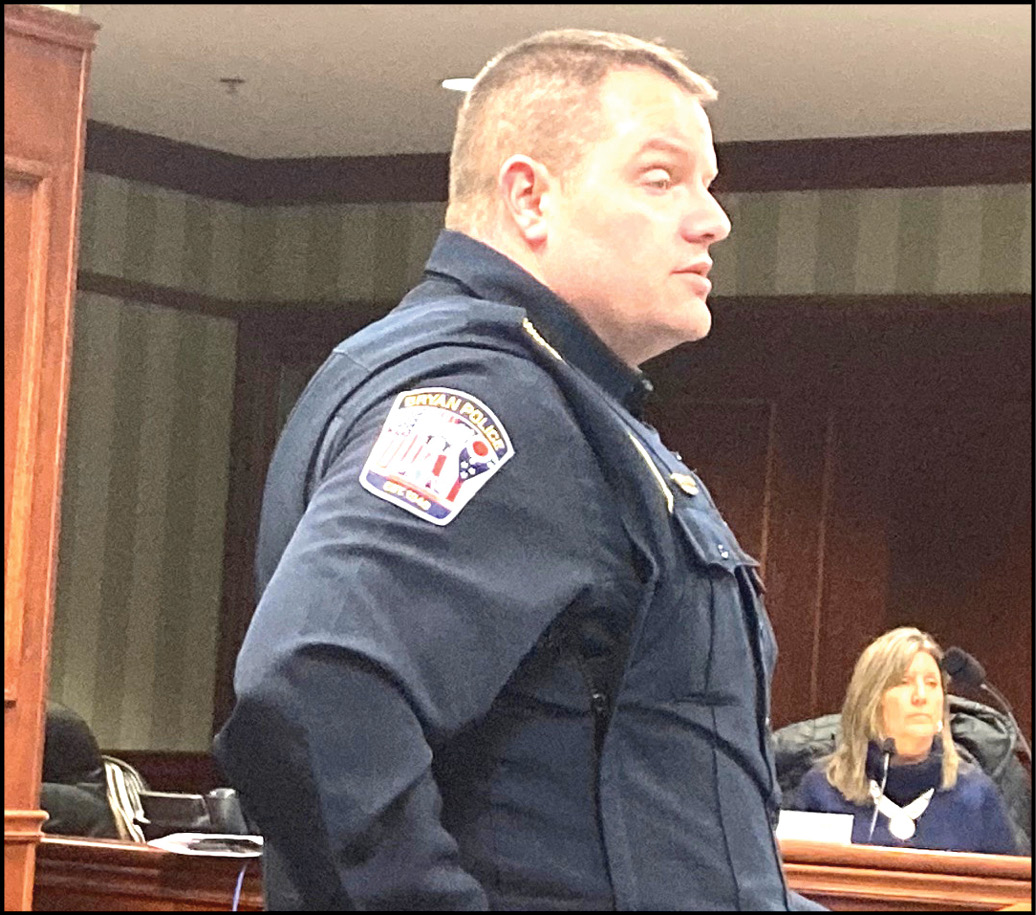
ANNUAL REPORT … Bryan Police Chief Greg Ruskey (above) gave the 2025 annual report at the Bryan City Council meeting on Monday, March 2.
By: John Fryman
THE VILLAGE REPORTER
john@thevillagereporter.com
Bryan City Council met in regular session on Monday, March 2, and heard a financial request from Bryan Fire Chief Doug Pool concerning repairs for the fire department’s tower truck.

Council members Mary Leatherman, Richard Hupe, Jim Kozumplik, John Betts and Steven Alspaugh were in attendance. The Pledge of Allegiance was recited followed by the approval of the February 16 meeting minutes.
Following approval of an ordinance for annual appropriations for the fiscal year ending December 31, 2026, and declaring it an emergency, Pool then addressed council on repairs being done on the fire department’s 1994 tower truck.
Pool had previously alerted council during the fire department’s annual report that more expensive repairs to the tower truck were possible.
“We sent it down for the first repair, and they looked at it, and came back saying, ‘yes, you need to do it,’” said Pool.
“The good news is not $30,000 or $40,000, but it’s about $20,000 for repairs. That’s what we’re looking at with this appropriation.”
The additional appropriation funds will be going towards installation of plastic slide blocks which control the ladder section on the tower truck, replacing the previous ones which have lasted for 31 years.
Pool noted the repairs are being done with the goal of having the truck back in service by mid-March. Kozumplik made the motion to approve the repairs with Alspaugh seconding it. It passed by a 5-0 vote.
Council also approved an ordinance providing the transfer of funds for the City of Bryan for the month ending March 31.
Clerk-Treasurer John Lehner said the transfer of funds would accommodate the closure of the refuse and recycling fund, the communications fund and communication capital fund.
He said the funds are no longer needed because those services are no longer provided, but the accounts still carry balances.
Lehner said the remaining balances in the refuse collection fund will be transferred to the street fund. The communications fund will go to the electric fund, and the communications capital reserves fund will go to the electric capital reserve fund. The total amount of funds being transferred is $4,143,345.93.
“We’ve asked Tyson Engstrom (Street Superintendent) and others to consider how that might be used since it’s a one-time influx of money to build it into some kind of one-time capital project, possibly an improvement to their building facility or something,” said Lehner.

Hupe made a motion for the transfer of funds for March with Kozumplik seconding it. The motion passed 5-0. Council approved a resolution to adopt the Williams County Hazard Mitigation Plan and declaring it an emergency.

Pool told council there is a requirement within Williams County to review this plan periodically.
“They have been asking for input from the city, emergency management, LEPC, having been involved with this process over the last six months,” commented Pool.
“We had input from the city where we’ve seen natural hazards within the county. They put together this plan with statistical data looking at populations, different hazard areas where the probability for natural disasters, windstorms, tornadoes, worst case scenarios, dam breaks, and they compile it all into one master plan. It requires an approval to accept it.”

Mayor Carrie Schlade gave a brief update on the progress for the city and county to move toward the next generation 911 service.
Under the next gen system, if a cell phone call for service is made within the city, it will go to city dispatch. If it’s a medical call that needs Williams County EMS, the city would dispatch to county communications.
Discussions have been centered on potential costs for the county and city due to needed software and other equipment, and whether it would be best to consolidate operations into one center run by the county.
“What I want you to hesitate about is that those numbers are very preliminary and not 100 percent accurate, especially the estimates and costs,” Schlade told council members.

Schlade and other city officials have met with the county commissioners and staff of county emergency communications in recent weeks to discuss the process.
“One thing that we did discover is if we relinquish our PSAP (public safety answering point), in order to get it back we would have to get permission from the county commissioners,” she commented.
“Long term, I don’t know if that’s the best option for our community. That’s something we must take into consideration.”
Police Chief Greg Ruskey presented the 2025 annual report of the Bryan Police Department.

Ruskey reported the department investigated 264 vehicle crashes, just 10 fewer than 2024. Officers issued 563 traffic citations for both adults and juveniles. Of all traffic stops, approximately 48 percent resulted in citations while 52 percent resulted in warnings.
There were 416 criminal arrests made, and the department received 8,821 calls for service, which included traffic stops.
Police dispatchers took 9,202 calls with Thursday, the busiest day of the week, reaching just over 1,450 calls received. The busiest time of the day continued to be from 2 p.m. through 4 p.m. with 1,179 calls taken.

Ruskey noted the police department currently has nine marked and four unmarked vehicles in its fleet.

Last year, the department tallied 122,003 miles using 9,133.20 gallons of fuel at a cost of $24,577.16 along with a maintenance cost of $15,006.88.
The police department was also awarded two state and federal grants totaling $11,662.63 in 2025. The department used the grant funding to purchase body-worn cameras and bulletproof vests.
Wastewater Superintendent Wes Wygant presented the 2025 Wastewater Treatment Plant report to the council.
Wygant updated on the wastewater treatment plant project which is going on. He said the project involves construction of a new thickener tank, new chemical building, new control building and new aeration tank.

He added that the current thickener tank was built in the 1940s and repurposed in the mid-1980s. He said the repurposed part is performing well, but the shell is falling apart around it, so they are replacing it.
Last year, the wastewater treatment plant operated with a total flow of 525 million gallons of water for a daily average of 1.4 million gallons per day.
They also handled 1.8 million gallons of digested class B solids dewatered, creating 227.82 tons of dry bio-solids.
Water treatment efficiencies included 94.5 percent removal of suspended solids, 97.8 percent removal of carbonaceous biochemical oxygen demand, 98.6 percent removal of ammonia nitrogen, and 90.9 percent removal of phosphorus. The cost of treatment per gallon was two cents.

Council then went into executive session with City Attorney Marc Fishel to consider the purchase of property for public purposes, the sale of property at competitive bidding for the sale or other disposition of unneeded, obsolete, or unfit property. No action was taken.
The next meeting of council is Monday, March 16, at 5:30 p.m.
For more local news, see Tornado Watch Issued For Williams & Fulton Counties Until 11:00 p.m..