

 PROJECT UPDATES … Paul Hanson and Mitch Smith from CESO Architects and Engineers outline details of a trip generation analysis performed at the intersection of South Defiance and Lafayette Streets.
 PHOTOS BY AMY WENDT / THE VILLAGE REPORTER
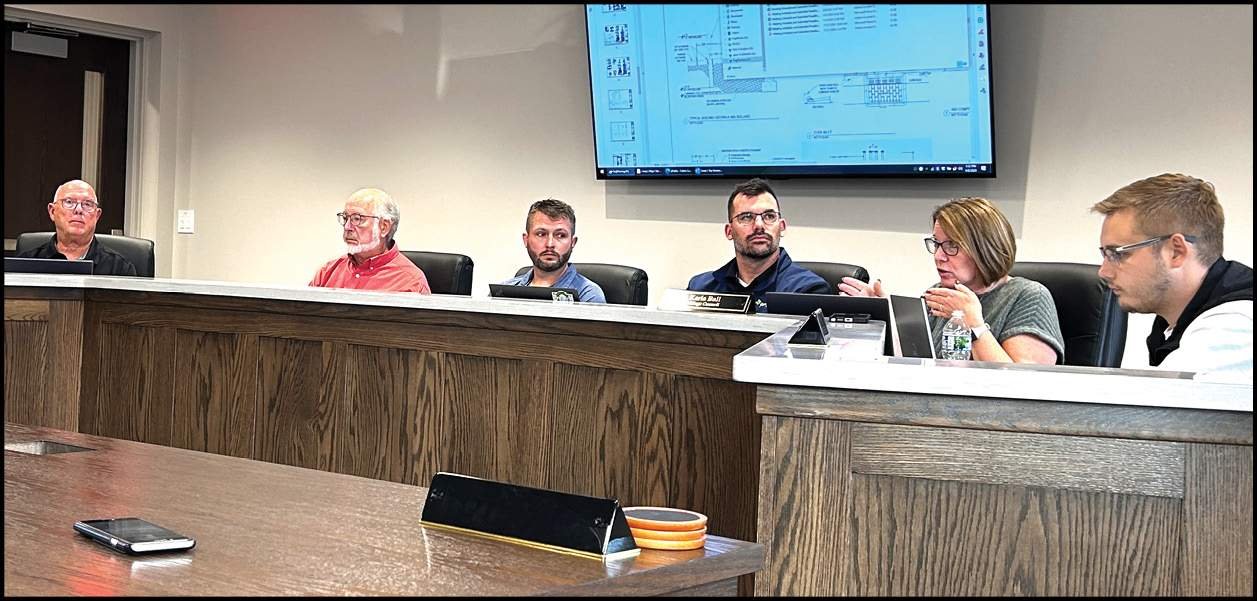
PLANNING COMMISSION … Left to right: Mayor Brad Grime, Steve Sauder, Trevor Meyer, Mike Evans, and Village Council Member Karla Ball comprise the Archbold Planning Commission. Grant Schaffner, on the far right, serves as the village’s Planner and Zoning Inspector.
By: Amy Wendt
THE VILLAGE REPORTER
amy@thevillagereporter.com
On Monday, September 8, the Archbold Planning Commission held a second public hearing for the major site plan review for Casey’s to construct a new 24-hour gas station and convenience store at 705 South Defiance Street.
Commission members, Mayor Brad Grime, Steve Sauder, Trevor Meyer, Mike Evans, and Village Council Member Karla Ball were present. Planning and Zoning Inspector Grant Schaffner and Village Administrator Aaron Alt were also in attendance.
The public seating area was nearly full, as many residents turned out to express concerns about the new business to be built at one of the busier intersections in the village.
Addressing formalities, on a motion by Karla Ball, seconded by Trevor Meyer, the commission approved minutes from the July 14, 2025, public hearings, which included variance requests for Fairlawn Haven as well as the first site plan review for the Casey’s store.
At the first public hearing on the Casey’s matter, an approval from the planning commission was put on hold to allow Casey’s and the village time to discuss issues and concerns brought up at the meeting.
The store is planned for the southwest corner of Lafayette and South Defiance Streets, positioned directly across from St. John Christian Church.
With the proximity of the high school and elementary school buildings, as well as the Memorial Park Ball Fields, the intersection experiences increased traffic depending on the time of day.
The storefront would face Defiance Street, and the proposed building is smaller than the average Casey’s location. Casey’s does not own the land; rather, it is leasing from a private developer.
The property, which is currently a large tract of grass, is zoned B-2, a classification that allows for general business and highway commercial uses, including both gas stations and convenience stores.
Before the commission proceeded with the hearing, commission member Mike Evans swore in representatives from Casey’s as well as village officials who would be speaking.
Planning and Zoning Inspector Grant Schaffner opened with a summary of concerns from the July 14 meeting and gave an update on changes to Casey’s site plan, including an increase to the frontage distance from the right-of-way and a revised traffic flow summary for commercial vehicles.
Paul Hanson and Mitch Smith from CESO Architects and Engineers took a moment to share further details and noted a trip generation analysis by the firm revealed 147 vehicles pass through the intersection on an average weekday afternoon and 128 on weekday mornings, which, according to the firm, is “far below the threshold for a full-blown traffic impact study.”
Hanson elaborated that the store is designed to capture “pass by” traffic, and it’s “a great location in town to serve the residents.”
Later in the meeting, it was clarified by CESO staff that the trip generation analysis was based on historical statistical data and not an actual count at the intersection.
Schaffner then read a letter from Village Engineer Dexter Krueger, who was unable to attend:
“After reviewing the trip generation summary that was submitted for the proposed Casey’s development, we agree with the conclusion that the forecasted trips generated from this will not cause a significant impact on the surrounding area or the nearby South Defiance and Lafayette/West Barr intersections.
“Allowing full access off of Lafayette Street will actually alleviate some traffic from the intersection, as westbound vehicles can use the Lafayette entrance/exit and avoid the intersection altogether. We also see no issues with allowing full site access to South Defiance Street.
So with that, the staff recommendation would be to approve as submitted with the following contingencies upon the final design that it meets all of Archbold zoning and engineering requirements, and continued collaboration with engineering staff to determine best practices for connecting to existing utilities, and then any additional conditions set forth by planning commission, with no limitations to access.”
Schaffner explained the anticipated traffic flow and said that to avoid turning Burke Street into a busy cut-through, it is recommended to maintain full access at Lafayette Street.
One Burke Street resident spoke up, expressing that Burke Street is already overwhelmed with traffic, especially during school, sports events, and factory rush hours. “It’s an accident waiting to happen,” she added.
After another resident pointed out additional traffic concerns, Schaffner responded, “The concerns are heard and noted, and obviously taken serious by all of us, which is why we’ve reviewed this (site plan) extensively.
“This is a by-right use, meaning that the parcel of land is zoned to allow for it to be developed as a gas station, or however the owner wants it to be developed. In this situation, they want it to be a gas station.”
“Casey’s feels that they have enough traffic and trips through there that they can run a successful business out of that intersection, knowing that there’s other gas stations in town,” Schaffner continued.
“Our goal is here is to make the best out of that situation, as just in most cases, we can’t tell them otherwise, because it’s zoned appropriately to be developed as a gas station.”
Mayor Brad Grime invited Casey’s rep, Erik Nikkel, to weigh in on the residents’ concerns.
Mr. Nikkel explained that to ensure safety, the company is planning ADA-compliant sidewalks and potential cross-access with neighboring properties to help manage traffic flow.
While he acknowledged there will inevitably be interaction between vehicles and pedestrians, especially children, he emphasized that Casey’s typically builds stores at busy intersections because their business model depends on being located where traffic already exists.
He also pointed out that Casey’s has a strong presence in other small towns, with over half of its nearly 3,000 stores in communities under 5,000 residents.
He added that the company is a community partner, citing their support for local schools, sports teams, and area chambers of commerce. Nikkel emphasized that Casey’s is not just a “big corporate” chain, but a brand that intentionally invests in smaller towns.
“I live in a town of 8,000 just outside of Des Moines, Iowa. We have three Casey’s in our town and everybody loves it,” Nikkel added.
An audience member asked Nikkel to clarify the size of the town where he lives and how many gas stations, not including Casey’s, are located there.
Ball interjected, “I just want to say, I think that something that we might be getting a little hung up on is the fact that it’s Casey’s.
“Understand that it could be any gas station. The way that this property is zoned is what – what we have to be looking at to approve or not approve this (site plan).”
She added that she understands the traffic concerns at the proposed location because she drives through the intersection every day on her way to work.
“But I just want to make sure you guys understand that this property that is owned was sold.
“And as long as whatever those developers decide to put there to fit into the way that this property has been zoned – which was set long before any of us that are sitting in these chairs – made that decision – okay?”
Ball continued, “So, however that zoning was set in place, long before us, our job is to just make sure that what is brought to us fits in that zoning code and dots all the I’s and crosses all the T’s.
“And if it does, you know, the amount of traffic that flows through there is really outside of what we’re – what our responsibility and job is here.”
Another resident raised the question of whether or not there were any restrictions on the sale of alcohol near schools and churches.
Village officials explained that there is no statewide prohibition on the sale of alcoholic beverages near schools or churches; however, there are restrictions on certain types of advertising for those items.
An audience member asked a different question about alcohol sales, noting that he recollected that a previous ballot measure for Discount Drug Mart, which had once planned to build on the same property, failed.
He asked whether a similar restriction would change the company’s decision to build a store at the proposed site. The Casey’s representative responded that while he couldn’t say in this instance, the company would have to “rerun the numbers.”
Administrator Alt clarified that Discount Drug Mart did hold a liquor license. Multiple individuals present at the meeting recalled a past ballot petition for Sunday sales on behalf of the store being rejected by voters.
However, according to the Fulton County Board of Elections website, on November 6, 2018, Archbold voters passed a “Drug Mart – Sunday Sales – A/3” measure with 311 (53.07%) in favor and 275 (46.93%) against the issue.
In the upcoming November 4, 2025, election, there will be a measure for voters to approve Archbold Three District – “Sunday Sale of Wine and Mixed Beverages, Off-Premise Sales” on behalf of Casey’s Marketing Co., DBA Casey’s General Store #5152, according to the Board of Elections website.
Village council member Chad Kern, who was not officially a part of the proceedings but was sitting in the audience area, addressed the room.
“I think most people here agree, we don’t want a fifth gas station. It’s the location that we have an issue with. Casey’s is not an issue with us at all.”
“And even the board members, I think, if you could talk to them individually, they don’t like this idea, but the problem is, they can’t fight it,” Kern continued.
“This has been fought twice in the state of Ohio by communities, and both times they lost, and the village or cities lost millions of dollars in legal fees. So all they can do is make it the best they possibly can for all.”
Later in the meeting, Administrator Aaron Alt confirmed Kern’s statement. “We’ve heard from the property owner, though – that denying of the rights that they have by (the village) exceeding the zoning codes – I mean, Grant and I have spoken to him directly – they (the property owner) have sued (in the past),” Alt stated.
“I’m not talking Casey’s,” Alt clarified. “Casey’s is working out a landlease…but because they’ve exceeded the zoning code, he’s (the property owner) reminding us that, you know, the next stop, if you’re denied, you take it to court. And that’s what Chad (Kern) was sharing.”
Alt continued, “They’ll go to court. They’ll sue Archbold. We’ll spend millions of dollars fighting it, plus settlements, and then they won’t exceed the zoning code.
“They will meet the bare minimum that the court allows them or requires them to do to put up the station, meaning it won’t look as nice. I can promise you that. That’s a challenge.”
Schaffner added on behalf of Casey’s, noting that the company has gone far beyond the minimum requirements.
“To be fair to Casey’s and the engineering staff, they have exceeded our code in every aspect. When it comes to landscaping and site design, we requested that they install a sidewalk on the front. “They weren’t required to do so.
We requested the landscaping alterations that they weren’t required to do, that they committed to. “Sounds like there might be a condition of planning commission to get a local contractor to maintain the property.”
Schaffner continued, “They’ve exceeded our expectations in our codified ordinances in every turn. I mean, personally, other than a few of the local companies that I’ve done site plans for, they (Casey’s), in terms of meeting expectations and being simple to work with, they’ve met every one of those goals.”
Another resident spoke up to voice his disappointment with village officials. “I would say just the frustration comes from somehow, whatever administration let that property get out of Archbold’s hands. Somebody severely screwed up.”
Alt explained that when the property went up for sale years back, the village was not aware that the land was on the market.
Additionally, the sale price was over a million dollars, and the village would not have been in a position to purchase real estate at that cost to taxpayers.
A second audience member then questioned why the village had not considered purchasing the property for an expansion to Memorial Park.
He also suggested Casey’s consider alternative sites in town to avoid traffic and pedestrian issues while providing ample parking.
Schaffner acknowledged the concerns but explained that individual property rights limit the village’s options.
While the municipality can regulate zoning, it cannot force a developer to sell land to Casey’s or prevent Casey’s from purchasing a property that fits zoning requirements.
The mayor asked if a lease had been signed, and Nikkel confirmed that while there is an agreement, the lease has not yet been fully executed, and the project will only move forward once all due diligence is complete.
Mayor Grime shared his concerns about property maintenance, particularly because the site is near a residential area, requesting that landscaping and upkeep be handled by local contractors to ensure accountability.
The Casey’s representative responded that they use regional vendors for landscaping, but agreed to work with local companies when possible if the village could provide a list.
The evening’s discussion went on to address a broad range of community concerns, including intersection safety for school children, insurance liability, signage type and location, access to Memorial Park, trash control, lighting and noise issues, and the potential impact on school busing. Potential future residential development in the village was a part of the conversation.
After all questions were addressed, Mayor Brad Grime proposed approving the Casey’s site plan with the stipulation that the company employ a local contractor for landscaping and maintenance.
Meyer made a motion to approve the plan, which was seconded by Sauder. The motion was approved unanimously by all commission members.
Before closing, a resident asked when construction might begin on the Casey’s site.
Nikkel explained that timing depends on completing the approval process and obtaining necessary permits from Wood County, but construction could start as early as six months. Schaffner noted that the site plan approval is just the first step in the process.
With nothing further, the meeting adjourned at 6:10 p.m.