
 PHOTO BY BRIANNA BALOGH / THE VILLAGE REPORTER
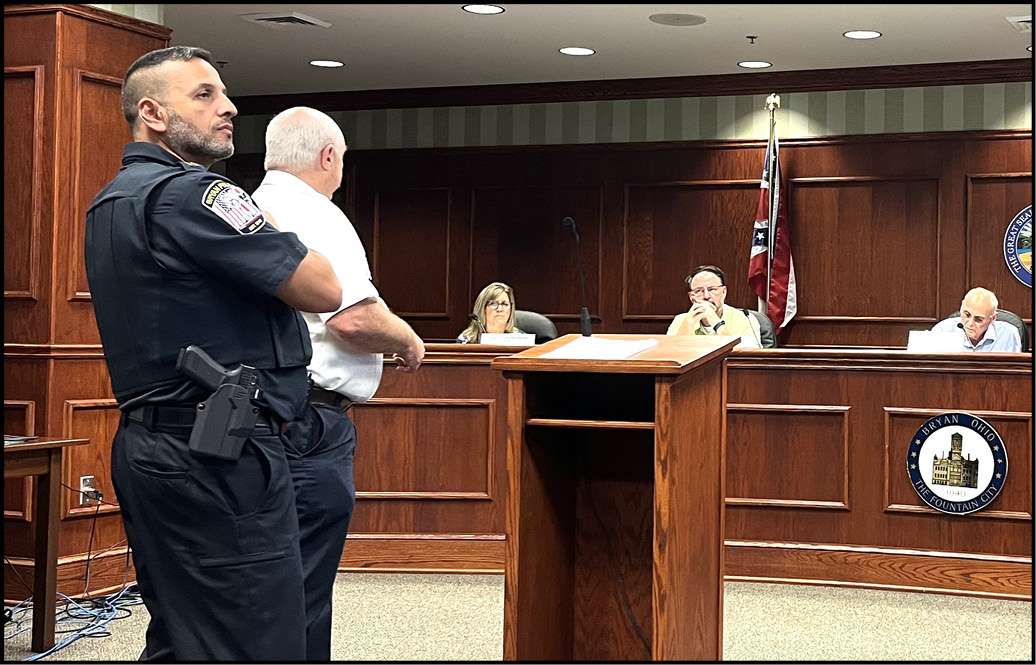
DISPATCH DEBATE … Police Captain Jamie Mendez (foreground) and Fire Chief Doug Pool address the Bryan City Council, answer questions and present details on the proposed Next Gen 911 dispatch system.
By: Brianna Balogh
THE VILLAGE REPORTER
publisher@thevillagereporter.com
Meeting on Tuesday, Sept. 8, the Bryan City Council entertained the expansion of the DORA district, held the first reading relating to the Next Gen 911 communication proposal, and approved a building permit for the North Annex building.
Getting straight into business, President F. John Betts called the meeting to order promptly at 5:30 p.m. The meeting started with the Pledge of Allegiance followed by an immediate motion to excuse Jim Kozumplik from the meeting.

Mary Leatherman moved to approve and Stephen Alspaugh seconded with all members passing the motion. All other members were in attendance, including Mary Leatherman, Stephen Alspaugh and Richard Hupe.
Also in attendance were Mayor Carrie Schlade, Clerk-Treasurer John Lehner, Fire Chief Doug Pool, Police Captain Jamie Mendez and a few other community members.
Moving straight into the agenda, Mayor Schlade spoke at the public hearing to expand the downtown DORA, designated outdoor refreshment area. The expansion being requested would expand to include the Gallery located at 317 W. Butler St., which is approximately 40 to 50 feet further than the current boundary.
A new map was provided in the ordinance packet, and no other changes would occur. The Gallery does not have a liquor permit and would not be serving alcohol, just allowing the drinks to be brought in. Schlade added that no residential areas would be included in the expansion. There was no public input on the matter.
Betts continued on with the agenda, asking for a motion to approve the meeting minutes from the previous meeting. Leatherman moved to approve with a second from Alspaugh, and all members approved.
Public participation followed with Steve Cox continuing a conversation from the previous meeting about street sweeping on Huntington Drive.
Cox reported there had been no street sweeping since July. Schlade verified she would contact the appropriate individual in the street department to get this taken care of.
Ordinances Pass As Emergencies
From public participation to government decisions, the meeting directed its attention to the bulk of the agenda, ordinances. First was Ordinance 41-2026, numbered and read by Lehner.
The request was not only for annual appropriations approval but also for declaring an emergency.
Lehner explained that this ordinance correlated to a residential fire occurring in 2025, where the city holds a portion of the insurance funds until the area is completely cleaned, repaired or demolished.
The $46,000 represents the insurance proceeds being released to the homeowner; the funds are from the owner’s insurance payment.
Hupe moved to declare an emergency and Alspaugh seconded. Leatherman moved to approve and Alspaugh again seconded. Both motions were approved unanimously.

The DORA expansion ordinance, 42-2026, followed. This ordinance was also being declared as an emergency. Schlade ensured that she would get the paperwork filed with the proper entities, communicate with the Chamber of Commerce so they could update maps, and when asked by Betts, she would also get with the street department to move any required signage.
Alspaugh asked about the neighbor’s opinion, to which Schlade answered that by law they had done their due diligence in holding a public hearing on the matter.
Hupe inquired if additional readings of the ordinance should be done. Schlade clarified that she believed the driver of this request was that people may have already been bringing DORA cups over into the Gallery and were being turned away because by law they were not allowable.
Schlade stated, “People are pretty responsible with the DORA and that has been shown.” Hupe moved to declare an emergency with a second from Leatherman.

Alspaugh then moved to approve the ordinance, seconded by Leatherman again. Both the emergency declaration and the motion passed.
Lehner continued with Ordinance 43-2026, prohibiting sleeping and camping on city-owned property and right of way.
Mendez spoke on this issue, stating that while they do not like to have to pass an ordinance such as this, it has been an increasing problem, and this is something many cities are utilizing.
Mendez noted he was concerned originally with some of the language, but clarified there would be police discretion and common-sense exceptions, like taking a baby to the park on a blanket or the Boy Scouts camping out to monitor the barn fest fire.

This is to deter some of the increased crime activity and frankly sanitation issues that have been encountered recently, Schlade added.
Both Schlade and Mendez emphasized that this was not to discriminate against anyone, but public safety and the safety of the parks have to be protected for local families.
Again, this ordinance was declared an emergency, moved by Alspaugh and seconded by Leatherman. Hupe moved to approve with a second from Alspaugh. Again, both motions passed unanimously.
Next Gen 911 First Reading
The next topic of discussion was the first reading of an ordinance to enter into an agreement with Carbyne APEX to provide Next Gen 911 services for the Bryan Police Dispatch in compliance with state requirements, a matter that had prompted numerous questions, comments and concerns in recent days, including some contentious social media posts the Friday before the meeting.

Both Mendez and Pool presented the details and addressed council members’ questions as thoroughly as they could.
Mendez briefly explained that APEX is a cloud-native, Next Generation 911 (NG911) call-handling platform, through the Bryan Police Dispatch.
This will also help decrease the wait time by allowing several different groups to talk at the same time.
Of the two options, the cloud-based services required less equipment to start up, were more economical and were more convenient if an emergency would shut the building down than in-house computer systems.


The state is not requiring a specific system but is requiring a Next Gen 911-compliant system. The system can be fully integrated with the state within 90 days.
Pool stated, “There was a lot of concern that we were actually looking to get rid of dispatch and we heard a lot of input back that they did not want to see us get rid of dispatch.
“They are very happy with what the city dispatchers are doing. They do something completely different than what the county does, both organizations are needed. They both do phenomenal jobs.
“They’re all professionals. It’s just that one-on-one, face-to-face that the city provides for the citizens of Bryan, that’s really what they wanted to maintain.”
The biggest questions asked by the council surrounded call times, staffing, resources and financial burden.
The agreement would see the City of Bryan operate its own call center through a PSAP, Public Safety Answering Point. Currently, landline calls are routed through Bryan Dispatch and cell phone calls are routed through Central Dispatch.
With this proposal, all calls within the city of Bryan, landline and cell phone, would go through Bryan Dispatch.
Pool explained that having in-house dispatchers allows them to monitor several different channels or talk groups through this service, which could include fire, police, or EMT, and route correlating calls accordingly.

He used the example of a car accident, which may include responses from several departments and can escalate and change very quickly, and it’s vital for the dispatcher to have that constant contact and be able to relay that information effectively.
With a switch to central, that information would be fed to the dispatcher from the central call taker, losing that key element.
Pool added that Next Gen 911 will be taking care of a lot of the physical hardware problems they are experiencing. Some of the equipment is outdated or obsolete.
The response time is one of the largest community concerns, as expressed by several council members. Pool noted that the goal is to keep response time within 20 seconds of the call coming in. He feels this proposal will ensure they continue to meet or exceed that goal.

Hupe asked about the requirement for two EMD, emergency medical dispatchers. Mendez clarified that Bryan Dispatch counts as one and Central Dispatch counts as one, even though they are not physically located on the same premises and are two separate PSAPs.
Pool added that several counties split their services in a similar way, with an automatic rollover as part of the Next Gen 911 system.
Cost And Control Questions
Before moving on, Hupe apologized if he put Pool or Mendez on the spot but stressed he wanted to avoid misinformation.
He reiterated that he wanted to hear it from them and make sure, when the decision is made, it is the right one.

Betts presented some questions from concerned residents that he had addressed to the best of his ability.
The financial portion, at around $200,000, seems to be high in a fast-moving technological world where this system could be phased out in two years.
He addressed the concern by emphasizing that there are some returns that cannot be monetized, like public safety and availability of emergency resources when desperately needed.
Betts stated that until public security can be guaranteed through a central system, he would not vote for it. Betts also added he found particular irritation with the control issue over the PSAP operation.

He summarized with a key question, “Am I gonna have a quicker, better response with our own dispatcher or not? Tell me or not, and why? I can’t make it any more simple or plain than that, or a challenge to whomever. Please come and let us know.”
Betts followed by emphasizing that the council has heard a wide range of viewpoints on the issue and is not relying on a single perspective.
He encouraged residents to continue directing any comments or concerns to council members.
Schlade noted that legal counsel had been contacted regarding financing, as well as recent questions, concerns and social-media posts that threatened to block the city’s ability to operate a PSAP.

She said that could bring up some Sunshine Law disputes or the dissolution of the very board responsible for blocking the PSAP.
She hopes to have a more definitive update by the next meeting, as the information was just received that Friday prior to the holiday weekend.
Pool clarified a little more on the financial piece, with a few key notes from Schlade. The initial payment would be for the software license for five years, equaling almost half of the full price.

The rest would be paid over those five years as a service-type fee for the cables and access.

Schlade added that consolidating and removing the Bryan City dispatch would cost around $30,000 to $40,000, which would be used in hiring after-hours call centers for street issues and alarms for elevators for the building.
Additional police staffing would also be needed to perform administrative work.
Not only would dispatch lose the obvious call response, but dispatchers also are trained as intoxilyzer witnesses for every agency in the county, deputized as municipal clerks typing charges for many municipalities, and can process bonds, saving the county bed fees at CCNO.
Leatherman asked about staffing and if an increase in call volume requires more dispatchers.

In anticipation of the move, as it is required to move from the current, outdated system, the police department reduced its officers to 20 in last year’s budget to allow for more dispatchers to be hired.
Mendez added that they are currently fully staffed and working through training, while a part-time hire is waiting to start training as they try to stagger actively training staff. The state is providing all required Next Gen 911 training.
While call volume cannot be predicted, both Pool and Mendez felt like the current staff would be adequate. The state sets the amount of call volume to require a second dispatcher.
Because of the call volume, one dispatcher with the ability to roll over to the second dispatch meets the state requirement.

In a few final points, council touched on the long history on this subject since Schlade’s tenure at least and the support of fellow community police departments for a city PSAP.
Council also thanked both Pool and Mendez for the work that has gone into this. The ordinance will have two additional readings before a vote, as no emergency was declared.
Loan For Bill’s Locker Room
Betts continued, asking Lehner to number and read Ordinance 45-2026, which accepted the recommendation of the Revolving Loan Committee.
The ordinance authorizes the mayor to enter into an agreement with Jinx Holding, LLC; Yahraus, Inc.; and Ryan R. Jinks and Karen A. Jinks. Schlade explained, “We were approached by Dennis Miller of Maumee Valley Planning and asked to provide RLA funding in the amount of $203,000 for this retail.

“The sale itself, the total we were given was $530,000. We typically do not go this high on retail but we are allowed by the state to go up to 40%, so we are within that frame.”
She continued, “We feel that Bill’s Locker Room had a lot of history. We feel that Ryan Jinks has a lot of history with Bill’s Locker Room.
The intent is for him to maintain all the current employees there.” The funds are technically state funds and are being used to keep a long-running, historically rich business in the downtown storefronts.
Schlade also clarified, after Betts asked, that the state likes a minimum balance and the fund is currently at twice that amount.

Hupe moved to declare an emergency, with a second from Alspaugh. Alspaugh then moved to approve, after the emergency declaration was passed, and Leatherman seconded. The ordinance was passed.
North Annex Building Permit
The final item on the agenda was a building permit for the North Annex building, located at 677 N. Main St. Planning and Zoning Administrator Andy Waterston explained he had the final permit for the Williams County Commissioners.
Siebenaler Construction is doing the work; the project is zoned as C2, construction type 2B, state use group B, and the cost is $1,339,950.
This is mostly interior renovation for office space with the addition of a small elevator and restroom, only about 155 square feet of additional space.

Betts clarified the elevator was for ADA compliance, and Waterston confirmed there was previously no elevator.
Hupe asked for clarification on the building permit timing and whether they were granted permission to start the process while plans were still in approval with the state.
Waterston clarified that a partial permit was issued by the state in November and he issued a partial permit on Nov. 21, 2025, giving permission to get started.
The details took longer than expected. This approval is for the full building permit, which must come from the council.

Hupe moved to approve and Alspaugh seconded. The motion was passed. The final motion was to adjourn, made by Alspaugh and seconded by Leatherman. The motion passed, adjourning the meeting at 6:40 p.m.
The next Bryan City Council meeting will be held Sept. 21 and will hear the second reading of the Next Gen 911 ordinance.