
 PHOTO BY AMY WENDT / THE VILLAGE REPORTER
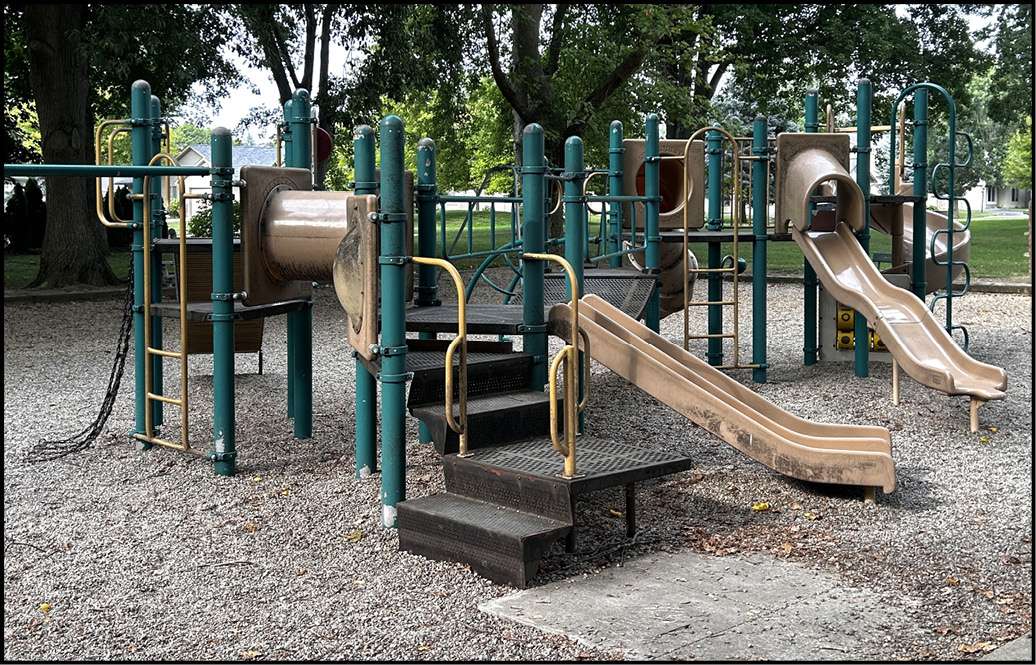
RUIHLEY PARK … Officials from the Village of Archbold plan to focus on upgrades for Ruihley Park in 2027, which will feature updated playground equipment.
By: Amy Wendt
THE VILLAGE REPORTER
amy@thevillagereporter.com
The Archbold Village Council’s Parks Committee held a work session on Tuesday, Sept. 8, immediately following the regular council meeting. Those present included Archbold Village Council members Gary Dominique, Mike Evans and Aaron Babcock, as well as Mayor Brad Grime and Village Administrator Aaron Alt.
Parks and Recreation Department Director Jen Kidder was also on hand to take part in the discussions.

Councilor Dominique called the work session to order at 6:07 p.m. The objective for the meeting was to discuss a pledged donation from the Archbold Rotary Club, ballfield maintenance and Ruihley Park playground improvements.
ROTARY CLUB SERVICE PROJECT DONATION
The first item discussed was a pledged $10,000 donation from the Archbold Rotary Club toward constructing a shelter either in the newer baseball diamond expansion in Memorial Park or as part of improvements at Ruihley Park.
Considering the baseball diamond area first, Parks Director Kidder explained that, ultimately, the long-term plan for the ball diamond expansion area includes a total of four ballfields, additional shelters, a concession/restroom facility and gathering areas.
The new ball diamond area is situated due west of the original four-diamond complex (Diamonds 1-4), known for hosting both Parks programming and Archbold High School varsity baseball and softball games.
Currently, the new expansion area comprises two ballfields, Diamond 5 and Diamond 6, and additional improvements will be added as funding becomes available.
Over the last two years, several trees have been planted in the new area with help from the Lions Club.
With the contribution from the Rotary Club and additional revenue generated from tournament admissions, Kidder advised that there will be enough funds to build a shingled 12-by-14-foot or 12-by-16-foot shelter, which is large enough to hold approximately two picnic tables.
Kidder pointed out that a shingled roof is preferred over metal sheets, as baseballs can dent metal roofing.
Committee members discussed whether a larger structure would provide more useful shade and seating, and the location and orientation of the proposed shelter were also considered.
It was mentioned that, rather than placing the shelter on the third-base side of Diamond 5 as originally proposed, perhaps a central location between Diamonds 5 and 6 would be more ideal, as it would provide more shade for spectators of both ball diamonds.
The group also discussed whether an existing shelter located in the original ball diamond complex to the east could be relocated and utilized in the new expansion.
Kidder noted that the shelter was often used by families in its present location, and committee members determined that the shelter’s condition and the cost of moving would need to be evaluated.

The long-term possibility of adding concessions and restrooms to the new diamond addition was also discussed, with Kidder noting those facilities are a higher priority than multiple shelters since Diamonds 5 and 6 are heavily used, particularly during tournaments.
Committee members generally agreed to explore the feasibility of a larger, more centrally located shelter and clarify what size structure could be constructed using the $10,000 Rotary Club donation before moving forward.
Looking at upcoming Ruihley Park improvements, the committee also discussed potentially using the donation toward refurbishing the shelter currently housing the Civil War-era cannon.
It was noted that the existing structure was considered to be in fairly good condition, but the foundation and some of the surrounding concrete may need work.

Due to its location, the shelter would possibly tie in with the anticipated playground improvements at the Kiddie Corral playground.
Members discussed long-term layout and priorities for both park areas, and no concrete decision was made regarding where to apply the pledged donation from the Rotary.

BALLFIELD MAINTENANCE
Moving on to the next topic, the committee discussed the village’s costs and responsibilities for maintaining athletic fields used by the school district, particularly the high school baseball and softball fields.
Kidder provided the committee members with calculations showing the village’s labor and expenses for maintaining the high school fields as well as the youth fields primarily used for Parks programming.

Costs of operating recreation programs that use school facilities were also presented. Kidder pointed out that weather causes the totals to fluctuate from year to year, and she believed manpower costs were somewhat lower in 2026 because of excessive rainfall, which resulted in several cancellations.
Kidder said that the Parks Department benefits from the use of school property, including gyms, football and soccer fields for its programming, and she believed the overall exchange is relatively balanced since the village provides field preparation.
However, she also stated she did not believe the village should be responsible for all recommended improvements to the high school varsity baseball field, as those could be considered capital costs as opposed to routine day-to-day maintenance, and the village does not use that particular field for its programming.
The village and school have shared some maintenance costs such as mowing expenses. The school also currently contracts with the village for fertilizer and weed control on football and soccer fields.

Kidder added that the soccer field sees little use from Parks programming, and she also suggested Diamond 2 could possibly be treated as a shared responsibility because it is utilized by both the school and the Parks Department.
Village Administrator Alt expressed that his main concern is not only the dollar cost but the manpower required to maintain school fields, specifically weekend work associated with field prep that can result in overtime for village employees.
“My concern is, we’ve got to figure out a staffing model that keeps overtime down for Steve and the maintenance crew…So, I don’t know if that’s a seasonal staffing thing that we have to look at…” Alt added.
Councilor Babcock contended that the varsity fields should be maintained by the school, noting that the Parks youth programs have historically helped develop athletes who go on to participate in school sports.

“I’m not going to disagree with you on the baseball field by any means,” Councilor Evans agreed.
Councilor Dominique suggested that the school identify specifically what work it wants performed on the varsity fields and provide costs so the village can determine how much, if anything, should be included in the village budget.
Discussion also touched on the new Miller Athletic Complex (MAC) annex, which sits on school property and was donated for student-athlete and community use.
Members questioned how it would be used by Parks programs and how access to the complex would be managed.

No formal arrangements or agreements between the village and the school were decided upon during the meeting, as the discussion was intended to get a clearer picture of the village’s investment and gather objective cost information for future discussions.
RUIHLEY PARK IMPROVEMENTS
The last discussion of the evening returned to Ruihley Park, this time focusing on proposed upgrade options to the Kiddie Corral playground located near the Scout Cabin.
The playground is estimated to be more than 30 years old, and the plan is to refresh Ruihley Park overall and replace the present playground equipment.
Playground proposals range from $250,000 to $450,000, and all include company-supervised installation, with village staff and volunteers doing much of the construction, as was done with previous playground projects at Memorial Park, Woodland Park and North Pointe Park.

By using village staff and volunteers for construction, labor expenses can be reduced, allowing for a more extensive equipment package to be considered.

All proposals were designed to accommodate both ages 2-5 and 5-12, replacing the current playground’s limited 2-5-year-old equipment.
A loose-fill wood-fiber mulch surface was included in each design, and Kidder explained that mulch is preferred over a poured-in-place surface like the one at Woodland Park, since it is easier to maintain and there are no costly repairs.
Rather than constructing one large picnic shelter in the area, Kidder suggested the design include several individual picnic tables with shade structures, allowing families and smaller groups more flexibility.

She said she would like to see additional places for people to sit and relax as well.
Members noted that the existing shelter currently housing a Civil War-era cannon could be repurposed and incorporated into the redesigned space.
Kidder recommended the committee consider the $250,000 to $350,000 options, noting a project in that range could still provide a much-improved playground for families to enjoy.
The group considered whether the playground could be shifted toward the middle-school side of the park. Due to the increased traffic on Holland Street, a more substantial fence would likely be needed in that area.

It was also pointed out that some of the park’s mature trees would possibly need to be cut back or removed to meet playground safety requirements.
Funding options discussed included village capital funds and Parks Department reserves, as well as a potential contribution from the Community Improvement Corporation (CIC).
Kidder shared that she had applied for a Land and Water Conservation Fund grant but was unsuccessful; however, she would continue to look for other grant opportunities.
The committee discussed other significant improvements needed at Ruihley Park, including work on light poles, buildings, bathrooms, the pavilion floors, sidewalks and trees.

After discussion, council members agreed to proceed with planning using approximately $350,000 as the target amount.
Kidder said the final design could be adjusted and that she would like to get input from local schoolchildren in choosing equipment and features.
The final project will also need to address related site improvements, including walkways, fencing and ADA accessibility.
Because the project would require significant volunteer involvement, construction would likely begin in the spring, and Kidder said the park would be without a playground for much of the construction period, so communication with residents is important early on.

The committee agreed that Kidder should begin to gather additional proposals based on the target cost.
By developing a more detailed plan and cost estimate, the village can determine how much money to earmark for the project.