
 PHOTO BY JESSE DAVIS / THE VILLAGE REPORTER
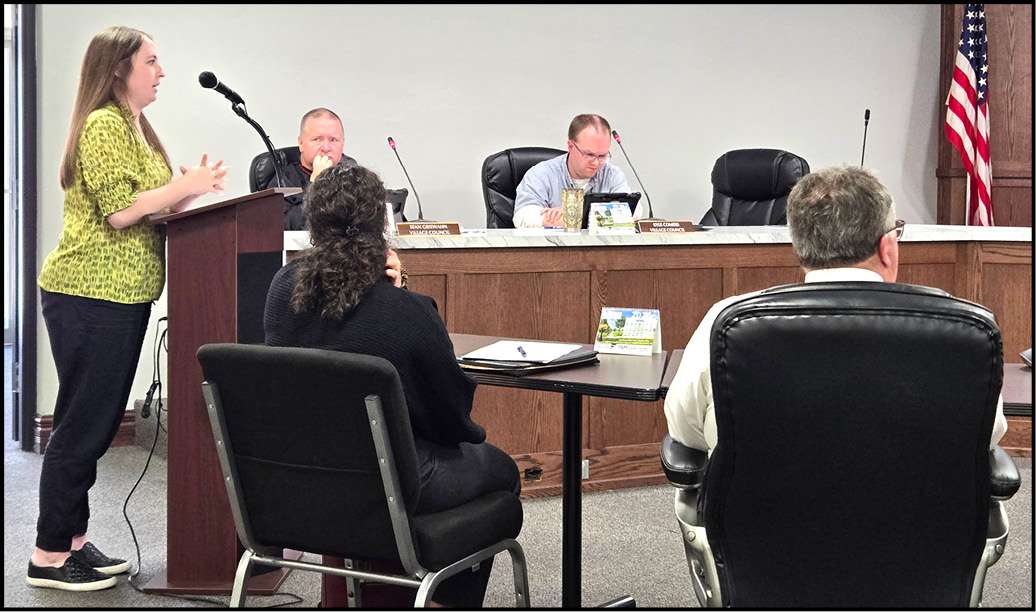
GETTING THE LEAD OUT … Maumee Valley Planning Organization Senior Planner Estee Blair gives an update on lead issues at the former Bunting Bearings site to the Delta Village Council.
By: Jesse Davis
THE VILLAGE REPORTER
jesse@thevillagereporter.com
Delta Village Council members heard an update on lead remediation efforts at the demolition site of the former Bunting Bearings facility during their meeting Monday.
Maumee Valley Planning Organization Senior Planner Estee Blair appeared on behalf of the Fulton County Land Bank, which controls the property along with Bunting Bearings.

According to Blair, the land bank and Bunting Bearings are under Ohio Environmental Protection Agency findings and orders that required, among other steps, the creation of a sampling analysis plan. She said that plan has now been created and approved by the OEPA.
The plan includes sampling of approximately 60 properties around the project site. Blair said letters have been sent to the owners of those properties explaining what they need to know.
The letters also include access agreement paperwork that must be signed by the property owners to authorize the activity unless they choose to opt out of the sampling.
“The sampling will be provided at no cost to the property owners. They will receive the results within two months after sampling, and then if there is any lead found on their properties it will be remediated within six months after sampling,” Blair said.
She clarified after a question from council that remediation will only occur if lead is detected above the safe limits set by the OEPA.
Blair said that as demolition of building three at the site approaches, Bunting Bearings will work through their decommissioning plan, which must be submitted to the OEPA for approval. She said additional testing is being done at the nearby school, and that any needed remediation will involve digging up soil to a depth of two feet for removal.
More information on the efforts as well as the sampling analysis plan and letter to property owners are available on the land bank’s website, located at mvpo.org/landbank.
RITA PRESENTATION
During a committee of the whole meeting prior to the regular council meeting, Regional Income Tax Agency Government Liaison Dawn Kuznik gave a presentation on the services offered by RITA, which is a governmental agency providing tax program administration including program management, collection, and legal support.
Kuznik provided a cost to the village for partnering with the agency, estimated to be between $37,986 and $41,985, or 1.74 percent to 1.92 percent of collections, with the village’s income tax collections estimated at just under $2.2 million.
She said the level of involvement as well as the extent of actions taken regarding problem taxpayers would be controlled directly by the council.
Other local municipalities currently using RITA’s services are Fayette, Liberty Center, Napoleon, and Swanton. RITA currently serves more than half of the state’s municipalities that have an income tax, with clients in 83 of Ohio’s 88 counties.
During the regular meeting, council members approved on first reading an ordinance authorizing the mayor to sign an agreement for RITA to administer the village’s income tax program. Councilman Kyle Comers cast the sole dissenting vote.

SEWER RATE INCREASE
Council members approved on first reading a reorganization of and increase to sewer fees for village customers.
Under the new rate structure, inside sewer rates for residential users as of Jan. 1, 2026, would increase to a $20 minimum fee for up to 100 cubic feet of sewage and $8.50 per each additional hundred cubic feet with an additional $3.78 combined sewer overflow service charge for the up to 100 cubic feet of sewage and $1.15 per each additional hundred cubic feet.

The minimum sewage fee would climb until Jan. 1, 2030, when it would peak at $31.88, with the remaining costs unchanged. The current inside residential sewer rate minimum is $13.34.
Inside sewer rates for commercial users as of Jan. 1, 2026, would increase to a $45 minimum fee for up to 100 cubic feet of sewage and $8.75 per each additional hundred cubic feet with an additional $3.78 combined sewer overflow service charge for the up to 100 cubic feet of sewage and $1.15 per each additional hundred cubic feet.

The minimum sewage fee would climb until Jan. 1, 2030, when it would peak at $71.73, with the remaining costs unchanged.
Inside sewer rates for industrial users as of Jan. 1, 2026, would increase to a $120 minimum fee for up to 100 cubic feet of sewage and $9 per each additional hundred cubic feet with an additional $3.78 combined sewer overflow service charge for the up to 100 cubic feet of sewage and $1.15 per each additional hundred cubic feet.
The minimum sewage fee would climb until Jan. 1, 2030, when it would peak at $191.27, with the remaining costs unchanged.
Outside sewer rates for residential users as of Jan. 1, 2026, would increase to a $24.50 minimum fee for up to 100 cubic feet of sewage and $12.75 per each additional hundred cubic feet with an additional $3.78 combined sewer overflow service charge for the up to 100 cubic feet of sewage and $1.72 per each additional hundred cubic feet.

The minimum sewage fee would climb until Jan. 1, 2030, when it would peak at $35.86, with the remaining costs unchanged.
Outside sewer rates for commercial users as of Jan. 1, 2026, would increase to a $90 minimum fee for up to 100 cubic feet of sewage and $13 per each additional hundred cubic feet with an additional $3.78 combined sewer overflow service charge for the up to 100 cubic feet of sewage and $1.72 per each additional hundred cubic feet.
The minimum sewage fee would climb until Jan. 1, 2030, when it would peak at $131.71, with the remaining costs unchanged.
Outside sewer rates for industrial users as of Jan. 1, 2026, would increase to a $351.24 minimum fee for up to 100 cubic feet of sewage and $13.25 per each additional hundred cubic feet with an additional $3.78 combined sewer overflow service charge for the up to 100 cubic feet of sewage and $1.72 per each additional hundred cubic feet.

The minimum sewage fee would climb until Jan. 1, 2030, when it would peak at $191.27, with the remaining costs unchanged.
Councilman Comers asked if there was a way to add a fourth rate level for enhanced industrial use to apply to businesses like Worthington Steel and NatureFresh Farms.
OTHER BUSINESS
Council members approved on final reading an annual memorandum of understanding with the Fulton County Department of Job and Family Services.
Council members approved on final reading an ordinance repealing a section of the municipal code barring the village from buying back cemetery lots.


At a previous meeting they authorized the village administrator to buy back unused lots at their original, lower cost for resale at the current price, and repealing the code section will allow that to take place.
Council members approved one ordinance on final reading and another on first reading the sale as surplus of unneeded village property.
Council members approved on first reading the village’s participation in the Ohio Department of Transportation’s road salt contract.
Interim Village Administrator Sam Chappell gave several updates, including that a part-time summer worker has been hired, a request for proposals has been issued for park and cemetery mowing contracts.

Also, military flags at the village’s east entrance have been replaced after funds were donated, that he would be joining the Fulton County Planning Board as the village’s representative, and that an application for a grant through T-Mobile has been submitted.
Chappell reported the administration is looking into the possibilities of updating, diversifying, and digitizing the village’s zoning permits and ordinances to, among other efforts, close some gaps. He said most of the ordinances have not been updated since around 2000.
He also provided information on a possible contractor who could help update the ordinances either in totality at a cost of roughly $25,000 or on a piecemeal basis.
Chappell reported the administration has applied for a grant to replace a broken generator at the village offices.

He said parts were previously bought to repair the generator at a cost of $3,000 but never installed due to a miscommunication underreporting the cost of a new unit.
Multiple subsequent visits have now raised the price to about $5,000 for additional parts and repair of the unit. He said a new generator would cost roughly $30,000.
In his duties as police chief, Chappell reported the department has received the ID maker that was ordered and that the department was involved in three Fulton County Special Response Team deployments.
The Delta Police Department will be hosting a “Keeping Our Girls Safe” women’s self-defense training on April 28 from 6:30 to 8:30 p.m.

The next regular meeting of the Delta Village Council will be held at 5:30 p.m. on Monday, April 20, at 401 Main Street in Delta.