 PHOTO BY JESSE DAVIS / THE VILLAGE REPORTER
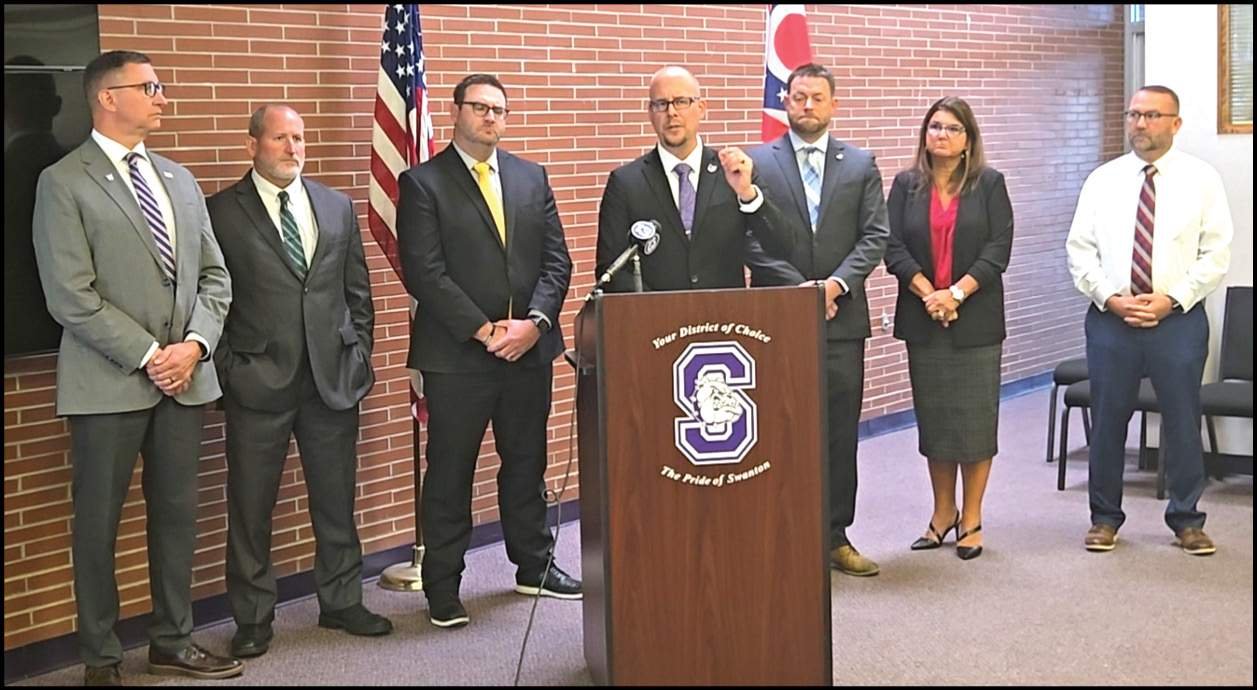
TAKING A STAND … Swanton Local School District Superintendent Chris Lake (center) speaks during a press conference Thursday on the possibility of school district consolidation in Ohio. He is joined by (from left) Wauseon Exempted Village School District Superintendent Troy Armstrong, Evergreen Local Schools Superintendent Eric Smola, Pettisville Schools Superintendent Josh Clark, Archbold Area School Superintendent Dr. Jayson Selgo, Fayette Local School District Superintendent Dr. Angela Belcher, and Pike-Delta-York Local School District Superintendent Doug Ford.
By: Jesse Davis
THE VILLAGE REPORTER
jesse@thevillagereporter.com
Superintendents of the school districts across Fulton County held a press conference Thursday morning after a letter they issued on the potential of district consolidation in Ohio sparked conversations throughout the community.
In the letter – which was shared and reshared across social media on Tuesday – the superintendents for Archbold Area Schools, Evergreen Local Schools, the Fayette Local School District, Pettisville Schools the Pike-Delta-York Local School District, the Swanton Local School District, and the Wauseon Exempted Village School District said state legislators were “systematically dismantling public education, piece by piece.”

They argued state money was being funneled to private schools with no accountability while 90 percent of the state’s students were attending public schools.
They also singled out Warren County Auditor Matt Nolan, who they said was summarized in an article to say competition between districts was driving up teacher compensation costs.
In response to local news inquiries regarding the letter, Swanton Local School District Superintendent Chris Lake reached out to the other superintendents to organize Thursday’s press conference. Lake also gave the initial, prepared statement.
In it, Lake said the state’s budget bill was “incredibly frustrating,” and that several parts of it targeted public schools and teachers.
He said they have, like all residents, “felt the burden of increased property taxes,” but that taking away the districts’ ability to raise funds was not a tenable solution.
“It has been apparent to all of us for some time that public schools are under attack in this state,” Lake said.
“The recently passed state budget saw the end of the fair school funding plan, a plan which for the first time tried to address the fact that school funding in Ohio has been deemed unconstitutional over two decades ago because of its overreliance on local property taxes.”
He said changes to the school funding structure was underfunding public schools by $1 billion, instead putting that money toward an unaccountable voucher program.
“A program which was just found to be unconstitutional by a judge here in Ohio,” Lake said. “In response to that court ruling, the state of Ohio has filed an appeal to preserve the program.”
Lake also lamented the inclusion of items “which hamper or completely eliminate the ability of public schools to raise revenues.”
“Governor DeWine vetoed many of these items, but Speaker [of the House Matt] Huffman and Senate President [Rob] McColley have vowed to overturn those vetoes to the detriment of public education,” he said.
DeWine also created a property tax reform workgroup to work on the issue of property tax relief in the state, and Lake said the superintendents want a seat at the table for their discussions, especially after workgroup members Nolan and Lake County Auditor Chris Galray started publicly floating the idea of school district consolidation.
“In particular, Lake County Auditor Chris Galray was quoted saying, quote, ‘I have the smallest geographic county in the state of Ohio.
“I don’t need eight library districts. We do not need 610 school districts in the state of Ohio, we need 94,’” Lake said. “Now we have heard rumblings of school consolidation talk over the last few months, but for the first time we have public acknowledgment that consolidation is a topic of discussion.
“It was for this reason that the Fulton County superintendents decided to write a letter to our communities.”
Lake said the tone of conversation in the legislature with regard to schools in recent days is “quite frankly, disturbing,” casting them as a drain on taxpayers and their communities.
“As [Pike-Delta-York Local School District Superintendent] Mr. [Doug] Ford pointed out this morning in our conversations, we’re the largest transportation entity in our communities, we’re the largest food service operation.
“We provide a valuable service, and they speak about us in Columbus as if somehow we’re the enemy, that we’ve created the tax problem,” he said.
Lake said the school districts didn’t ask to be funded through property taxes, and that they were just operating within the system created for them by the legislature.
“When you see that everything that they’re putting in in relation to property taxes is in some way about how do we eliminate a school’s ability to raise revenue, you know the natural talk would be well, if you’re gonna you know kneecap them where they have no money, well what are you gonna do with schools, they still have to operate. Well consolidation’s the next logical step, right?” Lake said.
He said now is the time to sound the working before residents “wake up someday and the public school that you knew is just gone.”
Lake was optimistic about future communication with legislators, pointing out that they had heard from McColley about meeting with them.
Speaking to The Village Reporter prior to the press conference, McColley said he is opposed to the “forced consolidation of our school districts.”
“Our school districts in many of these small communities, not only do they play a big role in the community identity and the sense of community and pride, and the history and tradition within that community but they also, in many cases, are one of the largest employers in that community,” McColley said.
“And so, a forced consolidation, would not be something I would support.” Lake latched on to the connection between schools and the communities in which they are located.
“When you travel across Fulton County, when you travel across northwest Ohio, when you enter these towns, what’s the first thing you usually see?
“You see a sign advertising the school district. Everybody in that town is using school colors in their storefronts. You could probably rob every house in northwest Ohio on a Friday night, because everybody’s gonna be at the football stadium, right, if there’s a home game. That’s what’s at stake, that individual town identity,” Lake said.
He said people identify with their schools, have shared experiences, walked the same hallways.
“There’s that shared collective memory and you know, if you’re gonna say well the best cost cutting measure is we’re just gonna consolidate all these schools, you lose that individual identity, your communities lose something special, and quite frankly you’re not going to get as good a product in terms of the education that we can provide to children. You’re just not,” Lake said.
He pointed out that some people move to the districts specifically because of the school district, and if all of Fulton County became one district that would be lost.
Archbold Area School Superintendent Dr. Jayson Selgo said they don’t believe consolidation is imminent, but that when they hear it is now being talked about, they view it with alarm, and that “perhaps we should be more vocal as leaders in our community and make sure that our citizens are aware of some of the conversations so we can have a more proactive approach to combat some of these things that we feel would be devastating to our local communities.”
“We are dominated by a lot of smaller schools,” Lake said, “and so if consolidation were to come it would be in the regions of Ohio that more smaller schools exist and that is northwest Ohio.”
Pike-Delta-York Local School District Superintendent Doug Ford said school districts are also discussing the changes in the determinations of state school revenue and how it impacts local school revenue.
“One of the things we’ve had to look at locally is diversifying our local revenue,” Ford said.
“Other than property taxes, we know that property tax reform is something we’d like to have a seat at that table to talk about, but one of the things we’ve done locally is diversity our local revenue with income taxes as well, and that’s something Pike-Delta-York is looking to do currently and will be on the ballot in November to try and diversify that local impact on our taxpayers.”
Lake said the superintendents understand the burden on taxpayers, and that the districts try to live within their means, sometimes foregoing things because they know not every levy cycle is going to be successful.
“We have, obviously, a property tax levy that we’ve renewed several times over the years. It’s stayed the same, it’s a fixed-sum levy.
“We have an income tax that we’ve renewed several times, but we’ve not gone out for new money because we’re always mindful there’s always a strain on voters. We feel it too.
“Like I say, we’re all taxpayers. I’ve been paying taxes in Swanton for 26 years. So, we’re very mindful of that, and again it really is a balancing act,” Lake said.
He said legislators have proposed a slate of bills that would eliminate certain types of levies entirely, as well as one that would require a 66 percent vote to pass a levy, which he said would be nearly impossible.
Pettisville Schools’ Superintendent Josh Clark said the districts are entrusted by the public with the responsibility to be good stewards of their finances and have daily conversations about what services to provide and which to forego in order to be responsible with the funds they do receive.
“We understand overall that in this story we’re not Goliath we’re David but it turns out David counties could be pretty powerful if they banded together and told the communities their stories,” Clark said.
“And that’s the goal for today, for this meeting today. We’re looking for a seat at the table. We’re looking to be proactive rather than reactive.
“And we’re looking to maintain that local control that is so vital for our communities and for our staff and for our students, because really at the end of the day this is about educating kids, this is about raising up that next generation of northwest Ohio leaders.”