
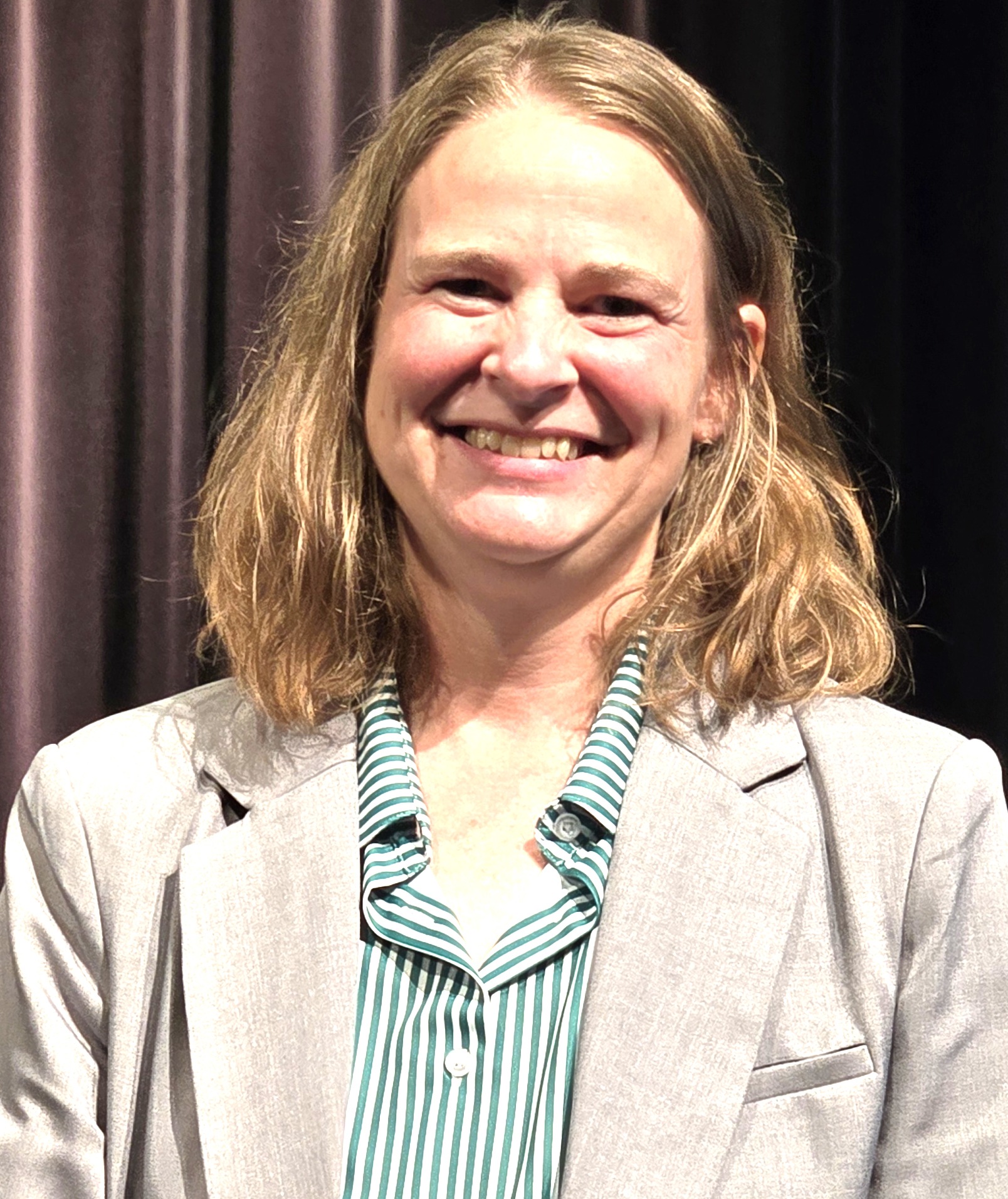
 TAKING THE REINS … Newly hired Pike-Delta-York Local School District middle and high school band director Dr. Beth Yoder appeared at Wednesday’s school board meeting, where her contract was approved. Dr. Yoder takes over for Zach Karpuszka, who died unexpectedly due to illness earlier this year.
By: Jesse Davis
THE VILLAGE REPORTER
jesse@thevillagereporter.com | Story updated Sunday, April 26, 2026
A plan projected to save the Pike-Delta-York Local School District roughly $2.7 million will only get the district to fiscal year 2030, when they will hit a “fiscal cliff,” according to statements made at the district’s board of education meeting Wednesday.
The formal plan was approved by board members as required by the Ohio Department of Education, Office of Budget and School Funding following the district’s five-year forecast completed in February showing a deficit cash balance at the end of fiscal year 2028.

Superintendent Doug Ford said the district has already been pursuing proactive measures since the end of the 2024-2025 school year, including the decision to not replace a retiring teacher and resigning bus driver/secretary, as well as combining the high school principal and superintendent roles, as well as reducing general fund expenses by $300,000 by funding computers, curriculum, and buses through permanent improvement inside millage.
Ford said the plan going forward includes the choice to not replace five retiring or resigning staff next year, changes to preschool structuring, and reductions in supplies and materials as well as capital outlay expenses. A further reduction in force of four staff positions is included in the plan for fiscal year 2028, though he said he anticipates expected retirements will cover the reduction.
Despite those cuts and with continued deficit spending, he said by fiscal year 2030, the district will be unable to cover payroll.
“This is cutting fat, this is starting to touch the muscle. We don’t want to get to the bone because that would certainly start to affect the educational services that we can provide, both in the classroom and experiences such as band, the arts, athletics, transportation,” Ford said.
At that point, he said, the only way to improve the district’s financial situation will be to increase revenue through tax levies, but he and Treasurer/CFO Leland Hays pointed out several ways the state legislature has put up barriers both in schools’ abilities to levy taxes while also reducing the amount of funding coming from the state.
According to Ford, the state share of funding has declined from 45.7 percent in fiscal year 1999 to 32.2 percent in fiscal year 2029, there is an anticipated claw back of $555,725 in past funding and a continuing annual loss of $370,483 due to House Bill 186, the Fair School Funding Plan is basing its disbursements on cost data from fiscal year 2022, and more than $1 billion in funds previously given to districts in the state is now going to private schools through the EdChoice Vouchers program.
Hays pointed to pending legislation that will further increase funding and other challenges for the school, including House Bill 420, which he said would eliminate all continuing levies and require all school levies be re-approved by voters every five years, and Senate Bill 311, which would eliminate qualified immunity for board members and make it easier for superintendents to lose their licensing.
“This is not a Pike-Delta York problem,” Ford said. “We’re ahead of the curve maybe, which we’ll do the best we can and try to balance this for as long as we can, but you will see every district in Fulton County going through this here in another year or the next year after that because of all of the revenue challenges I just talked about.”
Ford said schools in big cities are already suffering due to the same funding issues, with many making “massive layoffs.”
“Our goal is to avoid layoffs and just try to adjust through attrition,” he said.

Hays also described a challenge in local and state funding through tax abatements creating “ghost revenue,” where a business may provide a reduced amount of funding to the district through an abatement while the state simultaneously reduces their funding by using the unabated potential tax revenue in its calculations, effectively costing the district on both sides.
Declining enrollment also affects state funding, and Ford said the district has seen a reduction in its student body of 237 students, or about 18 percent, in the last 15 years.

As part of their efforts to pursue financial improvement through legislative change, board members voted to authorize the district to join the Ohio Coalition for Equity and Adequacy of School Funding, also known as the “Vouchers Hurt Ohio” coalition.
“The deduction of school voucher funds from the appropriations that fund authentic public education increases reliance on local tax revenue to maintain school operations in violation of the Ohio Constitution and clear directives of the Ohio Supreme Court,” the approved resolution states.
The cost of joining the coalition is 50 cents per student to cover coalition operating expenses and $1.50 per student to support the coalition’s efforts, totaling just over $2,600 based on current enrollment.
In addition to legislative challenges to school property tax funding, the Committee to Abolish Ohio Property Taxes has been collecting signatures for a constitutional referendum to fully eliminate the taxes in the state. The political action committee recently announced that with the election approaching, they are still roughly 108,000 signatures short of the required 413,000 signatures to get the amendment on the ballot.

Although they may not reach their goal in time for the May election, the committee can keep the signatures they have and continue collecting more until they reach the requirement to place it on a future ballot.
OTHER BUSINESS
Board members approved the district’s annual contract with the Northwest Ohio Educational Service Center at a cost of just under $1.3 million.

Board members approved the district’s annual contract with A&G Education Services for its Leap Program at a per diem rate of $170 per student.

Board members approved a variety of personnel items, including the resignation of Director of Curriculum, Instruction, Assessment, and Communication Barbie Shepherd, effective July 31. Shepherd has taken a new position as director of student services for the Swanton Local School District. They also approved the contract for new the new band director, Dr. Beth Yoder, who takes the place of Zach Karpuszka, who died unexpectedly earlier this year.
Board members approved the contract for new treasurer/CFO Terrie Freeman effective August 1.
Board members approved several policy revisions related to tobacco use prevention efforts.
Board members approved grant stipends for the Every Child on Track program.

Board members approved a field trip to Iowa State University in Ames, Iowa, for two of the district’s four Odyssey of the Mind teams to compete at the OM World Finals from May 27 through 31.
Board members approved the slate of 2026 graduates.
A public hearing was held regarding the potential reemployment of retired teacher Scott Tenney, but no one appeared to address the board.
The next regular meeting of the Pike-Delta-York Local School District Board of Education will be held at 6:30 p.m. on Wednesday, May 20, in the Delta High School auditorium.
