
PHOTO BY BRENNA WHITE / THE VILLAGE REPORTER
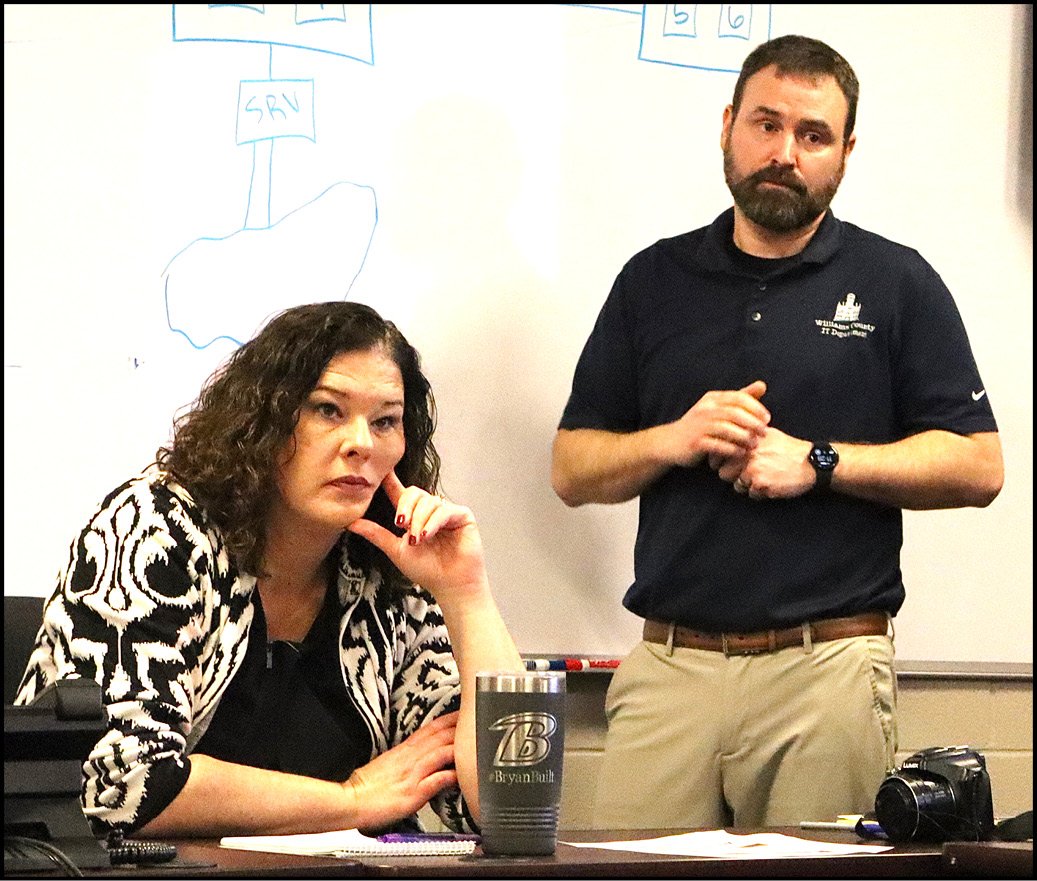
FUTURE OF 911 … Bryan City Mayor Carrie Schlade and IT Manager Jeremy Suffel discuss the future of a next-generation 911 dispatching transition within Williams County.
By: Brenna White
THE VILLAGE REPORTER
publisher@thevillagereporter.com
The Williams County Commissioners met for their regular session on February 17, 2026. The Board approved minutes from the February 12, 2026 session alongside the presented agenda. The payment of bills and appropriations were approved as well.

A change order for the Hickory Hills Wastewater Treatment Plant replacement project was accepted. Four permits to work within county and township road right-of-ways were approved under Charter Communications. The regular session adjourned at 9:45 a.m.
At 10:00 a.m., Commissioners joined EMA staff and City of Bryan officials to discuss how emergency response operations will function in Williams County.
In attendance were Commissioner President Scott Lirot, Bart Westfall, Terry Rummel, EMA Director Heather Mercer, Public Safety Administrator Michael Levy, IT Manager Jeremy Suffel, and County Administrator Vond Hall.
The City of Bryan was represented by Mayor Carrie Schlade, City Clerk John Lehner, Chief of Police Gregory Ruskey, Captain Jamie Mendez, Dispatch and Records Clerk Alex Smith, and Fire Chief Doug Pool.
Williams County is preparing to transition to next-generation 911 technology. The discussion focused on how medical calls will be handled while maintaining separate call centers.
There are two dispatching centers in Williams County: Bryan City Police Dispatching Center and Williams County Communications Agency. A key part of the conversation centered on clarifying the difference between a Public Safety Answering Point (PSAP) and dispatch operations.
A PSAP is the location where a 911 call is first received, while dispatch refers to the actual process of assigning and coordinating emergency responders.
Currently, both dispatch centers are operating as their own separate PSAP. The State of Ohio is in the process of consolidating multiple PSAPs within counties through its required implementation of Next Generation 911 (NG911). Williams County is expected to comply with NG911 updates by the end of 2026.

The county, or Central, handles all cellular 911 calls, landline calls outside of the City of Bryan, and administrative calls. The City of Bryan handles landline calls within the city limits and its own administrative lines.
Calls requiring emergency response are coordinated between Central and Bryan Police and Fire. Medical calls requiring EMS are always rerouted back to Williams County, as Bryan is unable to dispatch county EMS units.
Under the NG911 framework, cellular calls would be routed based on the caller’s geographic location rather than just defaulting to Williams County. This means cellular calls placed within the Bryan city limits would now be directed to the city’s dispatch center instead of Central.
Officials noted that the shift could change the call volume handled by each agency, especially due to the large number of medical calls the county handles.

Levy and Suffel presented two options for consideration.
The first option would have all 911 calls received by Central, which would dispatch EMS and fire. Bryan would continue dispatching its own police and be able to view calls in real time through a shared system.
This option reduces call transfers while allowing Bryan to maintain operational involvement. Bryan dispatchers would require training to understand Central’s dispatching methods.

The second option would have Central both answer and dispatch all emergency calls for police, fire, and EMS, with Bryan only handling administrative duties. This model would simplify operations and eliminate transfers but would remove Bryan’s PSAP role and local dispatch control. It was noted that this is how the Village of Montpelier’s system is currently set up.

The City of Bryan does not wish to stop operations and is reluctant to give up its PSAP status.
Mayor Schlade raised questions about long-term governance and whether PSAP responsibilities could shift in the future depending on county leadership changes. She noted the importance of building a system that remains effective regardless of who holds office.
Of the options presented, both parties appeared to favor the first option.
A third concept was also discussed in which Bryan could potentially take on dispatching county EMS calls. While no formal proposal was introduced, officials acknowledged the idea and indicated it would need further research.

Throughout the discussion, minimizing delays in medical response remained the main focus. Officials emphasized that EMS calls often require immediate coordination, and any future structure must ensure the fastest possible dispatch time.
This marked the first in what officials expect to be a series of discussions on future collaboration between the two dispatching centers. Both agencies are awaiting quotes for equipment upgrades and software ownership. Officials indicated more discussion will be needed before any final action is taken.