
 PHOTOS BY AMY WENDT / THE VILLAGE REPORTER
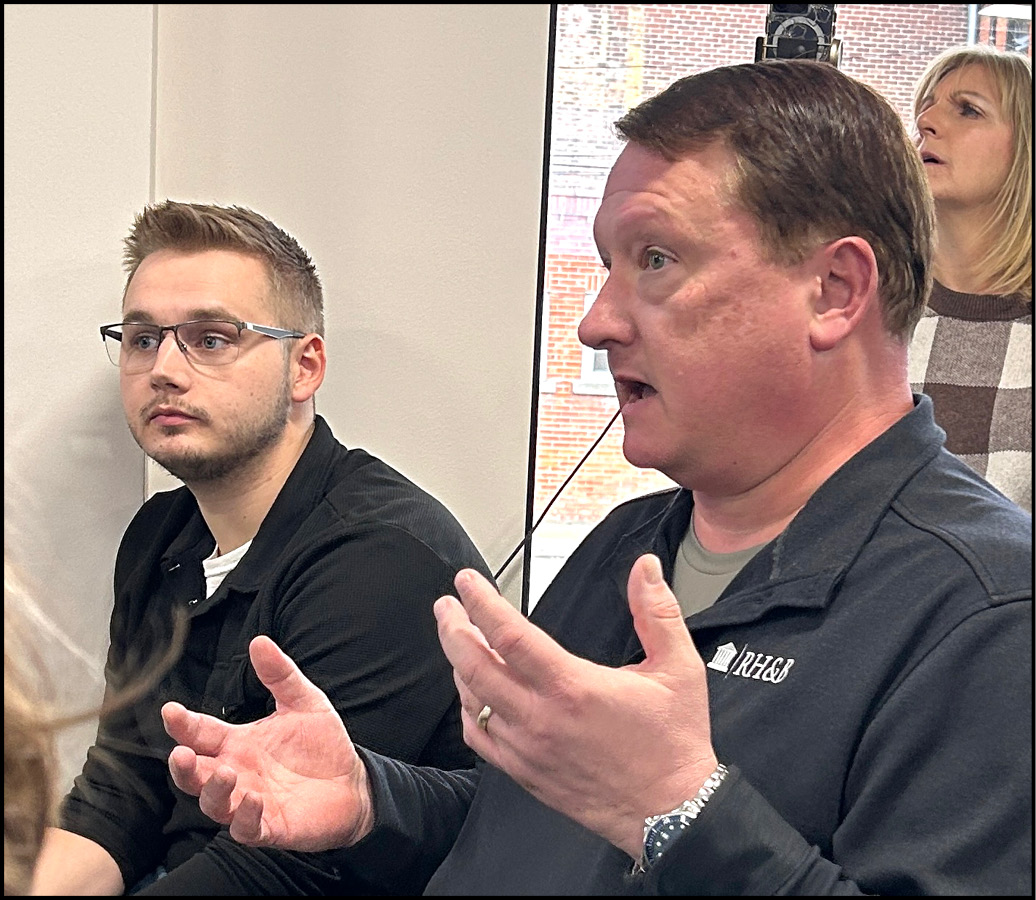
ADVICE…Law Director Robert Bohmer (right) offers village council members his legal opinion advising council against establishing a data center moratorium.
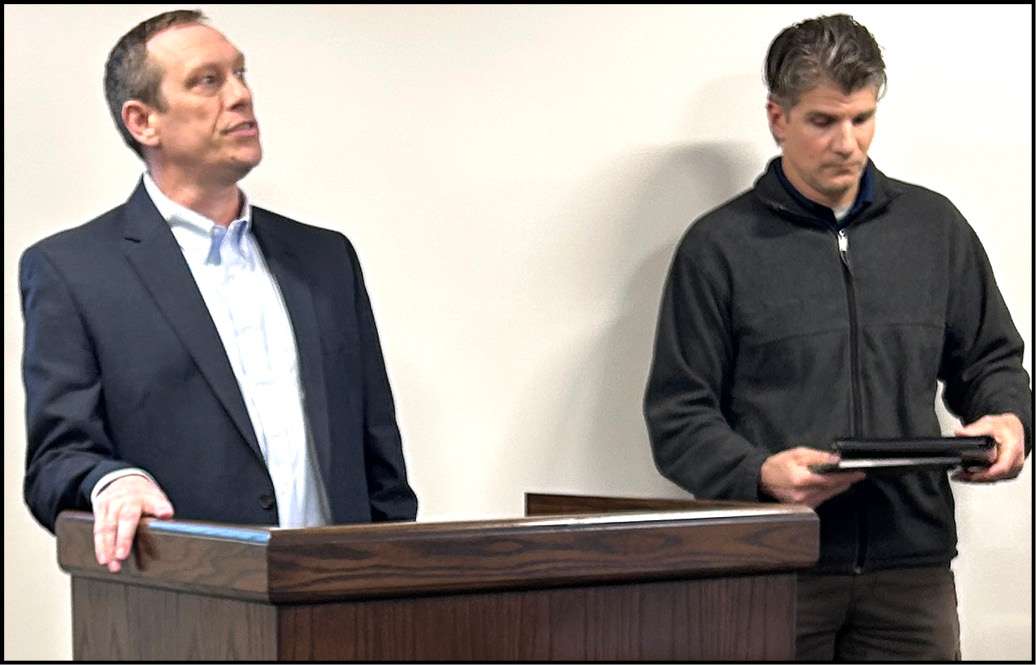 ROUNDABOUT UPDATE… (left to right) David Charville of Tetra Tech and Village Engineer Dexter Krueger offer an update on the roundabout construction slated for the intersection of County Road 24 and State Route 2.
By: Amy Wendt
THE VILLAGE REPORTER
amy@thevillagereporter.com
Returning to its regular location, the Archbold Village Council convened in council chambers on Monday, March 16, 2026.

Present were council members Karla Ball, Chad Kern, Aaron Babcock, Kevin Eicher, Mike Evans and Gary Dominique. Mayor Brad Grime, Village Administrator Aaron Alt, Clerk Cassie Storrer, Village Planner and Zoning Inspector Grant Schaffner, and Village Engineer Dexter Krueger were also in attendance.
The audience seating area in the council chambers was nearly filled to capacity with concerned residents opposed to the rumored development of a data center.
DATA CENTER BACKGROUND
Previous village council meetings that took place on February 19 and March 2 were held at the Ruihley Park Pavilion to accommodate increased public participation due to the possible development of a data center just outside village limits on County Road C.
At both meetings, the council discussed possibly establishing a moratorium to pause future data center construction temporarily.
The same topic was discussed at German Township Trustee meetings in February and March. On Monday, March 9, Dale Arnold, Director of Energy, Utility and Local Government Policy, Ohio Farm Bureau, spoke to attendees at the trustees’ meeting about data center development and the infrastructure needed to support these large sites.
Read more: Archbold Village Council: Data Center Moratorium Put On Hold Following Public Input
According to Arnold, local governments risk legal challenges if they implement formal moratoriums or pass exclusionary ordinances.
VILLAGE OF ARCHBOLD LAW DIRECTOR OPINION
The data center conversation continued at the village council meeting when Law Director Robert Bohmer presented his legal opinion that a moratorium is not necessary and no action is needed until there is a formal request for annexation for the village to consider.
After being introduced to the audience, Bohmer offered his thoughts on the matter.
“…Obviously, the decision is whether to proceed with an annexation or to rezone property actually within the village. There are processes and procedures for that, and that’s exactly what we would expect,” Bohmer began.
“One of the issues that I had initially was, there is nothing actually before the village right now, okay? The village council is being asked to do some things, but it does not comport with the processes that exist for this council to ordinarily make decisions.
“So again, if a moratorium is wanted, the council can do it. From a legal perspective, a moratorium really doesn’t mean much.

“And the reason for that is quite simple: a moratorium is a statement today that we don’t want to do something, whatever that something is.
“But as soon as somebody comes in with a project that’s interesting enough, it can be reversed. There’s no process to cement that in, to make that permanent, because that’s what zoning is. That’s what annexation is. That’s why there are specific processes for those things.
“I, from a legal perspective, don’t see any point to a moratorium. Again, Council may do what it wishes. It’s Council’s decision,” Bohmer continued.
“If there is no moratorium, or if there is, landowners in any point around the village or in the village already can make requests of this council, whether it’s an ‘Expedited 2,’ which is the presumptive way somebody would want to do an annexation.

“They can file, and then Council has a specific timeline under the statute within which to say what services it would or would not provide. So that’s when the decision is legally relevant.
“So let’s pretend there’s a different parcel, so it’s not controversial. Somebody files an ‘Expedited 2’ on a piece of property.
“The council has to decide within a set period of time whether they’re going to support it and let the parties know and the county know what different things would be provided.
“For example, water, sewer. What about roadways? So, that’s when the decision is right for bringing up and talking about.

“The same is if you have a problem within the village and they make a request to change zoning, there’s a process for that. So the questions being raised now aren’t necessarily the wrong questions to ask. Legally, I think they’re at the wrong time to ask.
“So if a property owner, however they acquire it, wishes to do a project, and they petition for annexation, for example, then this body gets the decision whether they want to support that project or not…Somebody has to file a petition.
“And if the village is not interested in such a project, they can say no. Okay, you don’t have to provide water. You don’t have to provide sewer. That’s this village’s decision to be made.
“…I don’t believe this council needs to do a moratorium, I don’t think it’s going to legally have any great effect, if any at all.

“So I would probably leave it to the processes that are in place that have kept wanted and unwanted developments happening or not happening, as the case may be, throughout Ohio.”
COUNCIL QUESTIONS
Councilor Chad Kern pointed to the city of Maumee and several Wood County townships as examples, noting they had established moratoriums despite having no current proposals for data center developments.
Kern asked Bohmer for clarification on why such an approach would not be recommended for Archbold.
Bohmer responded, “It still seems pointless to me.” Kern asked Bohmer why those officials chose to pursue a moratorium, to which Bohmer responded, “Because they feel pressured to do it, and they did it.”

Bohmer later elaborated, “Well, zoning has a foundation in law. A moratorium is a feeling of council at the moment.
“So again – and every legal counsel is entitled to give their own opinions on that. But when I’m sitting in front of this body, I represent you (the village). And I don’t see a point.
“I trust that this council will take up any petition for annexation or change zoning and deal with it as it would any other. And if it’s a project that is not in the best interest of Archbold or the area, it’ll make that decision accordingly.”
Councilor Kern then posed the question, “But a moratorium could be specific to a group of projects that you do not want to come in, correct?”

Bohmer responded, “That’s what the people supporting them say – yes…I don’t think that’s a good idea – no.
“I think, when you have different projects come in, there – they need to be judged on their own merits….You’ve singled out one subset of people with property rights.
“There are lots of property rights. Lots of different ways, people own or have a right to use property. I don’t like singling out one over another.
“At the end of the day, if they have a right to possess that property either now or through taking an action, they have the right to ask – just like everybody else, equally protected – to ask for annexation or change in zoning or any other process of variance.

“It doesn’t mean they’re going to get what they want…if there’s going to be a data center versus a factory, again, they have to equally come in and present the merits of their project.”
Addressing Bohmer, Councilor Mike Evans added that he spoke with Dale Arnold from the Ohio Farm Bureau following the last Trustees meeting.
“He kind of echoed exactly what you said. Don’t file anything other than just table it for the moment because there’s nothing to make a decision on.
“And he said, if we did do a moratorium, we’d just be opening ourselves up to legal battles,” Evans recalled.

Bohmer continued, “My point is, today, there’s nothing before this body that is right for consideration, because legally, nothing you would do today affects any particular project.
“And let me add that one thing that you just added, that might not open the village up to some possible exposure. What’s the point? You have the rights under the law to say no, or yes, when asked appropriately.”
Mayor Brad Grime brought up the concern by some that “the state can come in and override an annexation.”

“I never heard of that,” continued the mayor. “I’ve talked to a couple of state reps about that. They said, it’s possible that it could happen, but typically that would be a public project, which this is not.

“This is a private project. So their advice to me was that probably could not or would not happen under a private (project). Is that a correct statement?”
Bohmer affirmed that, to his knowledge, Mayor Grime’s statement was correct.
“Because, again, the annexation statute, for an example, doesn’t have, unless the state says otherwise, it doesn’t say that. It really is a county township/municipality issue,” Bohmer added.
Mayor Grime asked if the village was required to grant access to its taxpayer-owned water treatment plant for outside annexation.

Bohmer responded that the village is not obligated to provide public services and can legally say “no” to a project if it would strain the system’s capacity, using the physical constraints of the water or wastewater systems as grounds for denial.
If the village has excess capacity and desires the project, it can agree to provide services.
Bohmer noted that this decision is made after an annexation petition is formally filed. Councilor Eicher asked for the timeframe, and Bohmer clarified that the first deadline is approximately 20 days, noting the process is expedited.
Mayor Grime expressed his personal opposition to the proposed data center, stating, “So this group here, I’m pretty much speaking for myself, I think administration and council as a whole, we’re – we’re totally against this – this data center project.”

Summarizing his understanding of Bohmer’s legal opinion, Mayor Grime asked the law director, “So we are – in your opinion – we are protected? I mean, we don’t have to allow that (data center) in.
“We don’t need to create a moratorium to stop this project. In effect, it is stopped until the time it is presented to us, and then at that point, we are going to put an end to it?”
Bohmer responded, “If that’s the will of Council at that time, absolutely.”
The Mayor continued, “I just want to make it clear to everybody that we are working. We do not want this data center here.”

Administrator Alt then addressed the German Township Trustees in attendance, inquiring if the township had also decided against a moratorium following their own legal consultations. The trustees confirmed that they had reached the same conclusion.
CITIZEN RESPONSE
German Township homeowner Sarah Cromly, an attorney who practices in the state of Michigan, has a different take on the matter and shared with the council findings from her research, offering her own interpretation of applicable law.
“I’ve done some legal research that’s contrary to what the attorney (Bohmer) who was here today said about the special annexation procedure, if it’s a state annexation,” Cromly said, speaking as a private citizen and attorney licensed in Michigan.
She asked the council to review ORC 709.024, which she said she believes establishes an expedited “special procedure” for annexing land into a municipality specifically for “significant economic development projects,” such as large-scale data centers or industrial hubs.

According to Cromly’s reading of the statute, she pointed out “…total private, real and personal property investment, and a project shall be in excess of $10 million through land infrastructure, new construction, reconstruction, in selection of fixtures, etc.”
Cromly claimed that the project may already meet those thresholds, stating, “We already have that investment with the option contracts, which I believe is over $20 million.
“The next thing they have to have there shall be created by the project, and additional annual payroll in excess of $1 million.
“That’s it…I don’t know why he was saying it had to be a state project. That’s not true…The state has to certify it and say they meet those two requirements. There’s no appeal process.”

Cromly argued that, under her interpretation of the law, “There’s nothing you can do. Then it’s annexed, and you have to supply it (with) everything that you’re going to supply – water, sewer, roads, all of that.”
“So then what happens? Our zoning actually will take effect. Our zoning matters. This is the most important zoning ever,” Cromly stated.
Cromly continued, “I’m not here to fight for a moratorium. I think what German Township did is excellent, a great idea. They did not do a moratorium; they just are changing their zoning. And they did it. It’s done, they did it so fast.
Read more: German Township Trustees Weigh Moratorium Amid Data Center Debate

“It’s already drafted, it’s already done. We need to fix the zoning so that if something comes, we’re ready and we’re not just sitting here on our hands saying, ‘oh, well, we don’t have a moratorium.’”
Cromly urged the council to act proactively on zoning, stating, “So, I’m requesting that you please work with German Township and get their zoning language because it’s excellent; you’ve probably already seen it.”
Cromly further suggested that the state could annex the land under certain conditions outlined in the statute, stating, “Because the state can annex this land for you.”
Another audience member asked the council if they had started to work on the zoning changes needed.

Administrator Alt noted that the village is working with the same consulting firm that developed the 2021 comprehensive plan to help with the establishment of new zoning districts.
He further explained that once these districts are finalized, they will be presented to the Planning Commission for review and recommendation before coming to the village council for approval.
Alt also indicated that while he has not seen the revised German Township zoning language, he’s not sure it would be compatible with the village’s needs.
Another member seated in the audience asked when the village’s completed zoning updates could be expected.

Administrator Alt explained that the consultant is working on the codes “in March.” The audience member expressed agreement with Cromly’s claims, stating, “March might be too late.
“What Sarah said about annexation was absolute truth, and that some of the members sitting at the table that supported annexation…” Mayor Grime interjected, “That’s not true.”
Councilor Karla Ball addressed the community member who was speaking, “Our goal is not to just slap a band-aid on this, to make everybody go away. That’s not what we’re doing. We need to make sure that we’re taking our time intentionally.”
Cromly asked if a data center would be allowed under the updated zoning.

Alt answered, “It would probably be a conditional use in this new zoning district, and that’s why we wanted to establish a new zoning district so that we have the buffers and the difficultness…you can’t say ‘no,’ but you can put a lot of parameters in place that would be difficult.”
Cromly then asked where a specific zone allowing data centers would be located.
Councilor Kern interjected to explain that the village zoning can not apply to the property in question at this time since it still lies within German Township’s jurisdiction. “You can’t zone something that’s not a part of Archbold,” Kern said.
Alt addressed residents’ concerns that village officials were not acting proactively on the proposed data center and annexation issues.

He stated that village officials “aren’t going to make everybody happy overnight” and noted the challenges of responding to criticism on social media.
“Alt said he was unsure how to resolve the situation, adding that village officials “don’t want a data center and do not want to annex any land.”
Speaking to the German Township Trustees and Fulton County Commissioner, Joe Short, who were in attendance, Alt questioned how officials could meet community expectations while continuing “to protect the community.”

Mayor Grime reiterated, “We’re not gonna let a data center come in. It’s just not gonna happen.”

Another member of the public asked village officials if the matter is still “tabled,” and Councilor Ball responded, “We don’t have anything (official) we can address, because nothing’s been brought to us.”
Councilor Mike Evans added, “So, like, we’ve been pressured to follow a moratorium. Now, that’s basically off the table.
“Every week, it’s been a new request and every week we’re trying to figure it out, too. So, you know, it is taking a while.
“This isn’t gonna happen overnight, like Aaron said; this is a big deal. We’re to do it the right way and the legal way.”

Councilor Kern asked Alt if the council could receive an update on the status of the zoning amendments within the week and Alt agreed to provide that.
Alt asked the German Township Trustees if they had formally passed their new zoning amendments and if they were now in full effect.
The trustees indicated that while their legislation has not been formalized, they have the wording complete. At their next meeting, they will likely begin to look at the process of formalizing the codes.
Cromly asked village officials to act now by passing an ordinance to prohibit any property that is already under an option-to-purchase contract from being rezoned away from agriculture to protect the farmland. “It’s not just about not wanting a data center. It’s that we want farmland.

“So, why can’t you do that? Why do we have to wait this many months for you to go through all this zoning? Why can’t we just do that?” Cromly continued.
Village Planner and Zoning Inspector Grant Schaffner explained that if the property were to be annexed into the village by the state, the village’s zoning would be applied, and therefore, the village would have the opportunity to choose what zoning district the property is under.
Councilor Karla Ball asked Cromly whether, in her view, the proposed exclusionary zoning strategy could present legal issues for the village.
Cromly explained that while she is an attorney who practices in the state of Michigan, and she is able to study Ohio law, she is not intending to give legal advice, only legal suggestions.

“I have studied this law. I think that everything is new right now…if you tried it, and then they took you to Fulton County Court, I think that the judge might understand that this is an agricultural area.
“We’re not in the middle of an industrially zoned area. So I think I would take the risk to protect this land.”
“I’m just trying to help. And I think if we wait months, it will be too late,” Cromly added.
Councilor Chad Kern asked Cromly if, in her research, she found any other Ohio jurisdiction that has implemented exclusionary zoning to stop a data center, and she responded that she has not and that the trend seems to be establishing moratoriums.

“But we’re kind of on the cutting edge here.” She also noted that in her legal research, she was not able to find a concrete example of the state forcing an annexation under the “significant economic project” ORC statute.
Cromly pointed out what she described as limited public information regarding data center projects.
Cromly expressed concern that large technology companies are targeting rural communities and asked officials to consider new or more aggressive measures to prevent that development.
She also indicated that even if a potential developer chose not to pursue the project and abandoned their options to purchase other properties, then another developer could come in and offer even more money and could pursue similar projects in the future.

“These guys (technology companies) have amounts of money – money that we can’t even comprehend. So we need to be prepared,” Cromly shared.
Cromly described what she believes is a broader regional push for data center development, “Because they’re after Northwest Ohio…but RGP (Regional Growth Partnership Northwest Ohio) is – they’re having meetings in Toledo. They’re marketing Northwest Ohio as the data center capital of the whole world.”
Councilor Ball addressed all those in attendance.
“We’re doing the best that we can. I appreciate that Aaron (Alt) has said, you know, not one of us up here is interested or excited about a data center.

“Please understand that we’re not, and we’re not against you. The people that are bringing information to us – we appreciate it. There is a lot of information out there, but we have got to all work together.
“We’re working with zoning – or we’re working with the trustees. We’re trying to get our zoning in order. Our goal is not to push you guys off.
“We aren’t trying to brush this under the rug. That’s not going to solve anything. We’re trying really hard to just make sure that the decisions that we do make, we don’t have to come back to them again in six months or a year, because, oh, we overlooked something, and now we have to redo it again…”
ROUNDABOUT UPDATE
The Council also heard a brief update from Village Engineer Dexter Krueger and David Charville of Tetra Tech, the consultant that is designing a roundabout at the intersection of County Road 24 and State Route 2.

The project began with survey and geotechnical work in July 2025, followed by preliminary design work from October 2025 to January 2026.
The right-of-way design phase is planned to take place from March to July 2026. The design will be finalized and the rights-of-way acquired from August 2026 to July 2027.
Actual construction is scheduled to begin in May 2028 and continue through July 2028. Archbold residents can expect road closures related to the project to last 45 to 60 days.
OTHER BUSINESS
In other business, the council approved minutes from the March 2, 2026 meeting, authorized the payment of $505,380.69 in bills and payroll and accepted the February 2026 financial statements.

Moving on to legislation, the council approved Resolution 2026-11 authorizing the Village Administrator and Finance Director to advertise for a bid for miscellaneous street resurfacing, Contract 3-2026.
The resolution states, “This project involves the asphalt street resurfacing of Park Street from South Defiance Street to the west end, Blue Streak Drive from Park Street to the school property, Franklin Street from Park Street to the West Mechanic Street, West Mechanic Street from Franklin Street to the curb and gutter, Willow Way from Hawthorn Drive to and including Pin Oak Place.
“The project will also include rebuilding of West Mechanic Street from the end of the curb and gutter to the German Township Building, Jackson Street from South Lincoln Street east to the Alley and a portion of Pin Oak Place.
“In addition, north and south portion of the concrete overlay on South Defiance Street at West Barre Road will be removed and resurfaced with asphalt pavement. “This project will also include spot repairs on Miller Avenue and Beech Street.”

Also considered and approved was Resolution 2026-12, allowing the Village Administrator to authorize easement agreements with Ohio Gas Company.
Committee, Board & Department Reports before the council for review included the March 2, 2026 Ordinance & Resolution Committee minutes, and February 2026 reports for the police and fire departments.
In the February 2026 fleet report, it was recorded that 39 hours of repairs were completed.
Administrator Alt pointed out that the street department staff performed all of these tasks in-house, resulting in cost savings for the village.

The February 2026 Income Tax Report revealed a 1.1% increase from the same time last year. The next regular Archbold Village Council meeting is set for Monday, April 6, 2026, at 5:30 p.m.
Related Stories
- Archbold Village Council: Council Proposes Data Center Moratorium Amid Community Concerns
- Archbold Village Council: Data Center Moratorium Put On Hold Following Public Input
- German Township Trustees Weigh Moratorium Amid Data Center Debate
- Fulton County Commissioners: Board Reviews ODOT Roundabout Plan; Enters Water Agreement With Archbold
- Archbold Village Council: Community Questions Answered; Contract Changes Approved
Related Stories
- MONTPELIER VILLAGE COUNCIL: Council Discusses Spot-Zoning Concerns In Triplex Proposal
- WILLIAMS COUNTY PORT AUTHORITY: Port Authority Discusses Fountain Creek Senior Villas Project
- Regional Substance Use Prevention Breakfast Held In Archbold
- SWANTON VILLAGE COUNCIL: Stray Cat Program Begins To Take Shape