
By: Renea Kessler
THE VILLAGE REPORTER
renea@thevillagereporter.com
The Fulton County Commissioners called their meeting to order at 9:00 a.m. with the Pledge of Allegiance, opening prayer, and roll call before moving into regular business.
Commissioners first approved the minutes from May 14, 2026. They then approved the agenda as amended after noting that four additional resolutions would be added.
The board next approved the payment of bills, followed by appropriation and transfer requests for various departments. Commissioners also approved to execute a letter of support for Land Bank Brownfield applications related to the hotel in Swanton.

Resolution 2026-336 was approved for a service payment agreement for CAD system updates. Commissioners then approved Resolution 2026-337 for a cooperative agreement with the Village of Swanton for County Road 1 on behalf of the county engineer, followed by purchase orders and travel requests.
AIRPORT DISCUSSION
The board then voted to take several previously tabled airport-related resolutions off the table, including resolutions tied to the airport hangar and taxi lane project, airport grant applications, and professional engineering services. Commissioner Jeff Rupp then led a detailed discussion on the Fulton County Airport, its history, current activity, and the proposed construction of new T-hangars.
Rupp said he had brought in a program from the airport’s 1968 dedication, which included advertisements from local companies, photos, and information about those involved in the dedication. He explained that former Ohio Governor James Rhodes had promoted the idea of placing an airport in every county in Ohio, as well as on each of the islands in Lake Erie. Rhodes was known for saying that building a mile of road allowed someone to travel a mile, while building a mile of runway allowed someone to travel the world. Rhodes accomplished much of that goal, except for two counties.
Before the current county airport was built, Rupp said Fulton County had a grass strip on County Road E. The county later used property along State Route 14 to build what was then considered a modern county airport.
AERO BEACH PROPERTY
Rupp reviewed the airport property and the former Aero Beach property, explaining that the county purchased three parcels from Aero Beach on May 7, 2021, for a total of $946,000. That included $749,000 for the parcel with the hangars, $192,000 for the parcel with storage units, and $5,500 for a narrow strip of land. Rent from the property has brought in approximately $540,000 over the last five years, helping offset the original purchase cost. He said the former Aero Beach buildings include the Life Flight hangar, another hangar containing two airplanes and a hot air balloon, and a long building that is partly used for aircraft and partly used as the county vehicle maintenance facility.
The airport currently has 33 based aircraft, the most it has ever had. 24 of those are in the nested T-hangars, with additional aircraft in the main hangar and in the former Aero Beach hangars. He added that there are about five people on the waiting list for hangar space, though that number can change as people find other options. According to Rupp, demand for hangar space has increased because aircraft are more expensive than they once were, and owners are less willing to leave them outside. He said that when the county purchased the former Aero Beach buildings, and additional hangar space became available, it filled within months. He said he believes the same would happen if the county were to build six new nested T-hangars.
Rupp said the airport board would continue using rent revenue to help repay the county until the applicable portion of the Aero Beach purchase and the new hangar project are paid off. Commissioners noted they still need to determine how much of the former Aero Beach purchase should be considered airport-related, since part of the property is used for airport purposes and part for county vehicle maintenance and other county-related uses.
Once those costs are repaid, and rent revenue can shift to the airport board, it would create a significant revenue stream for the airport. He said that could help the airport become more self-sufficient and allow it to cover more maintenance, mowing, and building costs on its own, outside of larger capital projects.

FAA HANGAR FUNDING
Federal Aviation Administration funding is now available for hangar construction, which Rupp described as an opportunity that has not historically been available to Fulton County or many similar airports. He said the FAA has recognized a need for hangar space and has allocated funding for projects at smaller airports. The project bid came in at approximately $1,014,000, with engineering costs bringing the total project cost to approximately $1,208,000. Rupp said the FAA grant would cover $859,305, leaving a local share of $348,695. He explained that the total includes not only the hangar building itself but also asphalt work for access and taxi lane improvements.

Accepting FAA funds obligates the airport to remain open for 20 years. He said the county already accepts FAA funds for airport projects, including funding accepted two years ago for an upgraded weather reporting station being completed this summer. Rupp said he does not see the 20-year obligation as a concern because the airport is currently active and growing.
Rupp also discussed other activities at the airport, including crop dusters, Life Flight, a helicopter being used for tree trimming near power lines, increased fuel sales, and a growing flight school. He said the helicopter operation has been based there for about six months and is expected to remain for about three more months, using a large amount of jet fuel during that time. The airport board also watches fuel prices at nearby airports and tries to keep Fulton County’s fuel prices competitive. He said pilots will fly to Fulton County to save on fuel, and that the airport’s flight school has also grown since beginning operations there about three years ago. The flight school currently has four airplanes and is bringing on a fifth.
Commissioners discussed the long-term potential of the airport, including unmanned aerial vehicles and agriculture-related drone operations. Rupp said drone-based crop spraying is becoming more common and could present future opportunities for the airport.
Commissioners also discussed how the proposed six hangars could help bring the airport closer to 40 based aircraft. Rupp stated that 50-based aircraft is often viewed as an important number for airports, though he noted that the impact on grant opportunities is not automatic. He said additional hangars could help position the airport better if demand continues. Rupp also stated that around 2000, the airport board had proposed building 12 new hangars using a state low-interest loan program. He said the county would have needed to co-sign, but commissioners at that time did not do so. He said that if the project had moved forward, then the airport would already have those hangars at a much lower cost than today.

Commissioners then approved Resolution 2026-318, awarding the bid for the airport T-hangar and taxi lane project. They also approved Resolution 2026-319, authorizing the board president to execute the fiscal year 2026 Airport Infrastructure Grant application, and Resolution 2026-320, authorizing the board president to execute the fiscal year 2026 Airport Improvement Program Grant application. Commissioners also approved Resolution 2026-322, entering into contract 2026-50 with Crawford, Murphy & Tilly for professional engineering services for the construction phase of the T-hangar and taxi lane project.
EMS & FIRE SERVICES
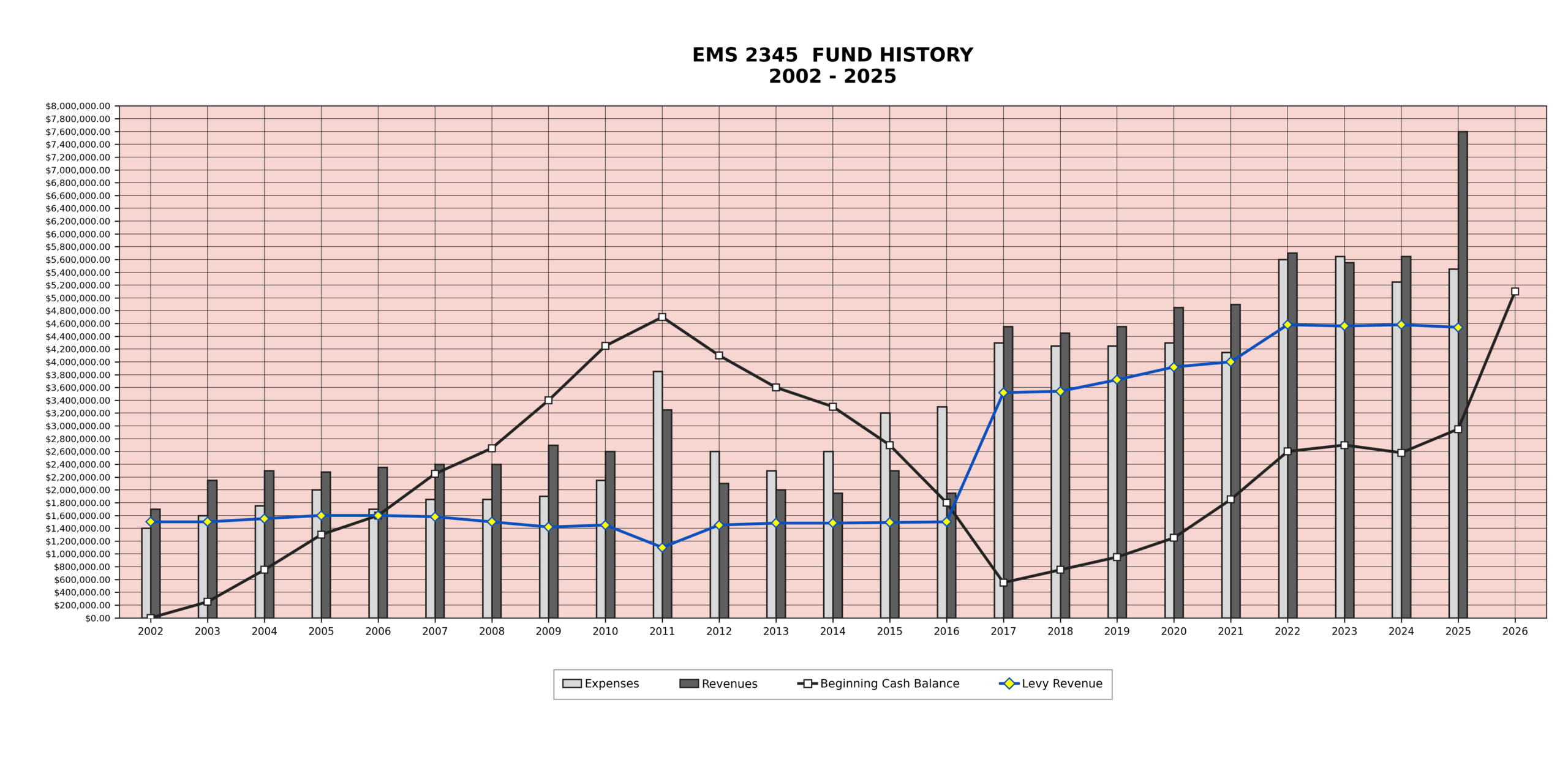
At 9:38 a.m., commissioners moved into a discussion with township representatives about EMS and fire services. Rick Kazmierczak of Swancreek Township and Ivan Hite of Clinton Township were present for the discussion, which focused on the county’s EMS structure, fire service costs, levy concerns, and possible future emergency service district models.
Hite thanked the board for allowing the discussion and said he wanted to better understand what EMS may look like in the future. He said getting the right people at the table makes a major difference, adding that “a little bit of information is dangerous” and that not enough information has contributed to public confusion. Hite said his purpose in attending was to become more aware of the operation so that when he talks with residents, he can provide accurate answers. He said if he does not have the right answer, he is not going to give one.

Hite first asked commissioners to clarify legal and operational authority over EMS. He said his understanding was that neighboring fire and EMS agencies operate independently, handle their own staffing, and participate in mutual aid, while the commissioners do not directly control their staffing or daily operations.

Commissioners clarified that Hite was asking about EMS rather than fire. Commissioner Jeff Rupp explained that the county appropriates money to different departments, which then report staffing information to their clerk, Jessica Schuette. He said staffing is checked, and if an agency is properly staffed, it receives the full amount. If an agency does not have enough paramedics or EMTs on staff, it is paid only for the hours it actually provides service.
Hite said his understanding was that the Fulton County Commissioners administer the EMS levy and participate in funding contracts with the other entities, but do not have operational authority over the departments. He said the agencies follow their own protocols and are not overmanaged by the county.
Rupp said that was correct, explaining that the county contracts with the individual entities. Commissioner Joe Short added that the contracts do include some specific service requirements, but for the most part, Hite’s understanding was correct.

Hite then asked what the county uses to determine funding distributions. Rupp said the current contracts specify what level of service each agency is supposed to provide, including manning and staffing expectations. He said the funding is somewhat different between the northern and southern agencies and was based on salary levels at the time the contracts were created.
Rupp said the county operates under a fixed five-year levy and does not receive a cost-of-living increase on the levy. Hite noted that the county levy was a renewal, while his township’s levy had been an additional levy, which he said likely caused sticker shock among voters. He said the current law also requires voters to be shown what a levy will bring in over the next five years.
Hite asked whether there is negotiation in the funding process, noting that some townships do not have fire departments and that townships do not appear to have much direct say in EMS contracts. Short said the county is essentially giving out all the money it brings in, meaning that if one entity receives more, another would have to receive less.
EMS STRUCTURE & HISTORY

Short then explained the original EMS concept, saying there were three northern stations, four southern departments, and what was called a central station. He said the county had allowed northern stations to use part-time fill-ins and on-call coverage to help their staffing situations. The central station was intended to go north and support those stations, but it did not work as designed. The county has since had to take another look at the structure. He said the facility may still house the helicopter and possibly a backup ambulance, but because the backup support did not function as planned, the county was forced to allocate more funding to the north.
Short emphasized that the EMS levy is countywide. He said the person in the furthest northwest corner of Fulton County pays the same four mills as someone living in the center of Wauseon. He said township trustees naturally look at their own township or area, but commissioners must look at the larger countywide system because it is not a specific township levy. The county distributes about $5.2 million and added that County Auditor Brett Kolb had additional information to present. Commissioner Rupp also said the county has distributed the full amount. Short said the county also has billing services, medication costs, training, and supplies, and has tried to be open and transparent about the money available.
Short said he agreed that EMS costs are difficult in the current economy, noting that wages and inflation have increased and that