
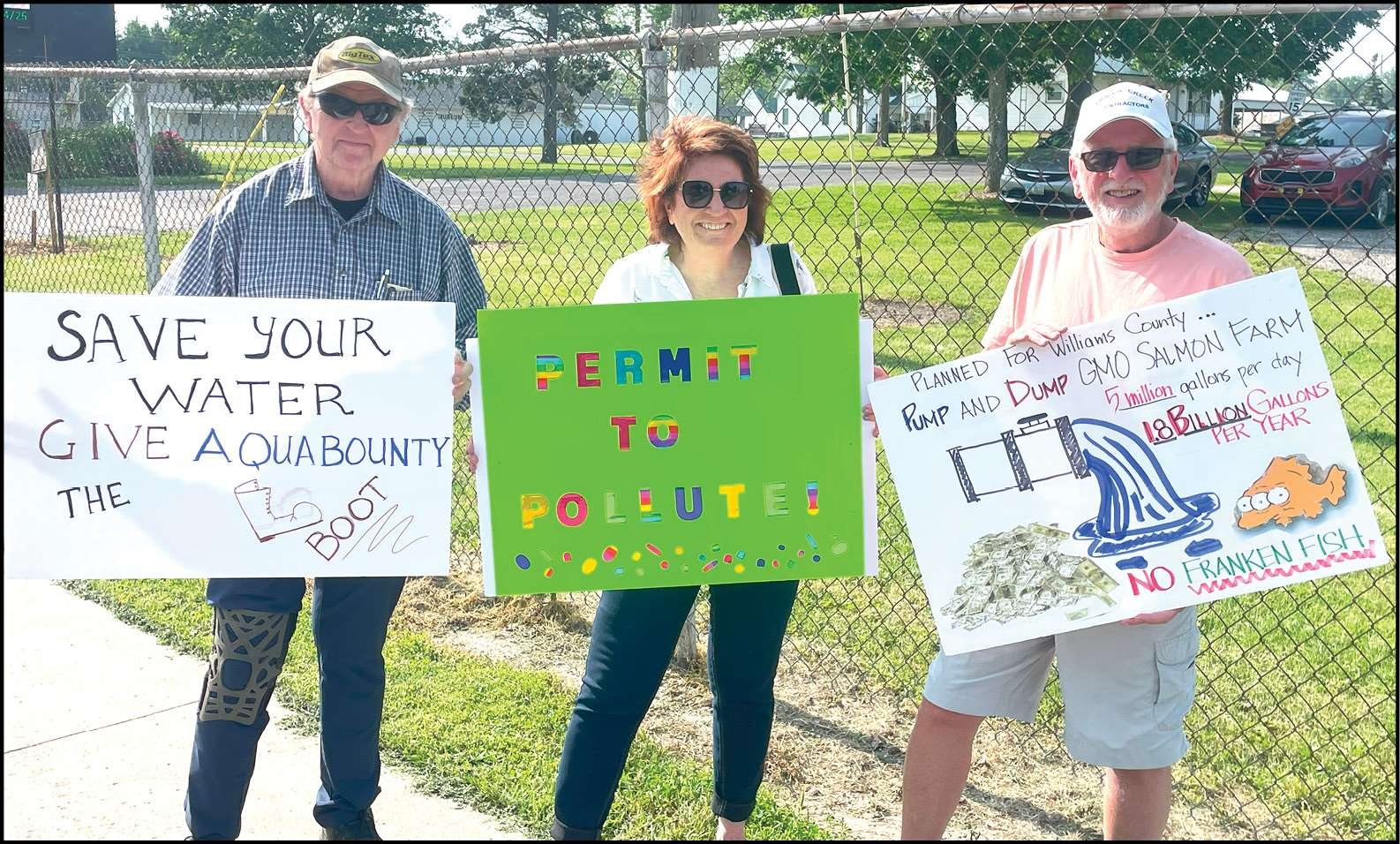
 PROTEST … Several protesters donned signs and shirts outside of the Williams County Fairgrounds before the EPA meeting began.

(PHOTOS BY BRENNA WHITE / THE VILLAGE REPORTER)
EPA ANSWERS … Ryan Gierhart explains in detail the EPA permit requirements for water discharge systems.
By: Brenna White
THE VILLAGE REPORTER
publisher@thevillagereporter.com

On June 11, the Ohio Environmental Protection Agency (EPA) held a public hearing to present and discuss a draft National Pollutant Discharge Elimination System (NPDES) permit for AquaBounty Farms, LLC.
The hearing, held in accordance with Ohio’s administrative procedures, offered citizens a formal opportunity to provide comments regarding the proposed wastewater discharge from AquaBounty’s facility located in Pioneer.
Lisa Cochran, Head of Communications and Outreach, Ashley Ward, Assistant Chief, and Ryan Gierhart, Permit Lead, were in attendance at the hearing. A professional court recorder was also present.
Before the proceedings, a peaceful protest was held outside the Williams County Fairgrounds, where locals across the county came to raise awareness for their cause.
The NPDES draft permit would authorize AquaBounty to discharge treated process wastewater into the East Branch of the St. Joseph River, a tributary to Lake Erie, by using a nicknamed “pump and dump” system.
The discharge is associated with AquaBounty’s planned operations as a land-based aquaculture facility that will raise genetically engineered Atlantic salmon.
According to the draft, the permit would allow for an average daily discharge of 4.4 million gallons of treated water.
The Ohio EPA emphasized that this action falls under the federal Clean Water Act, which mandates that such discharges meet specific environmental standards to protect surface water quality and aquatic life.
Throughout the presentation, the Ohio EPA detailed the framework guiding its decision-making, including both federal and technology-based standards.
The proposed permit includes numeric limits for several parameters; ammonia, total suspended solids, total phosphorus, total nitrogen, and biochemical oxygen demand.
In addition to discharge limits, the draft permit includes several special conditions. These include requirements for continuous monitoring, a certified Class III wastewater operator employed, implementation of best management practices, stormwater controls, and whole effluent toxicity testing.

The EPA made it clear that if any changes were to occur: location, size, output, etc., AquaBounty would have to restart the application process.

A bought transfer of approved permits is allowed, however, the same rules would have to apply. The only way it would be applicable is if another commercial aquatic facility would buy the rights to the property, and therefore the proposed permit.
“When that permit is being drafted, permit limits and different conditions are included to make sure there’s no loss of use,” Ashley Ward clarified.
An informal Q&A was held, giving the community a chance to ask questions before the recorded hearing began.
“Lowering water quality is necessary to accommodate development in the area,” read one audience member from a recent local newspaper.”

“This whole project could be lowering water quality. Who is going to determine what the level of water quality is?”
Ward answered, “The Director of the Ohio EPA, Katie Boyer, who evaluates those different socioeconomic benefits and losses when they are making that determination.”
“How can you determine what the water quality will be lowered to if they haven’t been in process?” the audience member pressed, wondering how the EPA can estimate the proposed effects of dumped water before operations begin.
“We do calculations,” Ward continued. “We look at each parameter, how much will be discharged, and how much the receiving water can handle – while still retaining the existing uses.”

“We then put limits on the facility, and they can’t discharge any more than what we limit them to.”
“Has testing already been done as regards to water quality, considering all of the agriculture run-off that goes into that?” another audience member asked.

“We did do a study of the St. Joseph River,” Gierhart explained. “It was back in 2013.”
Many locals expressed questions about the knowledge of the recent degradation. Fields closest to the river have experienced heavy flooding due to a very rainy spring, with overflow already naturally occurring.

During the public hearing portion, the EPA took recorded notes of the testimonies. After due diligence and research have been performed, they will respond with a written, formal response. They plan to accept formal comments until June 18.
Sandy Bihn, Lake Erie Waterkeeper, was in attendance to make an official statement.
“To base the antidegradation of the St. Joseph River on 2013 data, knowing how much has changed in the St. Joseph River, that is simply unacceptable.”
“Especially with a very vulnerable Fish Creek, which is the Maumee River’s most pristine creek, with dozens of fish species and endangered mussels.”

“Before the EPA determines the anti-degradation levels for this permit, there needs to be a new assessment of the river, which has been degraded with manure run-off and other discharge since 2013. This is a request to delay initiating the NPDES permit until there is a new St. Joseph River assessment.”
Many comments about AquaBounty’s recent decline in stock rates, selling of materials, and loss of employees made several locals unsure of the vitality of the business at hand.
Multiple people in attendance questioned the legitimacy of the permit request as AquaBounty faces serious monetary issues.
The Ohio EPA will review all submitted feedback before making a final decision on the permit. Until then, the future of AquaBounty’s proposed discharge remains uncertain – echoing the strong community voices determined to protect the region’s waterways.
