
 PHOTO BY JESSE DAVIS / THE VILLAGE REPORTER
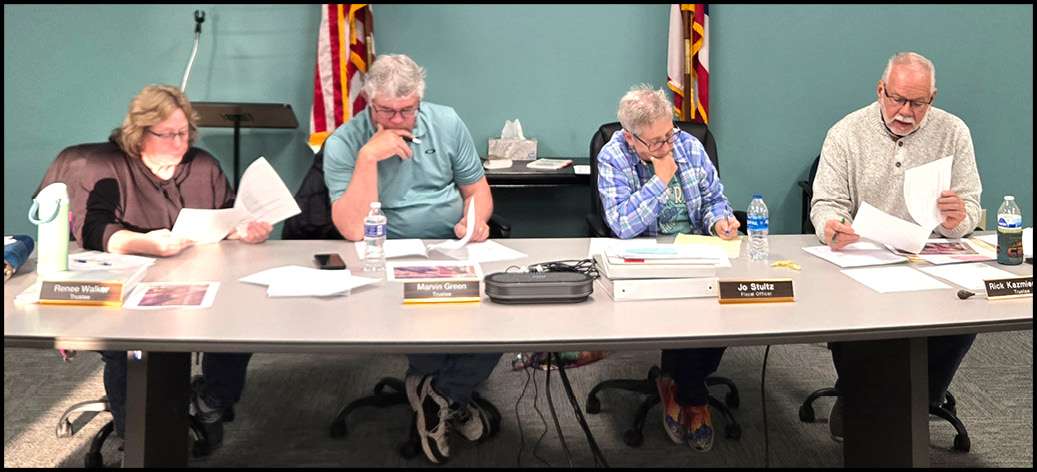
TOWNSHIP BUSINESS … Swancreek Township trustees meet to consider regular business Monday evening. Pictured are (from left): Trustee Renee Walker, Trustee Marvin Green, Fiscal Officer Jo Stultz, and Trustee Rick Kazmierczak.
By: Jesse Davis
THE VILLAGE REPORTER
jesse@thevillagereporter.com
Swancreek Township trustees chose not to implement a moratorium on data centers during their regular meeting Monday evening.
Discussion on the subject began when trustees Rick Kazmierczak and Renee Walker shared their experiences at a recent meeting regarding the facilities.

Among the recommendations made at that meeting were that governmental entities create or update comprehensive land use plans, including their position on data centers.
It was noted that Swancreek Township’s comprehensive plan has not been updated in roughly 30 years.
Kazmierczak shared his belief that a moratorium wouldn’t actually affect anything, that trustees would still have to research the subject and issue decisions on projects should any arise.
He also said he believed data centers will eventually be everywhere and are effectively unavoidable.
“I am not a technology person, I don’t like it, I would prefer to go back to the 1960s, but that isn’t going to happen, so I guess the argument for a data center is if you want to do all the stuff that you want to do on your phone, you gotta have new technology, you have to have that infrastructure to be able to support that,” Kazmierczak said.
“These things aren’t going away, and the younger generations live on these things, so you have to have the infrastructure.”

He also said they were told data centers could bring millions of dollars to the township, and claimed that newer data centers no longer require the same vast amounts of water as older ones.
According to an article written last October by the Lincoln Institute of Land Policy (a nonprofit, nonpartisan think tank in Massachusetts founded in 1946), however, mid-sized data centers use as much water as a small town, “while larger ones require up to 5 million gallons of water every day — as much as a city of 50,000 people.” The water is used in cooling systems for the data center equipment.
The article also states conventional data centers draw as much electricity as 10,000 to 25,000 households, while AI-focused data centers can use as much power as 100,000 homes or more.
In March, the U.S. Department of Energy announced plans for a major data center to be located at a decommissioned uranium enrichment plant in southern Ohio, which will require 10 gigawatts of power.
The project is planned to include up to 10 gigawatts of new power generation, including 9.2 gigawatts of natural gas generation.
In comparison, the maximum power that can currently be supplied to the grid during peak summer demand — called the “net summer capacity” — for the entire state of Ohio is just over 30 gigawatts, according to the U.S. Energy Information Administration.


Kazmierczak said he has reached out to the county economic development board and that there are currently no inquiries from any businesses seeking to locate a data center anywhere in Fulton County.
OTHER BUSINESS
Trustees approved transfers of $1,100 each out of the travel and property insurance premium funds for a total of $2,200 into the information technologies fund to ensure it has enough to cover necessary expenses.
The fund was budgeted $15,000 in 2025 and was initially planned for $10,000 this year before being reduced further to $7,000.
Trustees approved an updated set of cemetery rules and regulations as well as a price guide, cemetery burial authorization and indemnification affidavit, and heirs transfer form. The new rules and forms will be available on the township website.

While no vote was required, trustees gave their general approval to a plan to create a tote with attached list to hold records to be disposed of, with an annual disposal date set so trustees can review the list and approve the records’ destruction.