
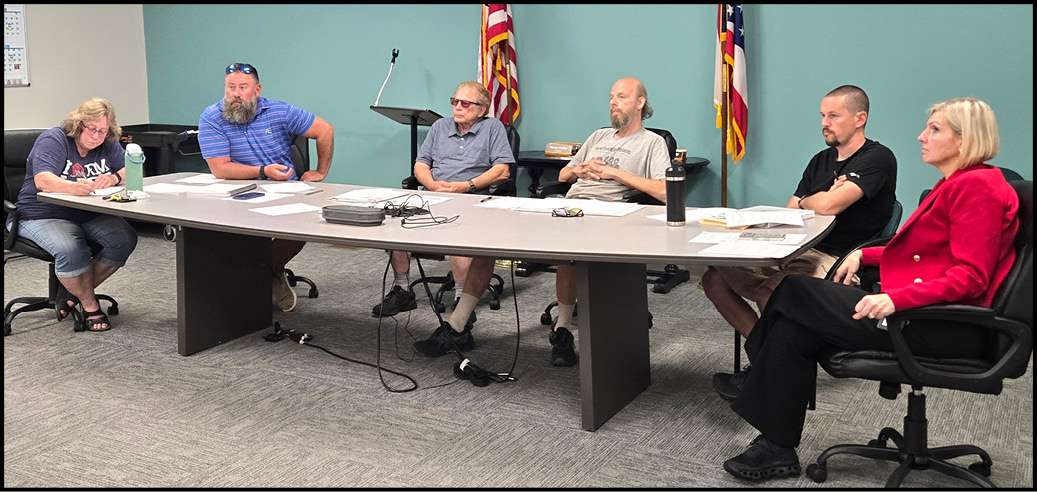
 PHOTO BY JESSE DAVIS / THE VILLAGE REPORTER
REGULATING GROWTH … The Swancreek Township Zoning Commission discusses during its most recent meeting potential new regulations on data centers and solar fields including the requirement of conditional use permits. Pictured are (from left) Renee Walker, commission chair Justin Watson, Lenny Mitchell, Scott Pawlicki, Luke Smigielski, and April Welch.
By: Jesse Davis
THE VILLAGE REPORTER
jesse@thevillagereporter.com
The Swancreek Township Zoning Commission is moving forward on efforts to update zoning regulations to include data centers and solar fields in an effort to get ahead of any potential developments in the township.
During their May 19 meeting, commission members discussed the best path forward, deciding to focus first on adding regulations for the areas of the township already zoned.

While their long-term plan is to bring a measure to voters affecting the currently unzoned areas, the deadline to get proposed legislation approved and submitted for the November election is too soon to meet the required trio of 30-day periods necessary for approval.
Commission chair Justin Watson brought tentative language for the additions to be reviewed by commission members prior to their next meeting.
Under the proposal, data centers not exceeding 15,000 square feet of gross floor area would require M1 manufacturing zoning, with larger data centers, including large-scale or hyperscale data centers, requiring M2 zoning, both as a conditional use requiring approval.
Other requirements included a 150-foot setback from dwellings or residential districts, a noise limit of 60 decibels measured at the property line, the enclosure and sound dampening of generators, visual screening of all mechanical equipment, and the completion of a traffic study for facilities larger than 50,000 square feet.
Fulton County Prosecutor Luke Jones was also in attendance and brought as an example language recently passed in German Township.
Their regulations did not specify data centers, instead attempting to get ahead of both current and future industry by targeting land use exclusively by “advanced manufacturing,” including such fields as advanced automation, robotics, AI, high-capacity electrical infrastructure, mechanical systems, and “controlled operational environments.”
He said restriction rather than prohibition was the correct route with regard to data centers and similar facilities.

“My legal advice is to not put in a full prohibition into your zoning resolution against any particular business or type of business or industry.
“That invites a lot of constitutional litigation that could potentially not only cost the township a lot of money but end up losing in the long run,” Jones said.
Commission members agreed to consider both sets of language and come to the next meeting prepared to hash out the details in person, choosing final language at that time.
They also discussed the long-term plan for unzoned areas, in which a business could currently purchase land and put in a data center immediately with no involvement whatsoever of township officials.
No decision was made, but they considered both bringing to the voters a narrow zoning regulation to be implemented in those areas exclusively addressing data centers with the potential for the full slate of zoning regulations to be included on a future ballot, as well as a nuclear option which would require the vacating of all existing zoning followed by a ballot item reinstituting the regulations across the entire township.

The benefit of the second option, according to Watson, would be that all township residents would vote on the measure as opposed to only those in unzoned areas, who are believed to have little appetite to be zoned.
He said that, while he supported the option, it was a high-risk scenario as the township would be left with no zoning at all if the ballot item failed, calling it a “dangerous game in an attempt to change the zoning makeup.”
Watson’s argument for the option was his understanding that roughly four fifths of the township’s population currently lives in zoned areas and would likely be supportive of reinstituting the regulations.

Commissioners also discussed pending plans to refresh the township’s comprehensive plan — the current version of which was passed about 30 years ago, as well as the issue of blighted properties in the township.

Jones said zoning regulations did not appear to be a successful option for dealing with blighted properties, particularly due to the lack of appetite from local judges to implement statutory penalties for violations.
He said a more successful route was to require cleanup, have the township pay to complete the cleanup if the property owner would not, and then bill the property owner for the work through their property taxes.
If the owner did not pay the taxes within one year, the property could be foreclosed and auctioned.
When asked by commissioners, Jones said he could not think of an instance in another township within Fulton County where that process had been completed once that it was needed a second time for any other properties.

The next regular meeting of the Swancreek Township Zoning Commission will be held at 6 p.m. on Tuesday, June 9, at the township offices, located at 5565 County Road D.