
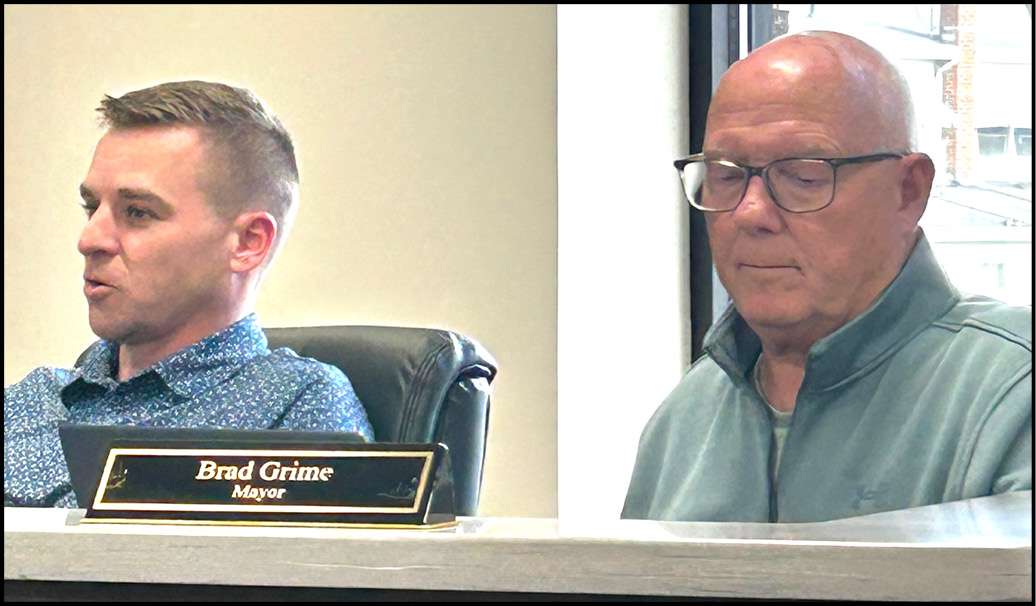
 PHOTO BY AMY WENDT / THE VILLAGE REPORTER
MORE TIME … Village Administrator Aaron Alt (left) and Mayor Brad Grime (right) address council members and attendees following the approval of a six-month moratorium on high-intensity industrial and infrastructure-dependent uses, which includes data centers.
By: Amy Wendt
THE VILLAGE REPORTER
amy@thevillagereporter.com
The Archbold Village Council met on Monday, April 6, for its first regular meeting of the month with council members Chad Kern, Aaron Babcock, Kevin Eicher, Mike Evans and Gary Dominique at the table while Council President Karla Ball was absent.
Mayor Brad Grime, Village Administrator Aaron Alt and Clerk Cassie Storer were also present.

Seated in the audience area were several members of the public concerned about the possibility of a data center project in the area.
Following the Pledge of Allegiance and a moment of silent prayer, the council addressed housekeeping items by approving minutes from its March 16 meeting. The payment of $366,090.02 in bills and payroll was also authorized.
As the council approved the March 2026 Financial and Earnings reports, Administrator Alt noted that while interest rates have slipped recently, the fund balance returns continue to grow.
DATA CENTER
Before the council was a resolution to declare a temporary six-month moratorium on high-intensity industrial and infrastructure-dependent uses, including data centers, advanced manufacturing facilities, and hot/cold/warm technology storage facilities.
The discussion followed differing perspectives shared at recent council sessions. At the March 16 meeting, Village Law Director Robert Bohmer advised the council that a moratorium was not necessary, noting there were no formal requests related to a data center at that time.
After Mayor Brad Grime introduced the resolution, Village Administrator Aaron Alt explained he feels the moratorium would allow the village time to conduct studies and determine the right approach, given that the current zoning code did not “clearly spell out how it would be done,” if one did try to move into the area.
“You know, we think back to when some of this really exploded nine weeks ago, at least.
“We’ve had a lot of different thoughts go in our head and I think at first it was trying to help the public understand that we’re not actively seeking one (data center),” Alt continued.
“There’s not one in front of us, and this council does not support, you know, significant development without doing proper studies and our zoning code did not allow for it at all.”
He added that the goal is to move past “damage control” and to focus on finding solutions, which could involve a flat-out prohibition, a “soft ban,” or zoning updates.
“So, we need to continue to look at healthy development. And I do believe that some of the individuals in this group – with the responsibility development group (Citizens for Responsible Development in Fulton County) – they want to help us find the right avenues for responsible development and ensure that our zoning is done correctly.
“Because at the end of the day, we can’t say ‘no’ to everything. We have to be open and willing to explore every option that we have to have a zoning code that works.”

Alt also noted that Iron Ridge Development has “no intention of bringing a data center” to the area.
The developer drew attention when purchasing 75.52 acres of farmland near Fulton County Roads 21-3 and C for nearly $1.8 million.
“So, this six-month (moratorium) hopefully allows the public some rest and allows us to take the time in these meetings so we can start focusing on what direction we want to go in,” Alt continued.
Council member Mike Evans questioned the need for a moratorium, noting that both the Farm Bureau and the village’s law director had either advised against it due to potentially exposing the village to litigation or deemed it unnecessary without a current formal proposal for a data center on the table.

Councilor Chad Kern stated, “From my research, no moratorium has ever been overturned if there has not been a permit already put out there or something has been filed…So, I think it can’t hurt anything.” Kern added that the moratorium duration can be adjusted if necessary.
Administrator Alt pointed out that the council would maintain the flexibility to amend or rescind the resolution at any time, noting a moratorium is less rigid than the more formal process required for a zoning amendment.
Council member Babcock weighed in, “I’m 50/50…I hear Mike (Councilor Evans), and I hear what you’re saying. We need to move forward and talk about other issues.
“And this is a way to do that, but there’s no threat on the horizon. I take Luke and Austin (of Iron Ridge Development) at their word.”

Kern countered, “But if there’s a threat and they try to file something, you cannot do a moratorium after the fact. You can’t do that. You can, but you’ll get sued.”
“So why are we being advised to wait until there is something on the table before we make a decision?” Evans asked. He also pointed out that once something formal regarding a data center is filed with zoning, the council would have around 20 days to act.
Council member Dominique responded to Evans, “That is why. This gives us the time to get done and not have to worry about it.”
Administrator Alt explained that he feels the moratorium is a productivity measure, and by putting it in place, he can focus on daily operations and working on drafting the zoning code.

“I know those guys (Iron Ridge Development) aren’t going to do it – 100 percent. But it doesn’t mean that somebody else isn’t going to come over here on the other end of town and see an opportunity to,” Alt added.

“I’m on the fence as well, just because of what the lawyer did say in the meeting,” said Dominique.
“But, I don’t want us to hit the easy button and then coast for six months and not get our zoning in order.
Grime clarified, “We’ve got to get this in front of the Planning Commission and go through the process. Our process is different than German Township, so I just want to – we got to make sure we get this right.”

Council member Eicher asked if six months would be an adequate time frame to get the zoning amendments completed.
Planning and Zoning Inspector Grant Schaffner advised that six months should be enough time once focused discussions begin. Alt briefly touched on the progress of the zoning work thus far.
“This (moratorium) isn’t an effort to shut down discussion,” Alt clarified. “It’s an effort to redirect energy and time to focus where we need to focus.”
“We’ve gotta work on that. But we’ve got to stop phone calls,” Alt continued. “We’ve got to stop emails. Quite frankly, we’ve got to stop the anonymous letters that are running through this town.

“Beating people up who have nothing to do with this. Wholeheartedly, no. Nothing to do with them. And the anonymous letters are still coming out.
Councilor Babcock pointed out, “I think it’s important for the public to know, and even those outside of here, that these are the only opportunities we get to talk about this stuff.
“We can’t meet behind closed doors, you know, more than two of us, to talk about these issues.”
Alt proposed setting a council work session prior to taking the zoning project to the planning commission for recommendation.

With no further discussion, the present council members — Dominique, Evans, Eicher, Babcock and Kern — approved a suspension of the rules.
Upon a motion by Chad Kern to approve the resolution for a six-month moratorium, which was seconded by Gary Dominique, all members present unanimously voted to pass the measure.
Mayor Brad Grime extended the invitation to any audience member who wished to speak on the matter. Archbold Planning Commission member Kevin Baez was the first to approach the podium.
“To Aaron’s (Councilor Babcock’s) comment earlier about this is the only time you guys get to get together to speak about things,” Baez began.

“I mean this respectfully, however you guys want to take it, but if this is the only time you guys get to talk about this stuff, then as a person in the community, talk about it.
Baez continued, “I’ve come to a lot of meetings, and usually they’re pretty quick, they’re pretty fast because you get something in front of you, you vote it through, whatever, right?
“I trust you guys that you’re doing the right thing for the community…So if you guys got to be in here for an extra hour to go through and make sure that you quell whatever doubts you might have on something, then you guys need to do that, because that’s what the public’s expecting.”
Baez also added that he has offered to help village staff with any research, and he believes a lot of community members are ready to help out wherever needed as well.

“…An executive session, something like that, would probably only stoke the fire,” Baez continued. “But if you guys need to take the time to talk these things out, then do it. We’ll sit here, and we’ll listen.
“So, I guess take that more as an encouraging word than bashing. Again. I mean it respectfully, guys. This community has trusted a lot in you guys. So, thank you.”
Area resident Sarah Cromly then addressed the council, asking if the moratorium had been officially passed. Alt explained that the resolution declared a moratorium, and it was effective immediately.
Cromly then thanked the council for proceeding with the moratorium because, in her opinion, it is the “right thing to do.”

Cromly also said she believes the council should put on record its reasons for declaring the moratorium, citing pending state legislation in House Bill 646, the newly proposed constitutional amendment that could ban such projects, concerns over potential health and environmental impacts and regional efforts to attract data center development.

With no further public participation, Mayor Grime addressed Mr. Baez and clarified that the council does talk about issues outside of meetings.
“And especially with this subject right here. It’s consumed nearly everybody…We just have to be careful that when we do talk about different things, we don’t have a group of three or four people getting together and not advertising that we’re having public meetings. But we’re spending a great deal of time in the conversation with this.”
Alt added that in the time he has been serving as village administrator, the council has never entered into an executive session; however, he explained to the audience that such sessions can be necessary for discussing sensitive matters.

AG DISTRICT RENEWAL PUBLIC HEARING
In conjunction with the regular council meeting, a public hearing was held to approve three parcels for renewal of farmland in the agricultural district designation.
Those properties include a 12.2270-acre plot for Tri Flo, a 13.0020-acre parcel for Grime Enterprises and a 51.0270-acre tract for Carol Nofziger.
Alt explained that these documents are received from the county auditor every five years for renewal.
He added that the Current Agricultural Use Value (CAUV) status is beneficial for landowners; however, if, for some reason, the property no longer qualifies for CAUV designation, there is a three-year repayment requirement.

With no objection from audience members, and following a suspension of the rules, Gary Dominique moved to approve the resolution with Mike Evans seconding. The resolution was passed by all members present.
WETLAND FUNDING
Council also addressed a resolution authorizing the village engineer to submit a grant application for financial assistance from the Ohio Department of Natural Resources for H2Ohio Funding for Wetland Construction.
Alt offered background, noting that if the grant is awarded, the village will move forward with the wetland construction project in accordance with the 2022 stormwater management plan and studies of the Flat Run and Brush Creek watersheds.
The project is anticipated to alleviate most of the flooding in the northeast quadrant of the village and will also benefit Sauder Village and area farm ground.

The project is estimated to cost $1.5 million, and that same amount in grant funds will be requested.
If the grant is not awarded to the village, Administrator Alt stated that the project will be tabled until next year and the village will reapply for funding.
Upon suspension of the rules, Mike Evans made a motion to approve the resolution and Gary Dominique seconded. All council members present approved the legislation.
OTHER BUSINESS
A resolution authorizing participation in the 2026 ODOT road salt contract was also approved and Street Department Superintendent Jason Martz was authorized to purchase 500 tons of salt.

Martz reported that during this past winter season, the department used 500 tons and currently has 350 tons on hand. Street crews use 20-25 tons of salt per winter storm.
The council reviewed the March 2026 Income Tax Report, which indicated revenue up 5.56 percent from the same time last year.
Administrator Alt pointed out the importance of an upcoming 3.3-mill levy renewal on the ballot, which generates roughly $450,000 for the general fund and serves as a key funding source for police and EMS services.
Looking ahead, Alt expressed concern over the uncertainty surrounding potential property tax elimination and declining sales tax revenue, warning of operational challenges.

Other committee, board and department reports before the council included:
-Police March 2026 – 844 calls for service (previous month 767 calls)
-Fire and EMS March 2026 – 97 calls for service (previous month 78 calls)
-Fleet Reports March 2026

The meeting adjourned at 6:19 p.m. The next regular monthly meeting for the Archbold Village Council is set for Monday, April 20, 2026, at 5:30 p.m.