
 PHOTO BY JESSE DAVIS / THE VILLAGE REPORTER
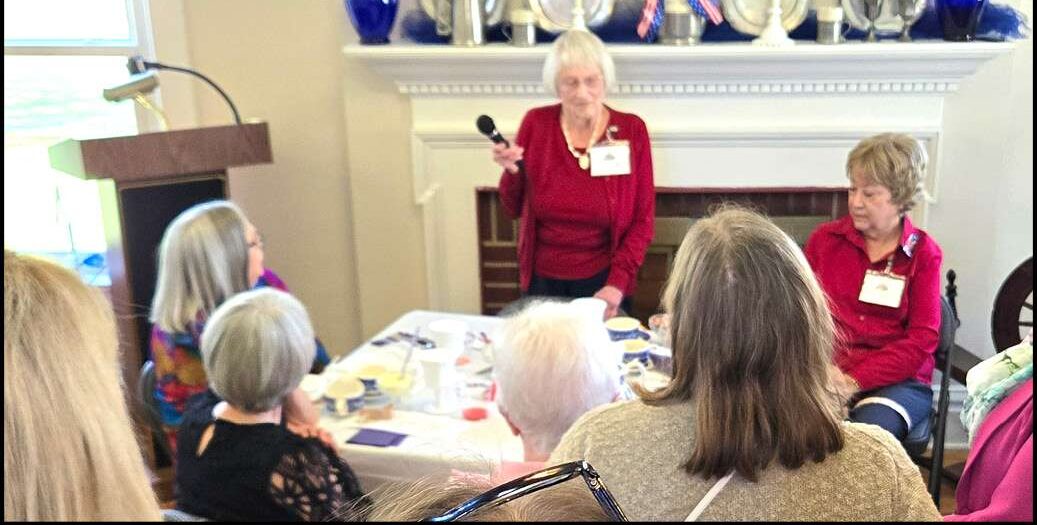
HOLDING COURT … 96-year-old Donna Tills holds the rapt attention of attendees at Saturday’s “Steeped in Democracy – Women Who Brewed Change” spring tea put on by the Metamora Area Historical Society.
By: Jesse Davis
THE VILLAGE REPORTER
jesse@thevillagereporter.com
In a historic Metamora home, amid a crowd of ladies quietly sipping tea, 96-year-old Donna Tills told her story.
The daughter of a suffragette, Tills said she didn’t enjoy the efforts of her mother as a child but that, as she grew, she also grew to appreciate the work that led to her right to vote.

Her tale was the focus of the Metamora Area Historical Society’s “Steeped in Democracy – Women Who Brewed Change” spring tea Saturday afternoon.
Tills was born in November 1929, at the beginning of the Great Depression, one of seven children growing up in Manitowoc, Wisconsin.
Her then-19-year-old sister went on to care for Tills for the first two and a half years of her life while her mother was in a sanatorium battling and recovering from tuberculosis.
“Now mother was a little woman. She had red hair and a temperament to match. Now my childhood was for the most part uneventful, but there was one day that came around periodically that I did not care for.
“In fact, truth be told, I hated it. Now that day was called voter’s day,” Tills said.
“On that day, I should have really rejoiced because it was a holiday and there was no school. However, on that day my mother dressed me and my sister who was four years older than me.
“We were follow-along children in this large family. Mother dressed us in our Sunday best and when we were groomed to her perfection even with bows in our hair, mother got in her favorite dress with a feathered hat, took my sister’s hand, and marched us to the voting area.”
Tills said that during the five-block walk to her elementary school where voting was held, her mother was always in a good mood, whereas she would lag behind as much as she could get away with.
“I was usually having a little prayer about please Lord do not allow any of my friends to be out and see this ridiculous parade,” she said.

With voting much simpler at the time, Tills said her mother would mark her selections with an “X,” fold her ballot in half, and drop it in a large, slotted box in the middle of the auditorium.
But that was only the beginning of the experience. As soon as they got outside, the lectures began.
“First she would always tell us how lucky we were that we had the vote, and then she went on and on about how you had to be responsible voters.

“How we had to know who we were voting for and why and so forth, and so forth, and so forth,” Tills said. “But then she would get on a roll and she would tell us about those days before the vote.
“She would tell us about the lawsuits. She would tell us about the parades. She would tell us about the protests. She would tell us about the jeers.
“She would tell us about the spitting. She would tell us about the tearing down of the banners. She would tell us about the destroying of all of the material the women carried. She would tell us about the sometimes pushing, shoving.
“But what frustrated mother the most was when women joined in the shouts. When women would jeer and would call and say go home, stay there, take care of your children.”

Tills said her mother would also tell them that newspapers would call women “emotionally unstable,” “unfit,” and that there was “scientific proof” they didn’t have the right temperament to be part of business or politics, and that they would just vote the way their husbands or fathers told them.

The lectures were still not the end, as she and her sister were made to share everything they had learned that voter’s day with the rest of the family after they got home.
She compared it to repeating everything she learned at Sunday school before the family could have their Sunday meal, saying “God, Jesus, and the voter’s day held top billing in our family.”
“It’s been many, many years of course, and I have voted in every election that I was able to vote in, both large elections, small elections.
“I’ve traveled quite a bit in big towns, big cities, small towns, and the village, but there still are occasions when I step into a voting booth, I think of my mother and I smile,” Tills said.
Tills hasn’t just taken advantage of her opportunities provided by the suffragettes. After leaving home she attended St. Olaf College on a scholarship.
She originally intended to become a doctor, but ended up triple majoring in biology, psychology, and sociology, later becoming a social worker for Lutheran Social Services.
While working for the agency in Fargo, North Dakota, she met her husband who just so happened to be a fellow Manitowoc native.

After a career spanning into her 60s and several other moves, Tills moved to Metamora in 2011.