
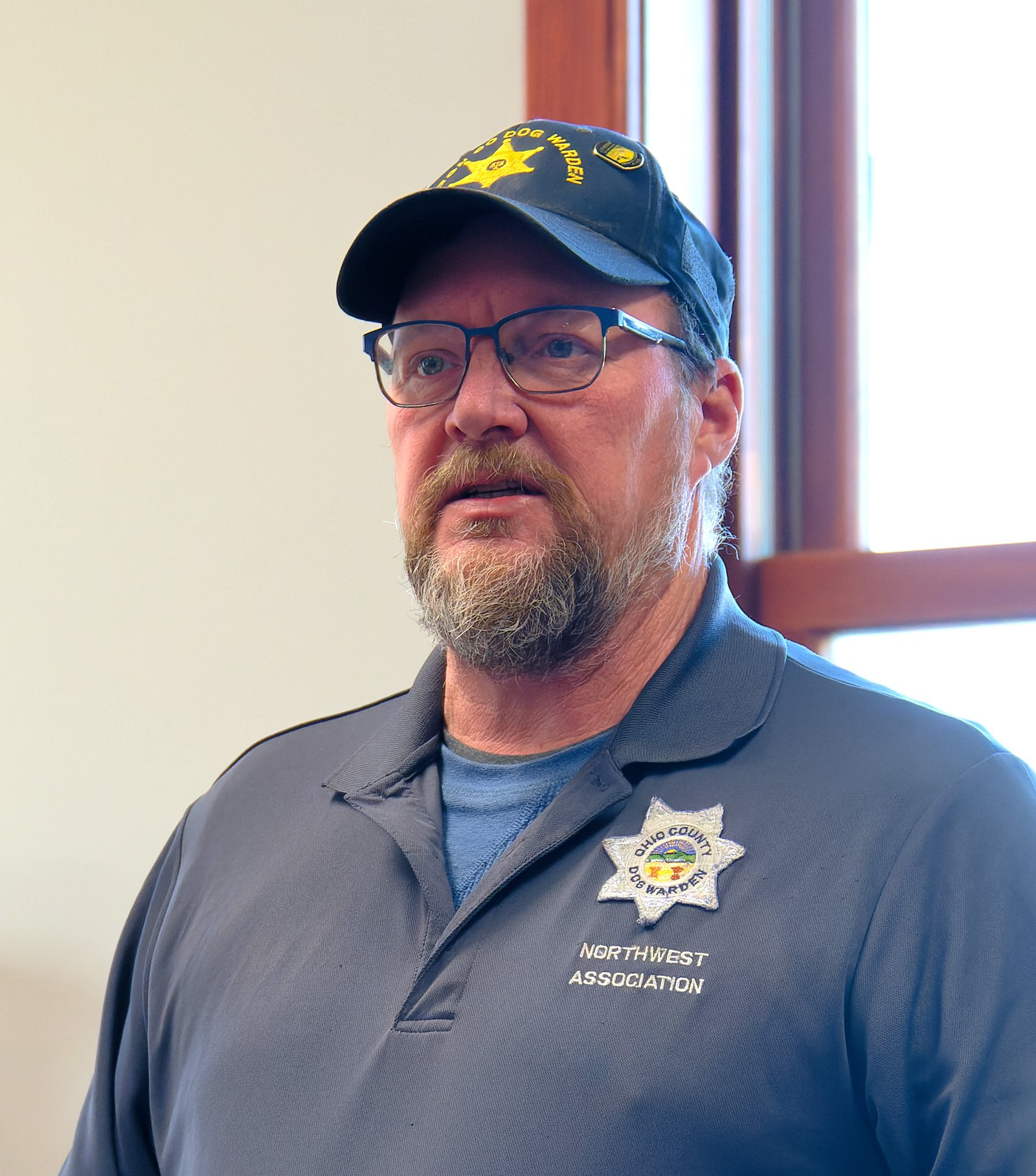
 WARDEN … Dog Warden Brian Banister attested to the progress the Humane Society has made over the past year.
By: Renea Kessler
THE VILLAGE REPORTER
renea@thevillagereporter.com
The Fulton County Commissioners met for their regular session on Thursday, January 22, 2026. Following the Pledge of Allegiance and opening prayer, the board approved minutes from its January 20 meeting and approved the agenda as presented.
Under old business, commissioners reviewed the Dog Warden reports for periods ending January 3 and January 10, along with a sales tax revenue report.

In new business, commissioners authorized multiple transfers of appropriations and funds for various departments. The approved transfers included more than $140,000 related to Job and Family Services, Children Services, Child Support Enforcement, Public Assistance, and Workforce programs.
Among the largest items were a $48,342.72 shared cost transfer related to Child Welfare Services and a $30,000 transfer for WIOA Youth to support Rapid Response funding tied to layoffs at Sauder Woodworking.
Commissioners also approved authorizing Addendum #4 to Lease 2016-52 with the Fulton County Board of Developmental Disabilities. The addendum covers utilities for the leased property at 550 West Linfoot Street, with the county agreeing to pay for water, sewer, natural gas, and electricity costs for calendar year 2026.
Under infrastructure matters, commissioners approved authorizing advertisement for bids for the 2026 Fulton County Crack Seal Program on behalf of the county engineer.
Sealed bids will be accepted until 10:00 a.m. on February 10, 2026. The engineer’s estimate for the project is $200,000. Purchase orders and travel requests as submitted were also approved.
During the 9:15 a.m. investment update, Scott Gruber of CMT reviewed 2025 market conditions and discussed expectations for 2026, noting that the past year continued to be marked by volatility but overall positive performance in both fixed income and equity markets.
Gruber said the Federal Reserve cut rates by a total of three-quarters of a percent from September through December, continuing a gradual easing cycle that has contributed to what many analysts describe as a potential “soft landing” for the economy.
He said while recent headlines have created uncertainty, including geopolitical and trade-related issues, overall economic indicators remain mixed but generally stable.
He reported that treasury yields across much of the curve have declined, with reinvestment rates now generally in the 3.5 to 3.75 percent range, noting that the county’s portfolio continues to benefit from higher yields locked in from previous years.
He said the S&P 500 rose approximately 16 percent in 2025, reflecting continued strength in equity markets despite ongoing volatility. Looking ahead, Gruber said markets are currently pricing in two additional Federal Reserve rate cuts in 2026, with the highest probability for the next cut projected around June.
He also discussed upcoming leadership changes at the Federal Reserve and noted that recent meetings have included more dissenting votes among committee members, which could influence future rate decisions.
Gruber said inflation remains above the Federal Reserve’s target but appears to be less of a driving concern than economic growth and employment.


He noted that while unemployment has edged slightly higher, the economy remains within what is considered a full employment range, and consumer spending continues to support overall economic stability.
He also reviewed changes in the yield curve, noting that longer-term investments are now offering higher yields than shorter-term options, allowing for more favorable reinvestment opportunities.
He said the county’s investment strategy continues to focus primarily on the three to five-year range to balance yield and liquidity. Gruber concluded by reporting that the county’s portfolio remains strong, with most lower-yielding pandemic-era investments now matured or nearing maturity.
He said reinvestment into higher-yielding instruments is helping maintain stable estimated income and positioned the portfolio to continue performing well despite a lower interest rate environment.

During the 9:30 a.m. update, Fulton County Humane Society representative Stephanie Moore told commissioners they are handling what they described as a county-wide community cat crisis, arguing there is no dedicated government office for residents to call when they find stray kittens, injured cats, or established cat colonies.
They said those calls instead come to the Humane Society, which they described as the only organization in Fulton County providing that type of response.
Stephanie said the county’s annual support has remained at $18,000 since 2017, but they characterized that flat amount as an “invisible cut” because inflation and operating costs have risen significantly over that time.
They said the county contribution once covered about 16 percent of operations, but now accounts for less than 8 percent, noting the Humane Society currently operates with five staff members and a permanent 10,000 square-foot facility.

They said they took 58 dogs from the dog warden last year and more than 200 cats from the community, and they cited what they described as a 42 percent increase in veterinary and medical costs.
They also reported altering 561 cats through their spay and neuter work, describing that effort as a public health investment aimed at reducing future litters and preventing wider community impacts.
The Humane Society asked commissioners to consider moving from a donation model to what they described as a shared partnership through a $5,000 monthly service contract.
They said the funding level would allow the shelter to keep its doors open and continue accepting animals that residents cannot afford to treat or that are found sick or injured, particularly cats.


They also asked for a collaborative planning meeting with county leadership to develop what they described as a sustainable approach for animal services. Commissioners and staff questioned Humane Society representatives about their trap, neuter, and return practices, including whether cats are released back to the same areas where they are trapped.
The Humane Society said some cats are spayed and released, particularly those sent through a transport partnership, and said cats are vaccinated. They said they loan live traps for community use and described the issue as county-wide rather than limited to one location.
Discussion also touched on leadership stability at the Humane Society, with commissioners noting there had been turnover in prior years and asking what had changed.
Humane Society representatives said their board and staff are now aligned on mission and priorities, including focusing first on dogs from the county dog warden and community needs.

They said adoption trends shifted after they prioritized warden dogs, explaining that some of those dogs can require longer stays and additional work before adoption.
Dog Warden Brian Banister also addressed commissioners, saying cooperation with the Humane Society has improved and that the shelter has taken a larger share of Fulton County dogs than in earlier periods.
He attributed turnover in animal welfare organizations partly to burnout and compassion fatigue, and he described rising costs associated with veterinary care, treatment, and cruelty cases.
Commissioners did not commit to the requested $5,000 monthly contract during the meeting. In their comments, they emphasized that county funding is mandated for dog warden services but not mandated for Humane Society operations, even while acknowledging the value of the shelter’s work for Fulton County animals.

Commissioners also raised uncertainty tied to a proposed statewide initiative involving property taxes, saying they are trying to be cautious with future budget decisions.
They encouraged the Humane Society to continue expanding community awareness and fundraising capacity, including discussion of strategies such as “Giving Tuesday” and consulting professional fundraising support.
With nothing further, the meeting adjourned at 10:16 a.m. The next regular meeting will be held on Tuesday, January 27, 2026, at 9:00 a.m.
