
 PHOTO PROVIDED / THE VILLAGE REPORTER
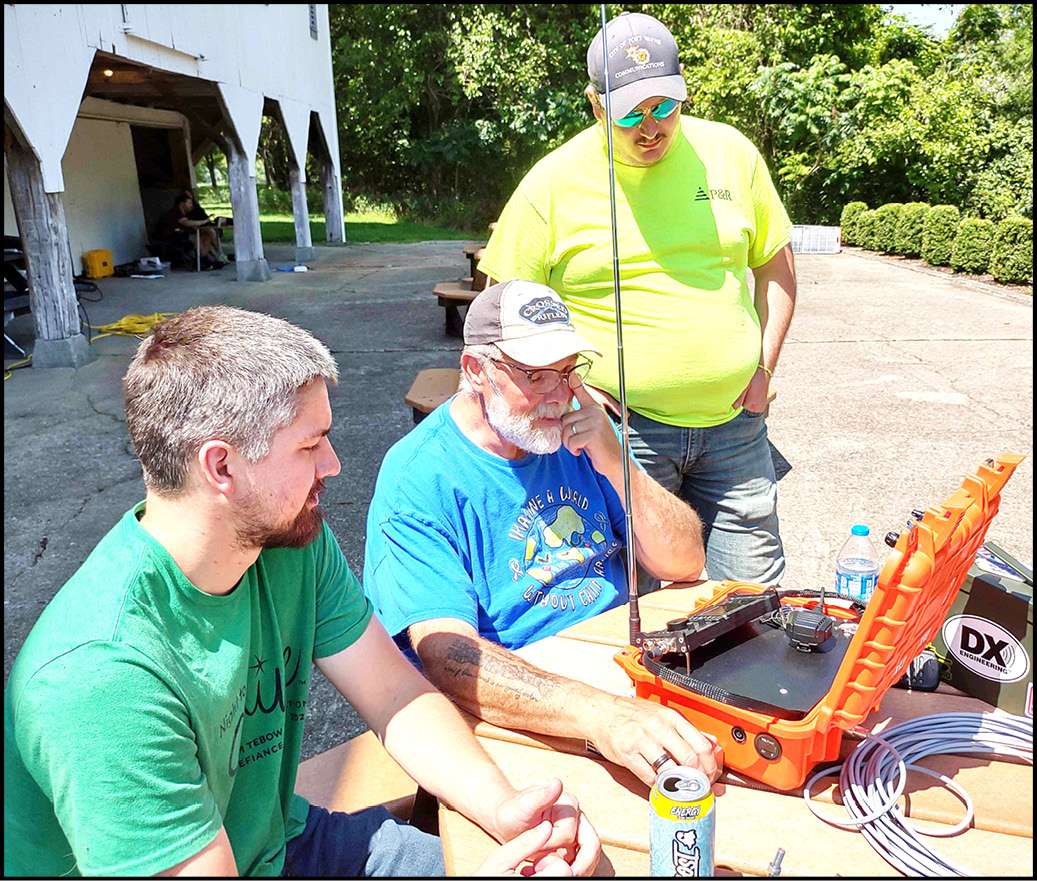
FIELD DAY … Al Andres KD8ZBS, in the middle, explains how to operate the radio go-kit while Lucas Leonard, left, and Beau Zuver KA8VBR, right, watch.
It wasn’t from an alien being, but some members of the Williams County Amateur Radio Association (WCARA) received a communication from outer space as they were operating out of Opdycke Park on Saturday, June 27.
It happened during their Field Day, an annual event held in June by the ARRL, the National Association for Amateur Radio.
During the event, members from radio clubs all around the nation try to contact other amateur radio operators in a contest to see who can make the most contacts over a two-day period.

Points are given not only for the contacts themselves, but also for other reasons, such as using renewable energy sources, like solar panels, to power the stations or for contacting special people.
One of the ideas of the contest is to simulate what it would be like for clubs to operate during a disaster situation when power and regular phone service could be interrupted.
WCARA member Mike Kwiatkowski, KE8YUJ, of Bryan, tried making a different contact this year. Assembling a handheld antenna that he received from a national ARRL teacher’s training course, he prepared to make contact from out of this world.
Using information he received at the training session designed to help provide teachers with technological lessons they can use in their classrooms, Kwiatkowski charted out the time when a scientific satellite from Saudi Arabia would be traveling over Williams County during the contest.

An instructor at Northwest State Community College, Kwiatkowski aimed the antenna toward the sky about 3:30 p.m. that day while Matt Geiger of Defiance, WB3AK, an instructor from Four County Career Center, held a radio transceiver and Lucas Leonard of Bryan, KF8DEY, read off the needed coordinates of the satellite.
Within a few moments they were able to hear transmissions from the Saudi scientific satellite known as SO-50. In the short time they had, they tried contacting the satellite, but there were too many other stations also trying to do that at the same time.
Meanwhile, other members of the amateur radio group were making more down-to-earth contacts through the day.

Stan DeGroff of Stryker, W8SRD, president of WCARA, brought some radios that could communicate long distances.
The radio operators made contacts with stations in Vermont, New York, New Jersey, West Virginia, North Carolina, Alabama, Arkansas, Indiana, Michigan and other stations in Ohio.
Al Andres of Bryan, KD8ZBS, also brought out the radio go-kit, a portable radio in a weather-resistant plastic box, and demonstrated how the group members could use it in an actual emergency.