
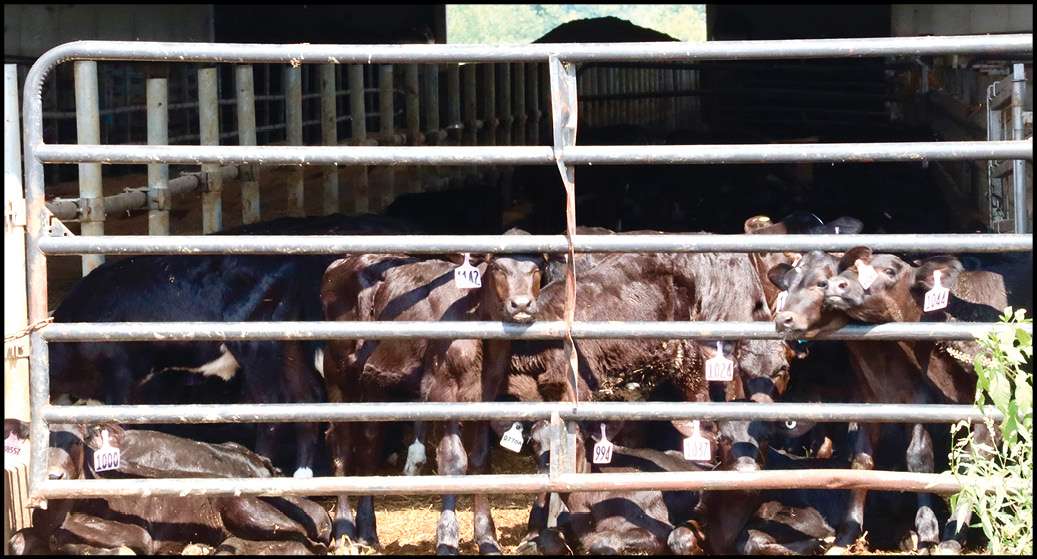
 PHOTO BY BRENNA WHITE / THE VILLAGE REPORTER
SCHMUCKER FARMS … Calves and cattle can still be seen filling both barns to capacity.
By: Brenna White
THE VILLAGE REPORTER
brenna@thevillagereporter.com
The Ohio Attorney General’s Office has filed a civil lawsuit against the owners of a large cattle facility in Superior Township, alleging they built and began operating a concentrated animal feeding operation (CAFO) without first obtaining the proper permits.
Filed on July 27, 2026, in the Williams County Common Pleas Court on behalf of the Ohio Department of Agriculture (ODA), the complaint names the owners of Schmucker Farms as defendants.

Two neighboring cattle barns, owned by Schmucker Farms, are located near the intersection of County Road 8.50 and County Road K, Superior Township.
The lawsuit marks the latest development in a permitting dispute that has been unfolding since early 2025, when state officials first began investigating the project.
According to the complaint, the construction of the barns began in early 2025 on two adjoining parcels of land.
Each barn was designed to hold between 900 and 999 beef cattle — the maximum number of cattle allowed before a permit to operate is required.
While each barn does individually fall below Ohio’s 1,000-head threshold, the Attorney General argues the barns legally count as one facility because they sit next to each other and operate under common ownership.
Under Ohio law, any concentrated animal feeding facility designed to hold 1,000 or more beef cattle must receive both a Permit to Install and a Permit to Operate from the Ohio Department of Agriculture before construction or operation can begin. The state alleges those permits were never obtained.
The complaint states ODA officials first learned about the project in February 2025 after receiving information that two cattle barns were under construction in Superior Township, Williams County.

A local resident filed a complaint alleging the project would house more than 1,000 cattle.
During a March 6, 2025, site visit, the complaint alleges one of the defendants even told the state officials the two barns together would hold more than 1,000 beef cattle.
According to the Attorney General, this means the project would require the proper state permits before business could continue.
The lawsuit also addresses a transfer of one parcel to another member of the Schmucker family, a minor, in March 2025. The Attorney General argues the transfer of ownership does not change the legal status of the operation.
The ODA issued a Notice of Deficiency in April 2025, informing the defendants they were allegedly violating state law by constructing, owning and operating the facility without the required permits.

The notice ordered the owners to apply for the necessary permits, stop construction and remove all cattle from the barns. An administrative penalty of $5,000 was also applied.
The defendants appealed with an administrative hearing held soon after. The penalty was upheld and the owners of Schmucker Farms were ordered to still apply for the permits.
The Attorney General now alleges as of July 27, 2026, Schmucker Farms still has not obtained the permits or paid the administrative penalty.

As part of the lawsuit, the State of Ohio is asking the court to order the defendants to stop violating Ohio’s CAFO laws, submit complete permit applications within 90 days and pay the civil penalties.

Ohio law allows civil penalties of up to $10,000 per violation each day the violation continues. However, any penalty amount would ultimately be up to the Williams County Common Pleas Court.
The lawsuit focuses specifically on alleged permitting violations for the two barns and does not address separate environmental concerns involving manure management.
The permitting dispute comes as the cattle operation has drawn increasing public attention in recent years. Schmucker Farms moved its cattle operation into Williams County after plans for a large CAFO facility in northeastern Indiana were unsuccessful.
Since then, neighboring residents and environmental groups have raised concerns about the size of the operation, manure management and potential impacts on local water quality.

As of July 31, 2026, no response to the lawsuit has been filed in the Williams County Common Pleas Court.