 PHOTO BY JACOB KESSLER / THE VILLAGE REPORTER
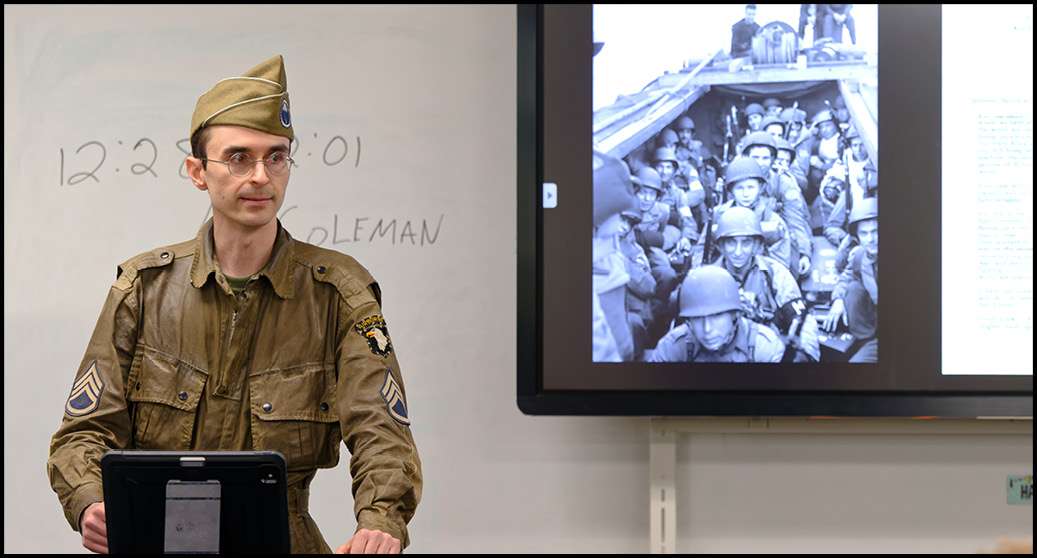
WWII … Trenton Coleman speaks to North Central High School students during a Historical Frontline Events presentation on the human side of World War II, with photos from the era shown behind him.
By: Jacob Kessler
THE VILLAGE REPORTER
jacob@thevillagereporter.com
Representatives from Historical Frontline Events, a local nonprofit, visited North Central High School on Wednesday, May 20, to speak with students about World War II history and the importance of remembering the human side of World War II.
The presentation followed the recent Echoes of Valor event at Auglaize Village in Defiance, where nearly all of the students in attendance for the presentation had taken part in a living history experience.

The event featured more than 100 World War II reenactors portraying American, French, British and German forces in occupied Mortain, France, roughly 60 days after D-Day.
During Echoes of Valor, students toured military camps, walked through an occupied village and were stopped at German checkpoints.
The event also included battle reenactments, skits involving French partisans and German troops, and World War II vehicles including a Sherman tank, American half-tracks, Jeeps, towed artillery, a German half-track, a German 222 armored car and more.
Speaker Trenton Coleman said the school presentation was meant to go beyond vehicles, uniforms and battlefield scenes.
Instead, he wanted students to remember that World War II was endured by real people on all sides, each with homes, families, fears, hopes and lives interrupted by war.

Coleman told students that history is often taught through dates, battles, leaders and military movements, but those details do not tell the full story.
He explained that deployment meant young men leaving behind normal life without knowing where they were going, when they would return or whether they would come home the same person.
He also stressed that remembering the humanity of those involved does not mean ignoring right and wrong. Coleman said World War II had clear moral realities, including the evil committed by the Nazi regime through the Holocaust, occupation and war crimes.
At the same time, he said students should understand that war consumed millions of ordinary people, including soldiers, civilians, families, prisoners and displaced people.
He told students that public history and reenacting should never glorify war, but should instead help people understand its cost.
Coleman also shared how history can become personal for visitors and reenactors, recalling moments when veterans or family members connected deeply with scenes or stories presented during events. He said those moments show why public history must be handled with respect, care and purpose.

As fewer World War II veterans remain to tell their own stories, Coleman encouraged students to ask questions, talk with family members, look at old photographs, visit museums, read letters and pay attention to memorials.

The presentation included a reflection activity asking students to imagine being 18 years old and leaving home for military training, unsure of where they would be sent or whether they would return.
Students were asked to think about what they would write in one final letter home and what they would want remembered if they did not come back.
The program ended with a question-and-answer period, giving students a chance to ask about World War II, reenacting, Echoes of Valor, uniforms, weapons, vehicles and the emotional side of history.