
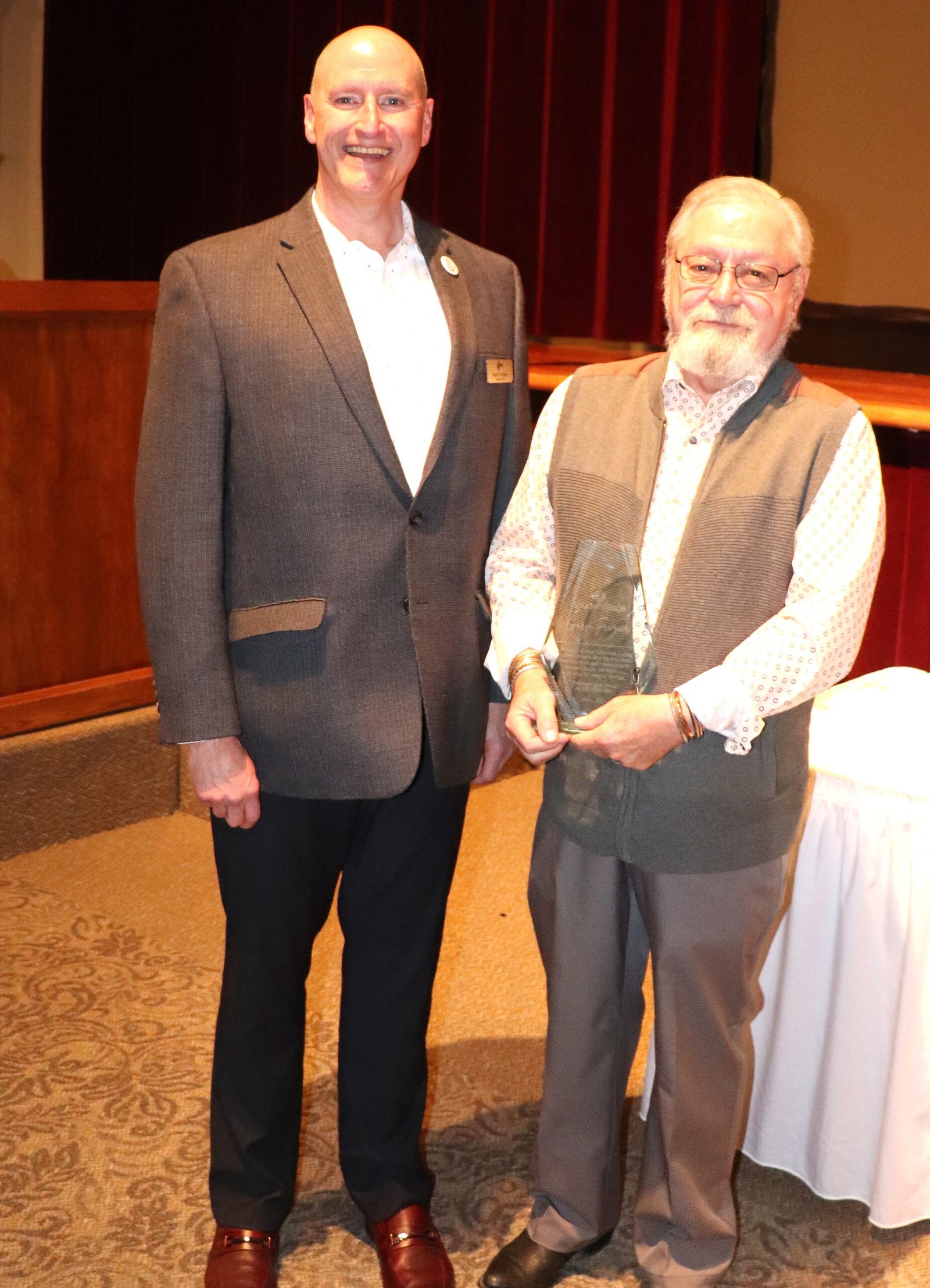
Archbold, OH — Gary Frazier of Pettisville, Ohio, was recognized Monday, April 20 at the annual spring meeting of Sauder Village employees for his 50 years of contributions to Sauder Village as registrar of collections and later as a historic interpreter. Considered one of Sauder Village’s first employees, Frazier’s efforts shaped the early days of Sauder Village.
“It’s an honor to award Gary for his 50 years of service,” said Sheri Friesner, Director of Historic Operations at Sauder Village.
“His dedication to history and Sauder Village is a true testament to his character. We’re grateful for his contributions throughout the decades and today.”

Frazier began his Sauder Village career in 1975, months prior to the village’s opening on June 14, 1976. He said after learning of Erie Sauder’s endeavor to create a museum, he reached out and expressed his interest in contributing.
“While in college, I had pursued an interest in museum work, but for various reasons, did not go into that path,” Frazier said.
“So when I heard that Mr. Sauder was in the process of creating a museum, I thought it was an opportunity to become involved in museum work and see where it goes. And so I contacted him by a telephone call, and he suggested that we meet.”
After meeting with Erie Sauder, it became clear he had not yet hired staff to curate or catalogue the museum’s many artifacts. Sauder wanted Frazier to identify the items he had acquired.
“My function was to research and identify the artifacts and write signage for them,” Frazier explained. “I knew that this was going to be very important because of the mass of things that he had.”
Frazier spent the following year teaching at Pettisville Schools during the day and cataloguing artifacts for what would become Sauder Village in the evenings and on weekends.
“I would teach during the day, and then I came home, I changed clothes and I went to the museum and I worked there, trying to organize the things that he (Sauder) had, so I could understand how they might be arranged and the potential for exhibits,” he said.

“But I worked until about nine o’clock, and then I went home, and prepared lessons and graded papers sometimes until two or three in the morning, then woke up and did it again.”
For nearly two decades until 1994, Frazier was the main person identifying, cataloguing, and curating artifacts. Because the number of artifacts kept growing, and due to his other commitments as a teacher, Frazier felt the job had become too big for one person.
“I suggested that they hire someone that would create exhibits and organize artifacts, and what I would do is to just take care of the artifact collection, because we were constantly having new things coming into the collection.” Frazier said.
Frazier’s title became Registrar of Collections. “It was my responsibility to keep track of all the artifacts, try to find out what new artifacts had come in and where they were, and then to mark them so a catalog could be created, so that those artifacts could be found at any one time,” he explained. “By that time, there were over 5,000 artifacts.”
“In museum work you become caretaker for these artifacts. They’re not yours. They don’t necessarily belong to the institution, although, in name they do.

“You become the caretaker for these historical artifacts and for the public, so we can learn from them. And so that’s what a registrar of collections was to do.”
During that same period, from 1992 to 1996, in addition to teaching and working at the village, Frazier was also pursuing a degree in guidance and counseling. In 1998, he retired from teaching and from his position at Sauder Village to pursue that new career path.
However, he was only really “retired” from Sauder Village for two weeks — he was quickly asked to return to serve as a consultant on the collections committee.

On the committee, his role included deciding whether artifacts should be accepted as gifts and providing guidance on museum collections. Also around that time, Frazier began working as a historic interpreter at Sauder Village on weekends.
He retired from his career as a counselor in 2015, where he worked for regional organizations including the Center for Child and Family Advocacy in Napoleon and Corrections Center of Northwest Ohio.
Frazier continues working as an interpreter at Sauder Village today. He interprets in many buildings across Sauder Village, but on a typical day, he can be found in Natives & Newcomers or on 1920s Main Street in the Farmers & Merchants Bank or Schuck Jewelry Store, sharing his wealth of knowledge with guests.
He is known around Sauder Village as someone passionate about preserving history and sharing that passion with the village’s guests.
“Gary is truly a steward of the village,” said Sarah Rupp, Village Experience and Evaluation Manager.

“He has a way of making connections for guests and helping them apply what they learn at Sauder Village to their own lives. Even after 50 years, he still seeks out opportunities to expand his knowledge.”