
 PHOTO BY BRENNA WHITE / THE VILLAGE REPORTER
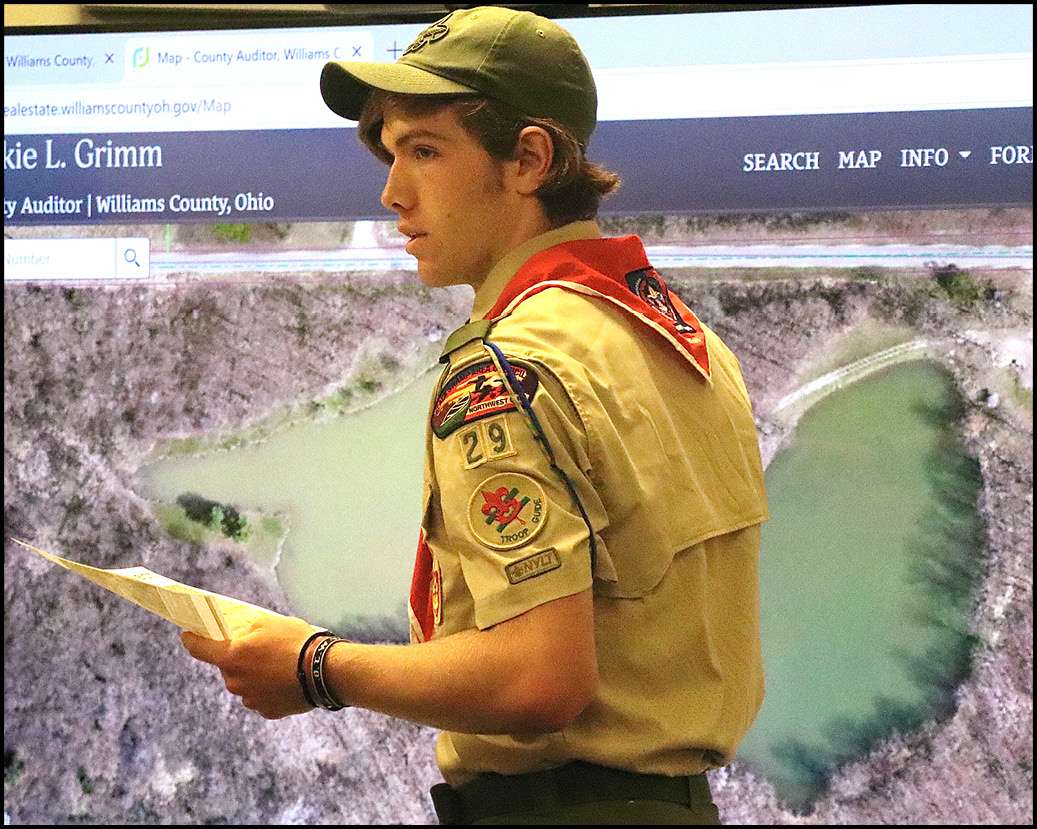
BLAZING A TRAIL … Edgerton Life Scout Ethan Bailey presented a new trail project he hopes to add to George Bible Park.
By: Brenna White
THE VILLAGE REPORTER
brenna@thevillagereporter.com
The Williams County Commissioners voiced their support for a local Scout’s proposed project during their Thursday, June 4, 2026, session, while discussing possible updates to the county’s sanitary sewer regulations.
AN EAGLE SCOUT’S TRAIL
Life Scout Ethan Bailey of Edgerton’s Troop 29 appeared before the board to present plans for his Eagle Scout service project, which would bring a walking trail to George Bible Park, located at 12988 County Road J, Montpelier.

A mulched walking path, benches and distance markers would be added to the park. Bailey explained that the trail would begin near the park’s west parking lot, loop around the lake area and connect to an existing stone roadway on the east side of the property.
According to Bailey, the project was inspired by a desire to help the community.
“I know of people who go out there, and a lot of them are fishermen, and I’ve had some requests for my project to include benches so they can fish out there as well,” Bailey told commissioners.
The trail would span approximately 1,536 feet, or just under one-third of a mile, and would use biodegradable mulch sourced locally.
Bailey estimated the total project would cost nearly $4,800 with hopes to begin work in mid-July for an August completion.
The project will rely heavily on volunteer support. Bailey said members of his Scout troop, local sports teams and adult volunteers have already expressed interest in helping with the construction of his project.
Due to George Bible Park being county-owned property, the Edgerton Scout sought permission to establish a fund through the county for donations for the project. Following his presentation, commissioners approved Bailey’s project with a motion of support.
OVERHAULING SEWER REGULATIONS
Commissioners met with Williams County Engineer Todd Roth to discuss possible updates to the county’s sanitary sewer regulations.
Roth explained that the current regulations have been amended numerous times over the years and are now compiled from several separate policies dating back to the late 1990s and 2000s.
“Our sanitary sewer regulations are a combination of a number of them from 1996 to 2000, we have some from 2001, 2006, 2003,” Roth said. “It started when we had 12 different districts, or however many there were, and now we’re in one district.”
He told commissioners he would like to consolidate the regulations into a single updated document while adopting current Environmental Protection Agency (EPA) guidelines.
This is because the county now operates under a single sewer district rather than the multiple districts they had in the past.

By adopting EPA standards, several areas within sanitary sewer regulations would be clearly defined, such as tap fees and connections.
Much of the meeting centered on sewer rates and ensuring fees are applied fairly across all users connected to the county system.
Commissioners and Roth discussed how campgrounds and trailer parks are currently assessed, as well as whether the regulations now properly account for all users.
Roth emphasized that the review is intended to create a more consistent and fair system for everyone rather than simply increase costs for Williams County residents.

“I’ve got to be sure we’re being fair to those people, that we’re capturing everything from the mobile home parks, the campgrounds, the commercial properties, industrial properties, things of that nature,” Roth explained.
The commissioners expressed interest in reviewing the proposed changes further before any actions are taken. Additional discussions, including one with the public, are expected to take place as well.
CONTRACTS AND GRANTS APPROVED
Multiple resolutions regarding Job and Family Services (JFS) contracts, grant agreements and settlement agreements were approved during the regular session.
Two Title IV-E contracts were approved for child placement. A Life’s Purpose, LLC will provide funding not to exceed $256,000, and Keystone Richland Center, LLC (Foundations for Living) will provide funding not to exceed $172,000.

A separate resolution authorized a short-term contract also with A Life’s Purpose, LLC. The term is only from May 20, 2026, to June 30, 2026, with a maximum amount payable of $27,000.
The board further approved a settlement agreement and right-of-way easement with AMP Transmission, LLC, for the AMPT Pioneer Second Reinforcement Project. Under the agreement, Williams County will receive $500 for the easement purchase.
Commissioners also entered into a Land Use Planning Grant Agreement with the Ohio Department of Agriculture.
The reimbursement-based grant provides up to $50,000 to support county land use planning and farmland preservation efforts through June 30, 2027.

An amendment to a technology grant awarded to the Williams County Common Pleas Court was also approved. The amendment extends the grant period due to delays associated with the installation of the CourtView case management system. The contract is now extended until February 15, 2027, with grant funds totaling $126,253.35.

The board also approved an Elections Security Grant Agreement between the Ohio Secretary of State and the Williams County Board of Elections.
Funding from the grant will assist the Board of Elections in meeting critical infrastructure security requirements and must be expended by August 31, 2026.
AIRPORT HANGAR TAX APPEAL
Commissioners also met with Stevie Lanzer of the Auditor’s Office and Prosecutor Katie Zartman to discuss the Williams County Airport’s recent denial of a property tax exemption request for one of its hangars.

The property around the hangar was approved for tax exemption; however, the actual hangar itself was denied due to it being leased to a private business.
“I think their conclusion, based on my reading of it, was drawn from the fact that they believe that neither of those two hangars were actually used for aircraft,” Zartman stated.
Lanzer explained that in order to qualify for a tax exemption, the hangars have to be used for public purposes.
According to the State Auditor, due to the fact that the hangars have been, and are currently, being rented to “for-profit businesses,” the county would not qualify.

A business operating inside the hangar is Fortner AirPro, which specializes in smaller aircraft repairs. They provide maintenance to public and private aircraft using the Williams County Airport.
“They’re putting avionics in the aircraft,” Rummel stated. “So people are flying their planes here, they’re parking them in there, and they’re working on upgrading the electronics in this aircraft to take it back out and fly it somewhere else.”
Rummel continued to explain that other large facilities such as the Toledo Express Airport have similar businesses working on maintenance in their hangars, and questioned whether they qualify for tax exemption.
The commissioners opted to appeal the tax exemption denial. Zartman will examine appeal papers as the process moves forward.

With no further business, the meeting adjourned. The next Williams County Commissioners meeting is scheduled for June 9, 2026, at 10 a.m.