
 PHOTO PROVIDED / THE VILLAGE REPORTER
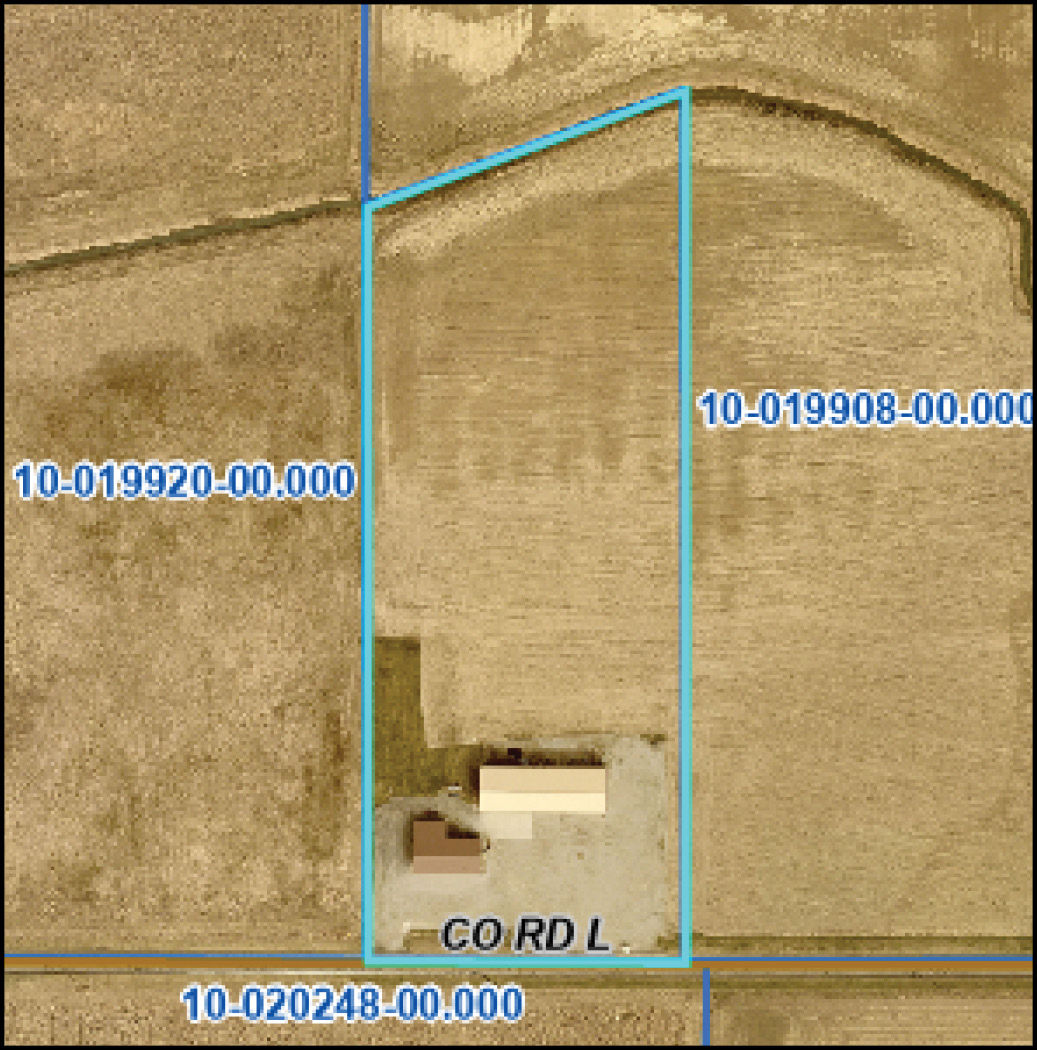
PARCEL … This map shows the parcel that is being changed from an M-1 industrial to an Agricultural/Rural Estate.
By: Renea Kessler
THE VILLAGE REPORTER
renea@thevillagereporter.com
The Fulton County commissioners held regular meetings Aug. 11 and 13. Both meetings began at 9 a.m. with the Pledge of Allegiance, opening prayer and roll call.
The board approved a letter supporting Fulton County Health Center’s participation in the Ohio High Value Network and its proposal under the Ohio Department of Health Rural Health Transformation Program.

The proposal would allow independent rural hospitals to share infrastructure and services, including a data and population-health platform, a referral hub and expanded value-based care capabilities.
It could also support care coordination, telehealth specialty access, remote patient monitoring and a rural maternal health initiative.
Commissioners said the program could help address limited specialty access, behavioral-health needs and transportation barriers while helping Fulton County Health Center remain an independent, sustainable rural healthcare provider. The board offered to participate on an advisory panel for the program.
Financial action Aug. 11 included a $3,000 appropriation increase to pay the Village of Fayette’s second-quarter sewer bill for Camp Palmer.
The board transferred $54,238.08 in Children Services shared costs, $28,962.94 for the county’s monthly Children Services obligation, $13,913.43 in workforce administration costs, $25,475.86 in Child Support Enforcement Agency shared costs, $16,416.39 for the county’s monthly CSEA share and $6,078.42 for the county’s mandated public-assistance share.
The board also distributed $19,895.51 in July interest earnings, including $13,422.81 to the Gas Tax and Motor Vehicle Fund, $3,152.85 to the Northwest Ohio Juvenile Detention Center Improvement Fund, $2,133.39 to the detention center’s Operations Fund, $870.50 to the Community Development Block Grant Revolving Loan Fund, $180.13 to the Maumee Valley Planning Organization Special Loans Fund, $133.03 to the Housing Rehab Revolving Loan Fund and $2.80 to a CDBG grant fund.

During the Aug. 13 meeting, commissioners reviewed Dog Warden reports for the periods ending July 4 and 11 and reviewed the county investment report.
The board also approved departmental appropriation requests and Draw Request No. 11 for the Lead Safe Ohio Grant.
The board awarded a bid for a comprehensive feasibility, governance and preliminary engineering study of the Wabash Cannonball Trail. Commissioners also authorized an application to the Ohio Department of Commerce to receive unclaimed funds.
Senior Center personnel action included rescinding an earlier personnel resolution and accepting an employee resignation. Commissioners also approved purchase orders and submitted travel requests.
The first public hearing concerned Stacy Gleckler’s request to rezone parcel 10-019908-01.000 from the M-1 industrial district to the Agricultural/Rural Estate District.
Regional Planning Director Christy Shadbolt said the property formerly operated as a chicken-processing facility. Gleckler plans to retain the existing building, convert its interior into a single-family home and continue farming the surrounding land. No one offered testimony, and commissioners unanimously approved the zoning-map change.

The second hearing addressed a broad update to the 2011 Fulton County Rural Zoning Resolution. Shadbolt said the document was reorganized and simplified, district purposes were revised and agricultural language was updated to reflect current Ohio law.

The amendments also clarify commercial and industrial uses, add electric-vehicle charging stations in nonresidential districts and make certain intensive uses, including outdoor storage, conditional uses.
Other revisions address M-3 industrial uses, fences, home occupations and home-based businesses, noise enforcement, yard sales, lawn and tree services and telecommunications-tower setbacks.
The updated code also covers advanced manufacturing, data centers, township-regulated solar installations, signs, site-plan reviews and more flexible parking guidelines.

Administrative procedures and notice requirements were updated, and a comprehensive definitions section was moved to the end of the document.
No one offered testimony during the second hearing. Commissioners praised the work involved in updating the code and unanimously approved the amendments before closing the hearing and returning to their regular meeting.