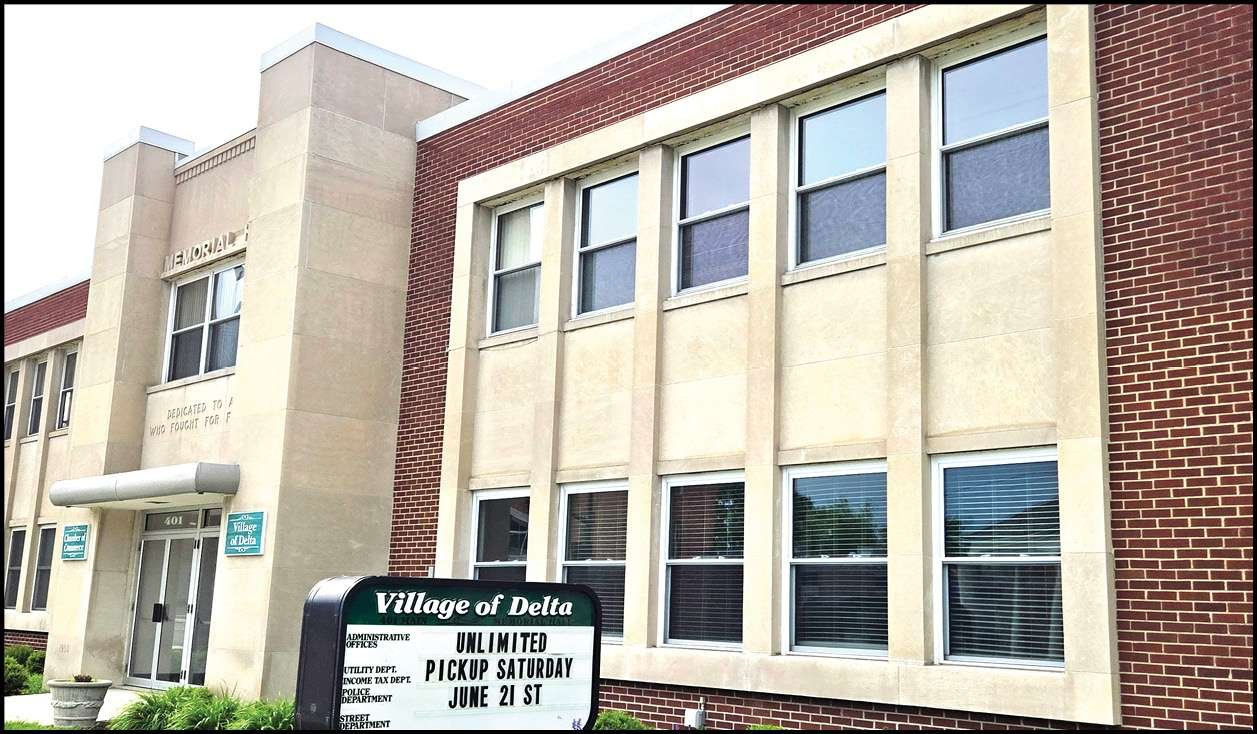
(PHOTO BY JESSE DAVIS / THE VILLAGE REPORTER)
DELTA SUED … The Village of Delta and several members of its council are the subjects of a recent civil suit filed by former village administrator Andy Glenn. Glenn is alleging age discrimination, wrongful termination, and defamation were to blame for his firing.
By: Jesse Davis
THE VILLAGE REPORTER
jesse@thevillagereporter.com
Former Delta Village Administrator Andy Glenn has filed a civil suit against the village and several of its council members, alleging age discrimination, wrongful termination, and defamation, among other claims.

The village is named as a defendant as well as council members Robert Shirer, Lynn Frank, Anthony Dawson, Chad Johnson, and Daphne Demaline. Of the members of the council at the time of termination, only Councilwoman Ashley Todd was not included, as she abstained from the vote.
Glenn’s legal counsel at Wasserman, Bryan, Landry & Honold, LLP filed the case in the United States District Court for the Northern District of Ohio Western Division on May 13.
BACKGROUND
Six minutes into the May 20, 2024 meeting of the Delta Village Council, council members voted to go into a surprise executive session made doubly surprising since they are usually held at the end of meetings rather than the beginning. Half an hour later, they came back in, resumed the meeting, and immediately moved to cancel Glenn’s contract.
Council members did not go into detail at that time as to any reasons behind the firing other than Shirer saying it was an at-will termination in response to Glenn asking to know the cause. Other than Todd’s abstention, all other council members voted in favor of termination.
After a break during which Sgt. Drew Walker – at that time serving as acting police chief – and another officer followed Glenn to his office to ensure he left the building after getting his things. Law Director Kevin Heban, along with Johnson and Todd all followed.
When the meeting again reconvened, Mayor Allen Naiber read a letter from Todd, who had not returned. In it, she said she would be stepping down due and that “clearly, the remaining council members do not have the best interests of the village in mind.” The council voted to accept her resignation.
Glenn first threatened legal action in September, when the council received a letter from his legal counsel. According to that letter, Glenn accused the council of violating his contract by not providing 90 days’ written notice, that the termination was motivated by his age, and that it was in retribution for him whistleblowing on village income tax issues, as well as “improprieties over two properties.”
The settlement proposed in that letter included payment of his salary from the date of his termination through the “standard termination date” of May 22, 2025, his 14 percent Public Employee Retirement System contribution for 10 years, as well as $250,000 in damages “resulting from the defamatory nature of the proceedings against him which have severely damaged his career as a public servant.”
At the time, Heban stated Glenn received 90 days of pay upon termination, which was all he was due in the termination, which he reiterated was an at-will termination.
Upon questioning by Shirer, Heban was unable to answer whether any written notice prior to termination was required by Glenn’s contract.
ALLEGATIONS
In his civil suit, Glenn alleges first that his termination was retaliation for him filing a complaint with the state auditor’s office and turning over “information pertaining to income taxes not going to the water funds and improprieties over two properties” on April 1, 2024. Such retaliation, he argues, would run afoul of the state’s whistleblower law.
Secondly, he alleges his termination was due to age discrimination in contravention of both state and federal law, as he was 54 years old at the time of his firing. The filing notes that Glenn “has been replaced by a substantially younger individual.”

The remainder of the allegations in the filing relate to what happened during the closed-door session immediately preceding his firing.
The filing alleges Naiber and at least two unnamed council members repeatedly asked for Glenn to be brought into the meeting to defend against the accusations, “but a majority of council refused to let that happen.”
In the only claim directed against one individual, Glenn alleges he was defamed by Shirer, whom he argues made false remarks about him.
The filing states it was Shirer who moved to add the executive session, during which Shirer read a prepared letter attacking Glenn’s character “and making several absolutely false accusations against [Glenn] in a demand for the council and the Mayor to immediately terminate his contract.” Further down the filing, it alleges Shirer’s actions were “motivated by a vendetta” against Glenn.


The filing also alleges council members worked together in a plan to threaten Naiber “that if he did not go along with them and their demands to terminate [Glenn’s] contract that they would immediately launch an investigation into the Mayor for malfeasance and would remove him from office.”
The filing alleges Naiber left the session in an emotional state, audible to those nearby, and that when he returned to the council chambers he was “visibly still crying.”
THE LETTER
A copy of the letter read by Shirer during the executive session, provided by current Village Administrator Chris Frazer, states Shirer was convinced Glenn had “no intent of keeping the Council informed of vital information needed for us to make decisions in regards to critical long-term financial decisions in regards to the Village of Delta.”
In it, Shirer describes a meeting between Glenn and himself on April 19, 2024. Shirer claims he questioned Glenn regarding individuals outside of the village being asked to look at the village’s financial books from the end of 2023, eventually getting Glenn to admit knowledge of two people who had shared that information – ostensibly the information Glenn claims in his suit he was protected by whistleblower laws for sharing with the state auditor’s office.

“Mr. Glenn was aware of information that should have been shared with council – allowing us to make more informed and beneficial choices for the village and he made a choice not to,” Shirer wrote.
Shirer also describes another meeting on May 16, 2024, in which Glenn asked him to come to the water treatment plant. Their meeting was also attended by a water treatment employee.
“To start the meeting I was informed that ‘several things have started to not get completed’ on the Administration side of the Water Treatment plan.”
“I was informed it was because Mr. Glenn was ‘being micromanaged’ and that he had told water treatment staff that Council was preventing him from completing his duties,” Shirer wrote.

Shirer wrote that he confirmed Glenn knew Naiber was his supervisor and the council did not direct his day-to-day duties, and was eventually told by Glenn the issue was the council questioning him over the spending of funds. “This is OUR JOB,” he wrote.
As their meeting continued, Shirer wrote, he was told that Dawson had visited the treatment plant two times in two weeks. Upon questioning by Shirer, the employee said no inappropriate questions were asked or comments made by Dawson, none of his questions made the employee feel uncomfortable, and the employee did not feel uncomfortable after Dawson left.
Shirer alleges Glenn then claimed Dawson had been put up to the visit by Frank.
“When asked about what evidence he had to support this claim did not answer the question – a habit of his. He instead asked if I knew Lynn [Frank] and Tony [Dawson] were related.”

“I informed him that I was aware, I informed him that I was also aware that he and Lynn were related and that I failed to see how any of these things had relevance in the discussion we were having,” Shirer wrote.
Glenn allegedly claimed Dawson was planning to use the information he got from the employee against Glenn in meetings. Shirer wrote that he asked both Glenn and the employee if Dawson had said or insinuated that he would, and both reportedly answered no.
Shirer wrote that Glenn later failed to take any actions to improve his relationships with council despite advising him to do so.
Instead, he wrote, Glenn tried to have Naiber forbid council members from speaking with village employees, seeking to also draft a new rule for employees that they would not be allowed to speak to council.


He wrote that he had many concerns about the attempt, ranging from how he was supposed to get answers to questions that Glenn wouldn’t answer himself, to whether employees would be fired if they spoke to a council member.
“I have personally had multiple items brought to me that I would have been totally unaware of because the Administrator chose not to share that information.”
“So now if I should choose to ask I’m putting that employee at risk of termination? By exercising my powers given via the Charter?” Shirer wrote.
Shirer went on to call the relationship with Glenn “untenable,” and that when he was asked why he was taking the steps he was, Glenn said “everyone was out to get him.”

Shirer wrote about his concerns regarding the ongoing audit from the state, indicating that he had not yet seen any correspondence or recommendations from the auditors.
“This is very strange seeing as Council has taken legislative action on recommendations from the Auditors. Are we fully complying with the auditors? Have we turned over all documents requested? Have they made recommendations? I have not had any of this information actually presented to me,” he wrote.
Shirer also mentioned other potential financial issues before ending with the statement “I do not believe that I can make accurate and informed financial decisions with all of these errors.”
DEMANDS
According to the filing, any of the reasons given for Glenn’s termination were “fabricated, as [Glenn] performed his job well, and to his employer’s reasonable expectations.” It claims he “suffered the loss of his job position, diminished earning capacity, lost wages, benefits, pension benefits, great mental and emotional distress, anguish, humiliation, and embarrassment,” as well as incurring additional financial hardship due to Glenn’s need to pay for litigation expenses and attorney’s fees.

The filing calls for an injunctive order to be made by the judge reinstating Glenn to his position “with full back pay, seniority and benefits” or for “front pay in lieu of reinstatement.”
Glenn is also requesting judgments against all the defendants for “compensatory and punitive damages for emotional distress, anxiety, humiliation and embarrassment plus his costs, interest and reasonable attorney fees,” as well as prejudgment and post-judgment interest and “whatever other legal or equitable relief he may appear to be entitled to.”
He also demands the case be tried in front of a jury.
RESPONSE
At the end of the May 19, 2025, meeting of the council, an executive session was held, ostensibly to discuss the suit. After the meeting reconvened, Naiber announced that the suit had been filed.

Heban stated the case was being turned over to the village’s insurer, who would be managing their defense.
When emailed for comment on the suit, Naiber, Shirer, and Johnson all responded by declining to comment, with Shirer and Johnson indicating it was at the direction of legal counsel. Johnson did add, however, that “we look forward to vigorously defending the lawsuit.”
Glenn, Frank, Dawson, Demaline, and Heban did not return attempts at contact prior to the date of publication.